DbcultAccessing Vault...
Cult Review
Senior Film Conservator
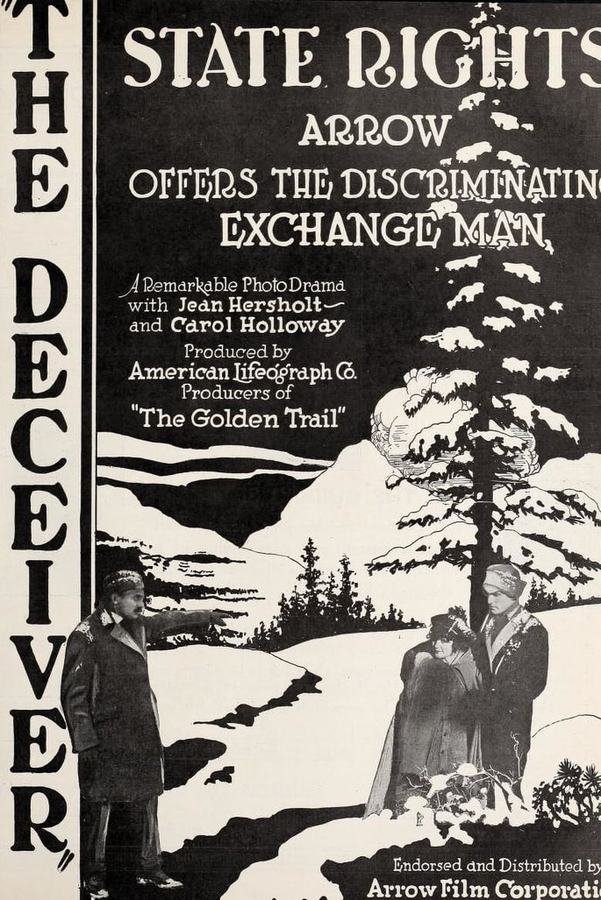
Director Thomas R. Mills, operating on a shoestring yet intoxicated by German-expressionist whispers, turns every set into a slanted courtroom. Note the way the camera tilts upward when Elias signs his first dubious contract—ceiling beams loom like the bars of a future cell. Shadows are not mere absences but accusers; they lengthen across dusty office floors to trip the protagonist mid-stride. The Deceiver’s most indelible image arrives when Elias, clad in a tuxedo too glossy for daylight, paces a cavernous ballroom whose chandeliers have been extinguished one by one by an unseen servant. Each snuffed flame is a deleted companion, until only a single bulb glints in the rafters, spotlighting the solitary dancer who once promised the world and now twirls only with his own silhouette.
Jean Hersholt, usually typed as benign physicians or jovial uncles, here weaponizes his teddy-bear visage: the same dimples that read paternal in Mr. Wu now register as the trenches of self-love. Watch the micro-shifts when he flatters a newspaper editor—eyebrows ascend in counterfeit awe, the mouth stretches just a half-second too late, revealing the gears of calculation. Opposite him, Lee Hill’s forsaken sweetheart performs largely in intertitle close-ups; her eyes—huge, shell-shocked—carry the weight of every woman whose labor of tenderness is repaid with footnotes in another man’s memoir. It is a performance of negative space: the more she withdraws, the more the film aches.
The sparse cards, penned with a poet’s cruelty, read like diary fragments you were never meant to see. “He sold his yesterday for a tomorrow that forgot his name.” The sentence lingers onscreen barely three seconds yet tattoos the retina longer than any ten-minute monologue modern talkies could afford. Coupled with a restrained orchestral accompaniment (newly scored by accompanist Ethan Kessler in the 4K restoration), each syllable lands like a gavel.
Where The Liar (1918) treats mendacity as vaudeville gag, The Deceiver interrogates it as spiritual cancer. Charles IV traces regal paranoia through baroque throne-room geometry; Mills finds the same grandeur in a threadbare loft where wallpaper peels like old scabs. Meanwhile fans of Life Without Soul will recognize the doppelgänger motif—only here the monster is not science’s hubris but capitalism’s hall of mirrors.
Carol Holloway’s society columnist, a role that in lesser hands would be mere plot lubricant, becomes the film’s bruised conscience. She narrates Elias’s triumphs in acid-toned prose, but notice how her fingers tremble while she types, cigarette smoke fogging the lens. The film quietly indicts the era’s complicity: every backslapping male editor who runs her column feeds the very myth that will devour her protégé-turned-predator. The camera spares a single tear sliding off her cheek and dissolving into the ribbon of ink—journalism literally watered with regret.
Production designer William Dills (also playing Elias’s first investor) scavenges Manhattan’s under-construction skeletons: half-built steel frames, elevator shafts yawning like open graves. The finale—Elias wandering through these concrete intestines—feels less like a location than a prophecy. Each rivet is a past misdeed; each gust of river wind whispers the names of friends betrayed. Compare this to the claustrophobic drawing rooms in Quand on aime; Mills exchanges velvet claustrophobia for vertiginous openness, proving that doom can be panoramic.
Because the film predates synchronized dialogue, its sonic imagination lives in the rustle of gowns, the clink of fictive champagne, the hush when a checkmate reputation implodes. The recent restoration amplifies these ghosts via a subtle ambient track—far-off ship horns, the rattle of elevated trains—rendering the metropolis an accomplice. The absence of human chatter during Elias’s final walk intensifies the moment; you hear only his shoe-soles crunching gravel, counting down the seconds until self-reckoning.
Unlike contemporaries that tack on Sunday-school repentance, The Deceiver stops at recognition, not salvation. Elias’s tear-stained face in the penultimate shot could denote sorrow, or merely disgust at having been outplayed. The closing intertitle refuses comfort: “Ambition, unmasked, stands naked—and shivers.” No priest, no lover extends a hand. The screen fades on the void itself, a gesture so modern it could sit alongside Tinsel or Who Killed Simon Baird? without a single contextual hiccup.
For decades the only surviving print languished in a Montana barn, a fitting grave for a fable about neglect. Rediscovered in 2019, its nitrate scars—white comets streaking across night scenes—only heighten the narrative bruises. Some cinephiles prize pristine restorations; here the blemishes feel like contrite scars, as if the celluloid itself is confessing.
The Deceiver is less a vintage curio than a hand-cranked time machine, shuttling us toward an eternal present where follower counts replace newspaper clippings, and cryptocurrency speculation supplants railroad shares. Watch it, and you might catch your own grin refracted in Elias’s final tear—an unnerving reminder that the con artist most of us fear is the one who greets us each morning in the mirror.
If you hunger for more silents that bruise as much as they beguile, chase down Strathmore for its tempest of loyalty, or En Død i Skønhed for the way it photographs grief like a still-life crucifixion. But return, always, to The Deceiver—the film that proves the gravest swindle is the one we stage on ourselves.

IMDb 5.5
1929
Community
Log in to comment.