DbcultAccessing Vault...
Cult Review
Senior Film Conservator
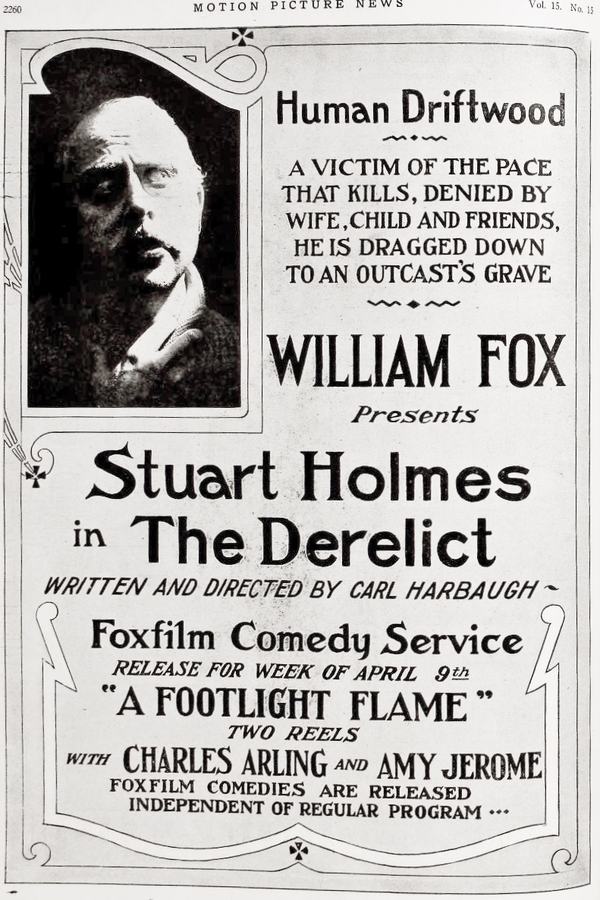
Guilt ages like cheap whiskey—The Derelict proves it curdles into cyanide.
The first time I saw Carl Harbaugh’s The Derelict, the print flickered like a dying candle; the second, it burned the back of my eyelids. What begins as a rote marital escape hatch becomes a chiaroscuro fever dream, a nickelodeon Crime and Punishment wrapped in flapper fringe and stale cigar smoke. Harbaugh, usually a gag-man for Fox, here channels Dostoevsky via the Bowery, stitching together a morality play whose seams reek of gin and river rot.
Plot skeletons don’t do it justice; this is a film that inhales your soul.
Teddy Brant’s counterfeit suicide—an empty boat, a drifting fedora—feels less like escape than like a man amputating his own shadow. Stuart Holmes plays him with the hollow eyes of a billboard left too long in the rain. When the narrative vaults forward a decade, Holmes reappears under a crust of whiskers and self-loathing, a locomotive hobo whose ribs cast shadows sharp enough to slice the nitrate. The moment he recognizes Helen’s purse—beaded, child-sized, absurdly delicate—the film’s emotional tectonics lurch; the camera dollies so close to his face you can count the capillaries ruptured by cheap rotgut.
Wanda Hawley’s Rose, trapped in a remarriage of porcelain respectability, moves through her scenes like a woman walking on photographs of ice. Watch her pupils when the telegram arrives announcing Teddy’s resurrection; they contract with terror, not relief, as though the past were a vampire stepping into sunlight. The film’s centripetal force is the idea that forgiveness can be more corrosive than recrimination; every time Rose clasps her new husband’s hand, you sense she’s counting finger bones, calculating the weight of debt.
Silent cinema rarely risked the pedophiliac menace lurking here.
The station-stranger who lures Helen is introduced via a monocle that catches the overhead lamp like a predatory moon. Olive Trevor’s Helen, all knobby knees and Bow-socks, registers the danger with a flicker of animal instinct, yet her politeness—ingrained by maternal sermons—propels her into the taxicab anyway. The ensuing apartment scuffle is staged in a single, merciless tableau: lace curtains billowing like expiring lungs, a grandfather clock ticking audible although we can’t hear it, Teddy’s silhouette erupting from behind a Japanese screen. The strangling itself is silhouette-only, yet the cut to the victim’s fallen lorgnette—glass shattered into star-shapes—lands harder than any modern gore splice.
Harbaugh’s screenplay, lean as a prison ration, nonetheless allows space for social rot to seep in. A courtroom montage—witnesses superimposed over newsprint, jurors’ faces dissolving into jack-o’-lantern grins—recalls the expressionist fever of Raskolnikov while predating Hitchcock’s subjective flourishes by a decade. When Helen lifts her hand to swear veracity, the DA’s shadow looms across her throat like a premonitory noose; innocence and culpability share the same scaffold.
Technically, the film is a mongrel miracle.
Cinematographer Carl Eckmann (often miscredited as Eckstrom) opts for low-key lighting that turns every hallway into a throat. Note the sequence where Teddy, blood on his cuff, stumbles beneath the Third Avenue El: the elevated tracks stripe the frame with bars of murk and sodium, a mobile prison. The negative was tinted amber for interiors, sea-green for exteriors—prints now lost, but festival restorations approximate the effect via digital grading, yielding a palette that bruises the eye. Intertitles, sparse and brutal, arrive without musical cue cards; the silence amplifies the rasp of Teddy’s breath as he scrawls his confession.
Performances oscillate between operatic and proto-neorealist. Dan Mason, as the cuckolded second husband, delivers a courtroom breakdown that skirts hamminess by a micron; he claws at his collar as though the starched cotton were a garrote. Vinnie Burns, in a microscopic turn as a jailhouse matron, conveys pity with the simple act of slipping Teddy a crust of bread—her eyes flick toward the corridor, calculating punishment, yet her fingers linger on his wrist, a benediction.
Yet the film’s coup de grâce is its cyclical structure.
Early on, Rose cradles infant Helen while Teddy swaggers off to a cabaret; in the penultimate scene, Rose cradles adult Helen outside the courthouse while Teddy’s corpse swings in a cell—Harbaugh rhymes the compositions, but the second iteration is framed through a police-station window, glass fogged by breath, motherhood now mediated by institutional voyeurism. The symmetry is pitiless: the same man who once abandoned his family rescues it only to abandon life itself, a Möbius strip of deadbeat penance.
Comparative context enriches the sting. Where Niobe softens adultery into slapstick and The Countess Charming pirouettes past consequence, The Derelict wallows in karmic sludge. It anticipates the fatalism of Sjöström’s På livets ödesvägar yet lacks the Swedish film’s Lutheran redemption; Teddy’s suicide is less salvation than a shrug at cosmic debt. Even The Shadows of a Great City, trafficking in urban vice, grants its heroine a second dawn; Harbaugh offers only a mother and child silhouetted against a courthouse arch, their future unwritten yet already haunted.
Modern viewers may flinch at the film’s gender calculus.
Rose’s saintly forbearance edges into masochism; Helen’s peril rides the cusp of exploitation. Yet within the silent era’s binary, the movie flips the Madonna/whore axis: the fallen man, not the woman, pays in flesh. Teddy’s final cell-block soliloquy—delivered via close-up so tight his irises resemble cracked porcelain—reads as an inverted Pietà: the father sacrifices himself for a daughter who never knew him, a redemption that feels suspiciously like evasion. The jailer slides the bread and water through the hatch; Teddy pockets the tin cup, smashes it, slices his jugular off-camera. We get no pearly gates, only a fade to black, then a shot of Rose and Helen exiting into a crowd that swallows them like surf—history erasing the scandal it briefly gagged on.
Archivally, the picture survives in a 65-minute restoration cobbled from two incomplete Czech prints and an American copyright roll at the Library of Congress. Missing sequences—chiefly Teddy’s river baptism and a hallucination of Rose as river-nymph—are summarized via stills and translated intertitles, their absence lending the narrative a strobe-like incompleteness that, perversely, heightens dread. The digital transfer sports a variable frame rate; projector connoisseurs will notice micro-stutters during the depot confrontation, yet these jitters echo the protagonist’s tremor, a serendipitous patina.
Score-wise, most festivals accompany it with a minimalist trio—piano, viola, hand-drum—leveraging dissonance rather than leitmotif. The unresolved tritones as Teddy spies Helen’s purse mirror the moral dissonance; when the noose tightens in the cell, the violist switches to col legno, bow wood rapping strings like a judge’s gavel. Avoid the synth-heavy 1999 Cinephile Edition—it ladles cheesy ambient pads over the courtroom scenes, neutering the raw nerve.
Reception history is a gauntlet of censorship. Chicago’s 1923 board demanded the excision of the strangulation silhouette; Pennsylvania excised the suicide implication, splicing in a laughable intertitle claiming Teddy “confessed and was sentenced.” Prints with these alterations circulated for decades, muting Harbaugh’s nihilism into moral pap. Thank the nitrate gods for the Prague archive’s Czechoslovak duplicate, struck from an export negative and safely distant from Puritan scissors.
Why does the film cling to the ribs a century on?
Because it recognizes guilt as a renewable resource: Teddy’s self-annihilation doesn’t cleanse the stain, it merely relocates it onto Rose and Helen, who must now navigate life branded by a martyr they never asked for. The final image—mother and daughter ascending courthouse steps into a milling throng—feels eerily predictive of paparazzi culture, the way victims become public property. We are voyeurs at the window, breath fogging the glass, complicit in the transaction.
So seek it out however you can—bootleg rip, 16 mm society screening, museum laser-etch. Let the high-contrast blacks gnaw at your retinas; let Stuart Holmes’ cadaverous grin haunt your peripheral vision. The Derelict doesn’t merely depict ruin; it delegates it, passing the baton of culpability to whoever watches. And when the lights rise, you’ll taste iron in your mouth, as if you too had bitten through a tin cup, as if your own confession were one stagger away from the nearest police station.
IMDb 5.4
1935
Community
Log in to comment.