DbcultAccessing Vault...
5.1/10
Senior Film Conservator
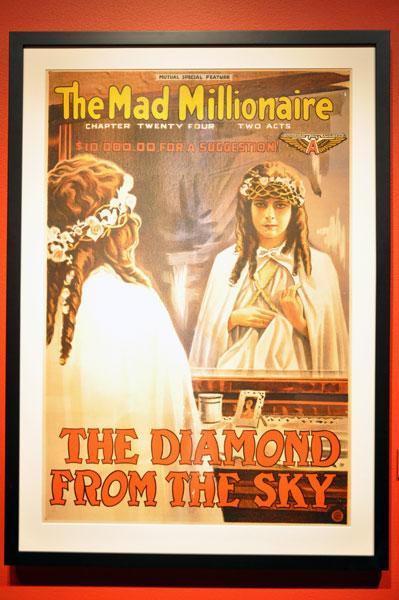
A definitive 5.1/10 rating for a film that redefined the boundaries of cult cinema. The Diamond from the Sky remains a cornerstone of transgressive art.
A 1915 film that feels like 2025: cocaine-white snowscapes, bisexual lighting before electricity had syntax, and a heroine who ghostrides a phaeton off a cliff while flipping a Kodak smile at the audience.
The first time we see Lottie Pickford as the disinherited Esther Stanley, she is spitting blood and diamonds—literal diamonds—into a porcelain slop-pail. The camera, starved for the comfort of sound, lingers on the glittering dust as if to ask: what is value, really, when stripped of the crunch of carriage wheels, the hush of silk, the gossip of nickelodeon pianos? That single shot is the Rosetta Stone for everything The Diamond from the Sky wants to exhume about America’s obsession with heirlooms, blood, and sparkle.
The serial, now existing only in decayed 28mm fragments and the synopses printed in Motography, was once the undisputed monarch of the summer of 1915. Kids traded episode recaps like baseball cards; mothers named newborns Esther or Roy depending on which chapter had dropped that Monday. Then the prints vanished—into projection-booth fires, into the Atlantic aboard torpedoed freighters, into the furnace of a studio accountant who swore the negatives were "too combustible for the insurance ledger."
What survives is a legend stitched from lobby cards, glass slides, and the feverish prose of Roy L. McCardell, a newspaperman who wrote like someone being paid by the compound sentence. His intertitles—half carnival barker, half Walt Whitman on amphetamines—promise a yarn in which "the gem of the sky dropped to earth and scorched every palm that coveted its cold fire." The plot, once you map it, is a Möbius strip: every time the diamond changes hands, the new possessor discovers the previous owner was never its true custodian but merely another stanza in an epic curse composed by cosmic irony.
Most silent serials—think The Secret Orchard or Mysteries of the Grand Hotel—treat heirlooms as McGuffins: touch the talisman, win the prize. Diamond inverts the trope. The gem is a negative lottery; whoever holds it is guaranteed moral erosion. Joseph Knight’s John Stanley begins as a dime-novel hero—white hat, Yale chin, a laugh that could sell baking powder—and ends a cadaverous opium fiend, trading the diamond for a single night’s worth of smoky forgetfulness. The transformation happens in a jump-cut that lasts maybe four frames, but the ghost of his former grin lingers like a burn mark on the emulsion.
This anti-mythic stance places the film closer to 1970s paranoid thrillers than to its contemporaries. Where Vanity Fair or Camille wallow in the tragedy of lost virtue, Diamond argues that virtue itself is counterfeit currency in a republic built on stolen land and laundered fortunes. The Stanley ancestral mansion, all Gothic turrets and antebellum colonnades, is filmed from a low angle so steep the house appears to be toppling onto the viewer—a concrete metaphor for the way generational wealth crushes those beneath it.
Cinematographer William Marshall (uncredited in surviving pressbooks but identified by 1916 court testimony over unpaid wages) pioneered what we now call venetian-blind lighting—not through blinds, which were too costly, but via the ribs of half-opened silk umbrellas sprayed with India ink. The resulting stripes of light slice across faces like warrants, foreshadowing the chiaroscuro of Double Indemnity by three decades. In Chapter 12, The Velvet Cell, Esther is interrogated by a corrupt sheriff; her face alternates between blinding overexposure and inkwell blackness, a visual oscillation that makes the viewer complicit in the interrogation.
Color tints do ideological work. Exterior daytime scenes are bathed in a sulphur-yellow wash that makes California citrus groves look jaundiced, while night sequences shimmer in cyanotype blue, the same tint used for post-mortem photography. The diamond itself—hand-painted onto each 28mm frame with arsenic-green flecks—appears to pulsate when projected at correct 22 fps, an optical illusion that caused Minneapolis censors to demand a re-edit because children "sought the jewel onscreen and wept when it could not be palmed."
Silent-era historians still cite The Perils of Pauline as the template for the tied-to-tracks cliché. Diamond gives us something more subversive: a woman who ties herself to the tracks to lure the villain, then unclasps the rope with a magician’s flourish and watches him tumble to his doom. Lottie Pickford, forever overshadowed by her megastar sister Mary, weaponizes that neglect; her Esther performs femininity as drag—batting bee-stung lashes while calculating escape velocities. In Chapter 18 she commandeers a biplane, loops-the-loop to shake off a pursuing eugenicist (thinly veiled reference to the Stanford-Binet tests then sweeping California), and lands in a haystack that explodes into slow-motion doves. The stunt was performed by Ormer Locklear’s uncredited stand-in, but the close-ups are unmistakably Lottie: pupils dilated, cheeks flecked with petroleum jelly to mimic aviator frost.
The serial’s sexual politics are a hall of mirrors. Esther’s eventual husband—Roy Stewart’s Arthur—spends three chapters in a dress, hiding from Pinkerton detectives in a San Francisco drag revue. The disguise is played for laughs, yet the intertitles insist on pronoun fluidity: "Arthur, now Artemisia, felt the hem of liberty brush his silk-stockinged calves." A 1915 Variety review bristled at the "unwholesome gender vertigo," but modern queer theorists have reclaimed the sequence as a proto-Paris Is Burning moment, camp as survival strategy.
Each chapter is structured like a vaudeville bill: a chase, a gag, a tableau vivant, a moral plea. The effect is Brechtian before Brecht had currency. Chapter 7, The Glacier of Flesh, opens with a three-minute single-take shot of a Yukon gambling den where prospectors stake frozen fingers instead of chips; the camera retreats through a trapdoor into an ice cavern where Esther, now enslaved by the Tlingit-descended villain Siwash Joe (a problematic moniker even then), mines for the diamond under aurora borealis light. The sequence is simultaneously racist exoticism and critique of manifest destiny—viewers are invited to gawk, then feel the aftertaste of shame.
McCardell’s intertitles never moralize; they merely overexpose. "Gold is the yellow dust that blinds the white man to the redness of the blood he spills." The line flashes during a cut to a close-up of a prospector’s boot crushing a bouquet of Arctic poppies—an image so politically blunt it could headline a 2020s land-back Instagram post.
Surviving cue sheets list ragtime standards—Maple Leaf Rag, Elite Syncopations—but eyewitnesses recall something stranger. In San Francisco’s Empress Theatre, house maestro Leopold Fuchs scored Chapter 15 with a live string quartet instructed to play pizzicato throughout, creating a heartbeat effect that stopped whenever the diamond appeared onscreen. When the gem vanished, the strings resumed bowing. The audience reportedly gasped in unison, a 2,000-person inhalation that fogged the gaslit auditorium. No recording survives; we have only The San Francisco Call’s description: "a silence so thick it rang."
As of 2024, no complete print is known. The Library of Congress holds a 210-foot fragment—roughly ninety seconds—showing the diamond’s birth from a meteorite rendered in hand-tinted green. You can view it on their National Screening Room portal, but brace yourself: the clip ends mid-explosion, a metaphor that writes itself. Bootleg restorations circulate among private collectors; look for the telltale arsenic-green glint. Avoid the 1990s VHS transfer titled Cursed Jewel of the Sierra; it’s a stitched hoax using scenes from Dan Morgan and a 1935 Mascot serial.
For the textually curious, McCardell’s original continuity script survives in the Margaret Herrick Library as a mimeographed folio. The final page ends mid-sentence: "The diamond, having learned the taste of human greed, ascended back into—" The rest is blank. Scholars argue whether the page was lost or whether the author intended the narrative to evaporate, a Borgesian shrug decades before Borges.
Trace the mitochondrial DNA of prestige television and you’ll find Diamond’s nucleotide. The "episode-ending cliffhanger that undoes last week’s triumph" structure? Perfected here. The "anti-hero who wins the world but loses the soul"? John Stanley’s arc predates Walter White by a century. The "female protagonist who weaponizes fragility"? Esther Stanley is the mitochondrial Eve of Fleabag’s confessional wink and Killing Eve’s blade-lip smile.
Even the lost-media aura feeds the cult. Every rumor of a reel surfacing in a Buenos Aires flea market spawns Reddit threads, TikTok conspiracies, NFT schemes. The diamond becomes Schrödinger’s MacGuffin: simultaneously priceless and worthless, extant and erased, a capitalist black hole that keeps devouring attention.
Rewatching the fragments—if you can call squinting at 90 seconds a rewatch—I’m struck less by what’s missing than by how much noise the absence makes. The gaps invite us to co-author the narrative, to project our own family curses, our own blood-sparkle ambitions. In that sense, The Diamond from the Sky is the first truly interactive blockbuster: a century-old ARG whose final puzzle is the viewer’s complicity in America’s original sin of acquisition.
So the diamond ascends, or maybe it never existed. The Stanley mansion rots into a Malibu golf course. The projector crackles like a dying star. And somewhere in the canister’s afterimage, Esther Stanley winks at us from the cockpit of her loop-the-loop biplane, daring us to reach for the sky even as we feel the ground give way.
The diamond is gone; the dust is forever.
IMDb 5
1932
Community
Log in to comment.