DbcultAccessing Vault...
7.7/10
Senior Film Conservator
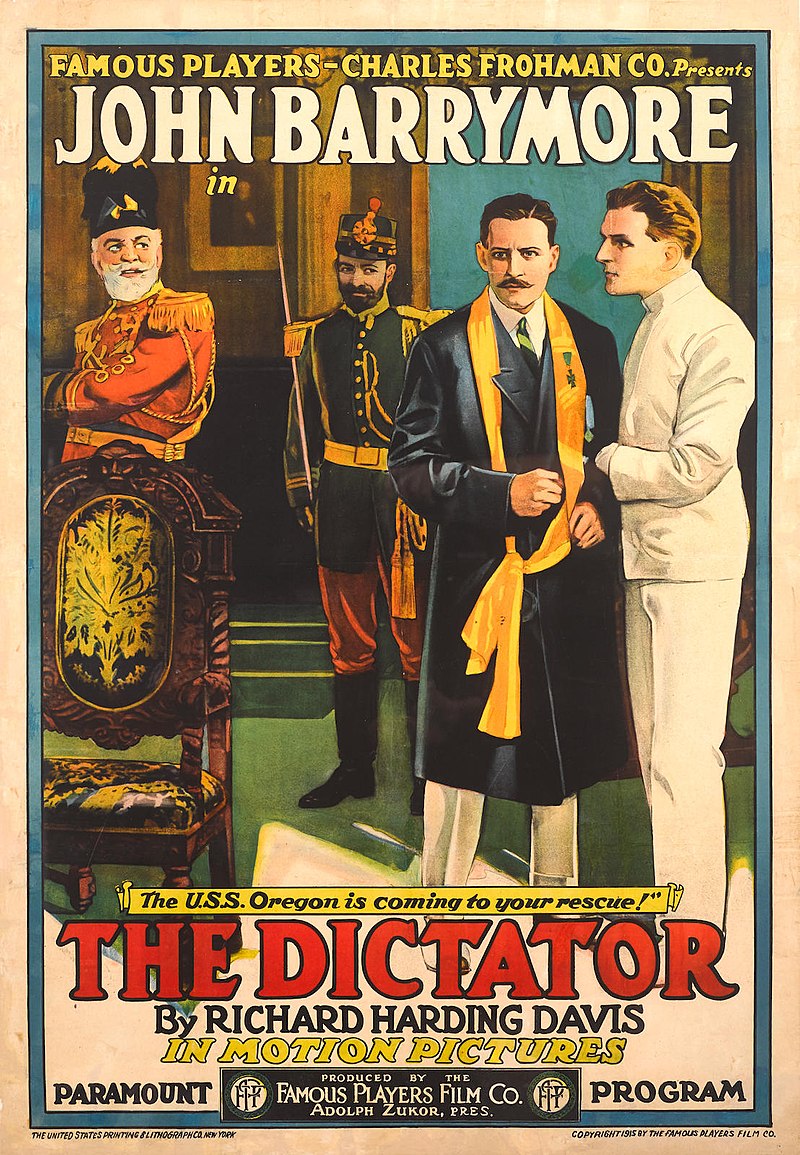
A definitive 7.7/10 rating for a film that redefined the boundaries of cult cinema. The Dictator remains a cornerstone of transgressive art.
A Fifth-Avenue fop boards a cab and disembarks a despot—such is the vertiginous moral escalator Richard Harding Davis sets grinding in The Dictator, a 1914 one-reel marvel that distills imperial hubris into carbonated farce.
Viewers lulled by nickelodeon froth may expect jaunty escapism; instead they confront a satire whose aftertaste is pure quinine. From the first iris-in, cinematographer William Wagner’s camera ogles Manhattan’s winter gaslight like a gossip columnist, then plunges southward into a chromatic fever of banana leaves and ochre dust. The tonal whiplash is intentional: privilege, once punctured, hemorrhages at tropical velocity.
Brooke Travers—John Barrymore in angular, pre-swashbuckler form—enters the narrative swaddled in mink-lined self-regard. His tête-à-tête with an extortionate cabman plays as light vaudeville until fists fly and a skull cracks on granite. That off-screen thud is the film’s true inciting incident: manslaughter, accidental yet irrefutable. Barrymore registers the moment in a micro-flinch, pupils dilating like a man who glimpses his own obituary. It is silent cinema’s gift to linger on that face, half-shadowed by the brim of a silk hat, and watch aristocratic composure curdle into animal calculation.
What follows is a reverse Odyssey: not a hero descending to claim kingdom, but a coward scurrying toward periphery where extradition treaties rot in desk drawers. The cab itself becomes Charon’s ferry—Travers commandeers the vehicle, pays the dead man’s blood-spattered meter, and races to a wharf shrouded in noir fog. One hard cut later, palm fronds scratch the horizon like prison bars.
Porto Banos, the fictional Central American port, is less geography than fever dream stitched from yellowed newspapers and Rooseveltian swagger. The American consul—Robert Broderick in rheumy-eyed scene-stealing mode—oozes the ennui of a man who’s sold passports like carnival tickets. His proposition to Travers is delivered over a glass of contraband brandy, the camera tilting upward to catch a lizard scaling the consulate wall—a sly visual rhyme for the reptilian transaction.
Once Travers accepts the “temporary” presidency, the film’s register shifts from urban panic to operatic burlesque. Davis’s intertitles, usually florid, here clip along like telegrams: “Proclamation No. 1: No taxes. Applause. Proclamation No. 2: All taxes doubled. Silence.” The gag distills colonial administration: policy as improvisational cabaret. Barrymore struts across adobe balconies, epaulets glittering, yet his shadow dwarfs him—an emblem of borrowed authority soon to be repossessed.
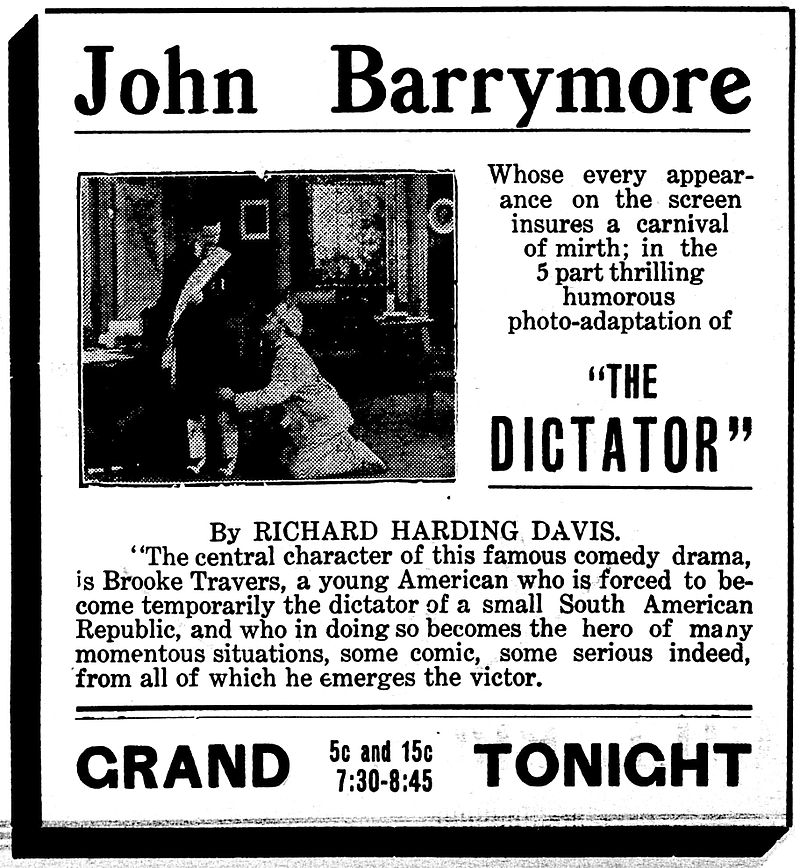
Where Travers seeks amnesiac exile, three women arrive to remind him identity is inescapable. The consul’s wife, played by Ruby Hoffman with matronly rapacity, wields matrimonial gossip like a machete—every smile is a ledger of IOUs. Esther Lyon’s former sweetheart, seething in widow’s weeds, embodies the vengeance of discarded concubines throughout hemispheric history; her glare could pickle plantains.
Charlotte Ives’s missionary, Ruth Alden, supplies the moral counterweight. Introduced beneath a cruciform palapa, she tends lepers while humming Methodist hymns, her tonal certainty the antithesis of Travers’s ethical card-shuffling. Their courtship transpires in chiaroscuro: lantern light carves halos around her, leaving Barrymore’s face half in penumbra, as though even photons refused complicity. When he confesses his past—via a deftly etched close-up of trembling intertitle—“I killed a man for two dollars and change,” the film pauses for a heartbeat of grace. Ruth’s response, a hand placed atop his not in absolution but in shared culpability, reframes redemption not as erasure but as collaborative penance.
Budget constraints become aesthetic virtue. The revolutionary skirmish—usually epic spectacle—here unfolds in a single alley no wider than a saloon bar. Combatants spill from doorways like irate chorus members; muzzle flashes ignite hand-painted backdrops, their artificiality underscoring the make-believe wars that empires export. Directors Edwin Middleton and Fred E. Wright splice stock footage of troop trains with studio close-ups so audaciously mismatched the collage feels Brechtian decades before epic theater.
Listen to the score if screening with accompanist: ragtime segues into habanera, then collapses into dissonant stride piano as Travers signs death warrants with a wax-seal stamp shaped like a teddy bear—an absurdist flourish worthy of Buñuel.
Modern audiences know Barrymore for Don Juan or Grand Hotel, but here he is Harlequin with impostor syndrome. Watch his gait in cabinet scenes: spine erect, knees flexed, as if perpetually ready to bolt. The performance is a seminar in micro-gesture—eyebrows semaphore panic while the mouth issues despotic decrees. When forced to review a firing squad, he fingers a button on his tunic the way a child rubs a security blanket. It is comedy mined from cognitive dissonance, prefiguring the neurotic sovereigns of The Great Dictator or In the Loop.
One tableau remains indelible: midnight thunderstorm, palace shutters banging like loose coffin lids. Travers stands before a broken mirror, uniform drenched, medals tarnished. Lightning freezes the frame—six fractured selves regard one another, each blaming the other for the carnage outside. Barrymore lets out a silent howl, mouth agape, eyes reflecting back not moonlight but the orange glow of a village burning under his command. In that instant, comedy gutters into tragedy without a single subtitle.
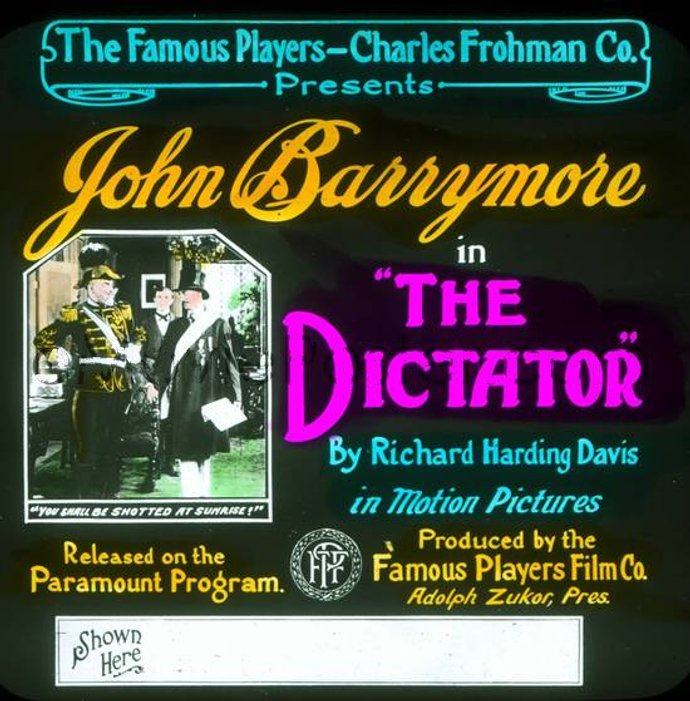
Spoilers are antique for a 110-year-old film, yet the finale still jolts. Travers engineers a coup against his own regime, rigs the treasury to explode, and escapes with Ruth aboard a gunboat flying Norwegian colors—an international loophole in sepia. One anticipates a reversion to status quo: playboy absolved, tropical backdrop discarded like a spent set.
But Davis withholds catharsis. Mid-voyage, Ruth insists they detour to Key West to testify before a maritime court. Travers agrees, pride crumbling into something like relief. The last intertitle lands like a thrown gauntlet: “Tomorrow, the real revolution begins—within.” Fade-out on the couple silhouetted against dawn, handcuffed not by iron but by conscience. It is an ending both romantic and radical, suggesting accountability transcends latitude.
Place The Dictator alongside its 1914 siblings and its insurgent streak sharpens. Where A Good Little Devil flirts with moral allegory and Strike heralds Soviet montage, Davis’s film occupies a liminal satirical zone seldom visited during nickelodeon infancy. Its nearest ancestor might be The Might of Gold, yet where that picture moralizes avarice, The Dictator ridicules the power that gold purchases. Compare also to Barrymore’s later The Sparrow where he again essays redemption, but cloaked in Gothic mysticism rather than political burlesque.
Academics seeking proto-fascist critique will find fertile soil: the ease with which democracy’s dregs don authoritarian garb anticipates Sinclair Lewis’s It Can’t Happen Here by two decades. Feminist scholars may excavate the film’s triangulate female voices—each woman weaponizes rumor, faith, or eros to unmale the patriarchal state.
Film preservationists long presumed The Dictator lost—another casualty of nitrate neglect. Then in 1998, a Portuguese-language print surfaced in São Paulo, Portuguese intertitles intact beneath Brazilian censor stamps. The Library of Congress undertook a 4K photochemical restoration, grafting missing English cards from a 1915 Kansas City Star clipping that serialized them alongside department-store ads. The resulting hybrid flickers between languages like a diplomat code-switching at gunpoint, but the dissonance oddly amplifies the film’s theme of fractured identity.
Contemporary screenings with live jazz trio reveal its percussive heart—every cymbal crash synchronizes with on-screen executions, turning genocide into scat rhythm. Audiences laugh until breathless, then recoil at their own laughter. That uneasy ricochet is the mark of enduring satire.
Viewed today, The Dictator plays less like historical artifact than newsfeed prophecy. Swapping tweets for telegrams, TikTok for telegraph wires, we again witness dilettantes stumbling into geopolitics, authority minted in backrooms, accountability deferred to “later.” The film’s genius lies not in predicting specifics but in anatomizing the evergreen cocktail of panic, vanity, and PR that fuels the climb—and the plummet—from street-corner fracas to presidential palace.
Seek it out however you can: archive stream, repertory cinema, or a scratchy DVD scored by your own crackling conscience. Let Barrymore’s nervous smirk haunt your feed. Remember, revolutions begin not with banners but with a single overpriced cab ride—and the cowardice to flee the curbstone where consequence bleeds.
IMDb —
1920
Community
Log in to comment.