DbcultAccessing Vault...
Cult Review
Senior Film Conservator
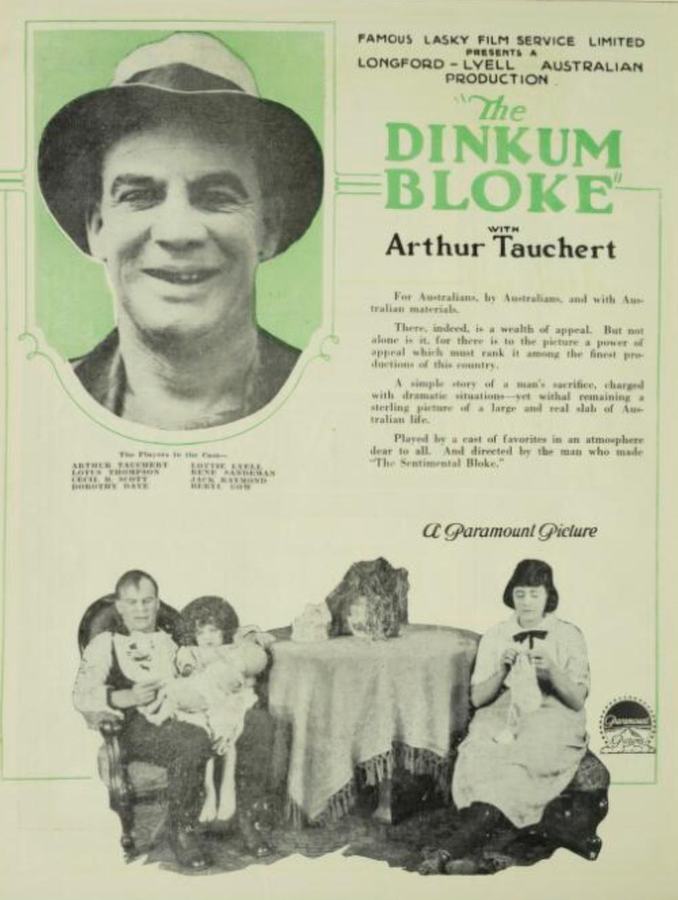
The cinematic landscape of the early 1920s was often a battleground between the burgeoning artifice of Hollywood and the gritty, localized realism of independent territories. Amidst this friction, Raymond Longford and Lottie Lyell crafted The Dinkum Bloke, a film that transcends its silent-era constraints to offer a profound meditation on the Australian character. This isn't merely a sequel in spirit to their earlier triumph, The Sentimental Bloke, but a more somber, mature exploration of the consequences of time, loss, and the rigid structures of social caste.
One cannot discuss this work without acknowledging the tragic brilliance of Lottie Lyell. In what would be her final screen appearance, she brings a luminous yet grounded presence that anchors the film’s early domestic bliss. Her collaboration with Longford was the heartbeat of early Australian cinema, a creative partnership that rivaled the most prestigious pairings in Europe or America. While films like The Soul's Cycle delved into the metaphysical and the reincarnation of spirits, Longford and Lyell remained steadfastly committed to the physical, the tangible, and the immediate struggles of the working class.
The narrative architecture of The Dinkum Bloke is deceptively simple, yet it pulses with a raw, unvarnished humanity. Arthur Tauchert reprises his role as Bill, the 'Bloke' whose transition from a carefree larrikin to a grieving widower and devoted father provides the film's emotional spine. Tauchert’s performance is a masterclass in laconic expressionism; he conveys volumes with a slight shift of his heavy brow or the weary slump of his shoulders. It is a performance that eschews the theatrical histrionics common in the early 20s, favoring a naturalism that feels startlingly modern.
As the plot unfolds, we see Bill’s daughter, played with a blossoming charm by Beryl Gow and later Cecil Scott, being pulled toward a world that views Bill’s rough edges as liabilities. This tension between the tenements of Woolloomooloo and the manicured lawns of the wealthy is handled with a nuance that avoids the didactic traps of lesser melodramas. While The Vanity Pool focused on the shallow machinations of the social elite, Longford uses the elite world primarily as a mirror to reflect Bill’s steadfastness. He is 'dinkum'—true, honest, and unpretentious—even when that honesty requires him to step into the shadows to ensure his daughter’s happiness.
The cinematography, though surviving only in fragments today, reveals a filmmaker deeply in love with the urban sprawl of Sydney. The camera captures the dust of the streets and the smoke of the chimneys with a documentary-like precision that contrasts sharply with the ethereal, dreamlike qualities of contemporary European works like Fortunato. 1. Der tanzende Dämon. Longford’s eye is not looking for demons or ghosts; he is searching for the divine in the mundane. The framing of Bill in his small cottage, surrounded by the ghosts of his past, evokes a sense of claustrophobia that is both physical and social.
In the broader context of 1923, The Dinkum Bloke occupies a unique space. It lacks the cynical edge of the French production L'argent qui tue, which critiqued the soul-crushing power of money through a more nihilistic lens. Instead, Longford offers a more sentimental, though never saccharine, perspective. He suggests that while money and status can alienate, the core of the human spirit remains incorruptible if it stays true to its origins. This theme of suppressed but burning emotion is also found in Sleeping Fires, though Longford’s 'fires' are those of paternal duty rather than romantic obsession.
The film also stands in stark contrast to the whimsical or fantastical elements of the era. Where Prunella sought to create a storybook world of innocence, The Dinkum Bloke confronts the grit of reality head-on. Even the lighthearted moments of comedy, which Longford expertly weaves through the narrative, feel earned. They are the brief respites of a man who knows that life is a series of hard knocks. This balance of humor and pathos is something that even the most polished Hollywood productions of the time, such as The French Doll, often failed to achieve, settling instead for surface-level artifice.
The brilliance of the script, co-written by Longford and Lyell, lies in its rhythmic use of Australian slang in the intertitles. This linguistic specificity gives the film a voice that is distinctly regional yet universally understandable. It captures a moment in time when the Australian identity was still forging itself, separate from the British colonial shadow. While Comin' Thro' the Rye leaned heavily on traditional British pastoral tropes, The Dinkum Bloke is unapologetically urban and local. It celebrates the 'jackeroo' spirit in a metropolitan setting, a theme further explored in Caloola, or The Adventures of a Jackeroo, but with more psychological depth.
There is a sequence in the second act where Bill attends a high-society function to see his daughter. The way Tauchert occupies the space—fumbling with his collar, looking at the ornate furniture with a mixture of awe and disdain—is heartbreaking. It’s a sequence that could have easily descended into slapstick, much like the situational comedy in Here's Your Man or the triviality of A Golf Insect. Instead, Longford focuses on the internal dignity of the character. Bill isn't a clown; he’s a man out of time and out of place, a theme that resonates with the mystery of identity found in Unknown 274.
Technically, the film utilized natural lighting to an extent that was revolutionary for the Australian industry. The shadows in the Woolloomooloo alleyways aren't just lack of light; they are characters in themselves, representing the weight of Bill’s poverty and his past. This use of chiaroscuro, while perhaps not as stylized as the Turkish tragedy Kiz Kulesinde Bir Facia, serves a narrative purpose that is entirely grounded in the film’s emotional reality. Longford didn't need the grandiosity of Milady or the regal posturing of La reina joven to tell a story of consequence. He found it in the steam of a kettle and the silence of an empty chair.
It is a profound tragedy that so much of The Dinkum Bloke has been lost to the ravages of nitrate decomposition. What remains is a tantalizing glimpse into a cinematic language that was reaching its zenith just as the silent era was beginning to fade. The fragments we possess suggest a work of immense empathy and structural sophistication. It was a film that dared to suggest that the greatest hero isn't the one who conquers nations or discovers fortunes, but the one who has the courage to remain himself in a world that demands he be someone else.
Ultimately, The Dinkum Bloke is a testament to the power of regional storytelling. Longford and Lyell understood that the more specific a story is to its own soil, the more universal its appeal becomes. By focusing on the hyper-local dialect and the specific social anxieties of post-war Sydney, they created a timeless portrait of fatherhood. The film avoids the melodramatic pitfalls that plague many of its contemporaries, opting instead for a quiet, devastating honesty that lingers long after the final intertitle fades. It is a cornerstone of Australian culture, a 'dinkum' masterpiece that deserves a place in the global pantheon of silent cinema. Its absence from the complete historical record is a void that every film historian feels, but its spirit continues to inform the rugged, empathetic heart of Australian film to this day.
A cinematic relic of unparalleled emotional honesty, Longford's work remains the definitive portrait of the Australian working-class soul.
IMDb 5.6
1919
Community
Log in to comment.