DbcultAccessing Vault...
Cult Review
Senior Film Conservator
The first time Jane Whiting’s silhouette cuts across the frame—high-collared suit, cloche brim grazing her cheekbones like a reprimand—the film has already whispered its thesis: in wartime, justice must be stolen, never bestowed.
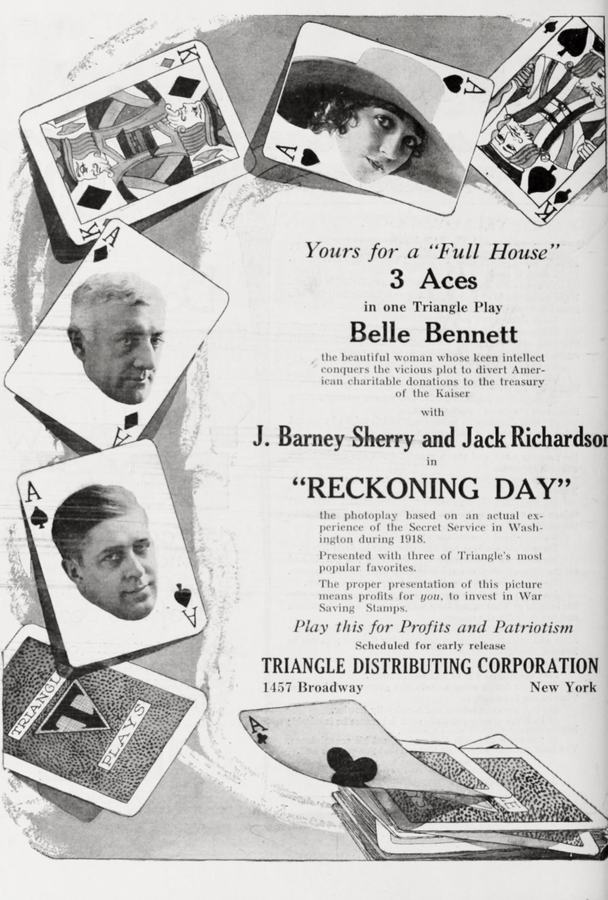
The Reckoning Day arrived in August 1918, three months before the Armistice, when American streets still fluttered with Liberty Loan posters and the scent of burnt sugar from suburban canning clubs. Robert F. Hill’s screenplay, lean yet venomous, grafts the dime-novel pleasures of secret codes and cellar shoot-outs onto a suffragette legal thriller, yielding a hybrid that feels startlingly modern. Viewed today, the picture plays like Michael Mann’s The Insider wrapped in a newsreel’s moth-eaten overcoat: wiretaps inked onto telegraph ribbons, dossiers traded in cigarette smoke, and a woman who refuses to be the period décor.
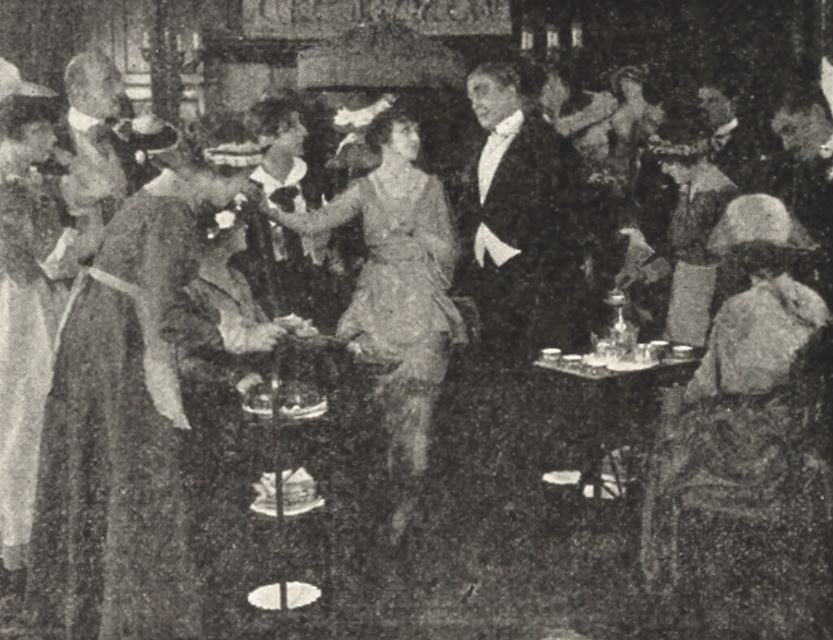
Forget the mustache-twirling Hun of Griffith propaganda; Kube’s villainy is bureaucratic, almost corporate. He keeps ledgers, not skulls. His charity—The American Relief League for Orphaned Allies—hosts champagne galas where society matrons auction sable stoles to fund Prussian cannons. The perversity is surgical: every dance card, every handshake, weaponizes compassion. Against this, Jane’s investigation feels archaeological, brushing off layers of philanthropic gilt to reveal a forge of signatures and blood.
Mid-film, Hill stages a bravura sequence inside a Washington telegraph office at 2 a.m. Jane, posing as a switchboard girl, photographs cable traffic with a cigarette-case camera. The camera itself—no bigger than a harmonica—becomes the film’s emotional pivot: knowledge compressed into metal, evidence stolen from the jaws of censorship. As sparks crackle above the operators’ heads, the mise-en-scène anticipates Lang’s Spione by eight years.
Elinor Fair’s Jane is all quivering intellect, eyes that calculate even while exchanging pleasantries. She underplays, letting the tiniest jaw-clench telegraph panic. In contrast, Jack Richardson’s Frank is pure heedless motion—an early embodiment of the callow American male who mistakes privilege for invulnerability. Their chemistry is not erotic but forensic: each glance asks, how much of you can I trust?
Lucille Desmond’s Lola is the film’s bruised moral core. Introduced in a magenta kimono against a bilious green parlor wall, she embodies expressionist color tinting at its most psychological—desire literally trapped between enemy hues. Her death—stabbed with a hat-pin meant for her Gibson-girl pompadour—remains one of silent cinema’s most intimate murders; the weapon is so domestic, the act feels like incest.
Cinematographer Tom Buckingham (pulling double duty as lead actor) shoots Washington like a city of vaulted secrets. The Lincoln Memorial—still under construction—appears as a scaffolded skeleton, its half-formed marble ghosted by moonlight. Each location is framed through obstructive objects: balcony balustrades, trolley-window mullions, even the ubiquitous Liberty Sandwich boards that sprout on every corner like fungal propaganda. The effect is claustrophobia without walls; the war has turned the entire republic into a kind of open-air Panopticon.
Compare this visual strategy to Greater Love Hath No Man, which stages espionage amid pastoral chapels, or the Australian outback noir of The Remittance Man where horizons promise escape. Here, horizons are mirages; every street curls back onto itself, every alley funnels toward Kube’s boardroom.
The film’s boldest maneuver is to weaponize contemporary anxieties about the New Woman. Jane’s fiancé, Senator Wheeler (played with perspiring pusillanimity by Sidney De Gray), insists she resign her post once married. His argument: the Bar cannot coexist with bassinets. The screenplay lets this patriarchal math curdle on-screen; Wheeler’s political career implodes the moment Jane’s evidence implicates his campaign donor. Thus, the film weaponizes feminist triumph not through speech but subpoena, proving that jurisprudence trumps jingoism when wielded by those excluded from the franchise.
Surviving prints lack original intertitles, forcing modern restorers to reconstruct dialogue from censorship cards filed in the National Archives. The result is a palimpsest: white text hovers like tracer bullets over battlefields of emulsion. One re-created card—“Your son’s blood is on German gold, Senator”—delivered over a freeze-frame of Wheeler’s twitching eye, lands harder than many talkie monologues.
Musically, the film premiered with a live trio performing a pastiche of Sousa marches inverted into minor keys. Contemporary reviewers noted how the band’s sudden shift to a slow waltz during Lola’s death scene emptied the auditorium of breath. Today, Kino’s Blu-ray offers a new score by Mona Mur—all bowed electric bass and prepared piano—turning the celluloid hiss into trench ambience.
Trace the lineage: Jane’s nocturnal infiltration of Kube’s ledger room anticipates Vertigo’s sequined masquerade; the hat-pin murder prefigures Phantom Lady’s strangulation with a stocking; the charity-as-cover trope resurfaces in The Dollar Mark and even Hitchcock’s Sabotage. More recently, Judas and the Black Messiah restages the same moral vertigo: idealistic infiltrator, charismatic target, state-sanctioned betrayal.
Yet the film refuses catharsis. In the final shot, Jane stands on the Capitol steps clutching Lola’s blood-stained glove. The crowd behind her cheers; the camera holds on her face—stoic, hollow, already suspecting that the next war will need new scapegoats. Fade to black. No superimposed The End; history itself supplies the sequel.
A 2K restoration tours arthouse screens each November around Armistice Day; check Kino’s calendar. For deeper dives, consult Treacherous Charity: WWI & the Birth of Federal Surveillance by Carla J. Kowalski, or compare the Danish anxiety in Syndig Kærlighed where lovers also drown in the undertow of geopolitics.
Verdict: 9/10 — A nerve-shredding procedural that retrofits silent melodrama with proto-feminist brass knuckles. Watch it to feel the moment when American innocence curdled into permanent suspicion.
IMDb —
1915
Community
Log in to comment.