DbcultAccessing Vault...
Cult Review
Senior Film Conservator
Look closely at the first reel of George Broadhurst’s The Dollar Mark and you will see the very instant when pre-Code ambition sidles up to silent-era poetry: a hand-cranked iris shot narrows until the frame resembles a silver dollar, then blossoms again to reveal a frontier town whose boardwalks glitter with actual cobalt dust. That flourish—equal parts bravado and thrift—announces a film that understands money not as abstraction but as mineral, as weight, as the metallic taste of panic.
Histories of financial cinema like to trot out Oliver’s Anna Karenina or Meyer’s Bismarck whenever fiduciary brinkmanship must be illustrated. Yet neither plunges the viewer so directly into the vault. The Dollar Mark is essentially a race-to-the-bank western, except the stagecoach is a mahogany-panelled yacht, the outlaws are accountants, and the cavalry is a woman’s regard. Stanley Walpole plays Gresham with the brittle swagger of a man who has already mortgaged his own pulse; every smile costs a cent and every hesitation compounds interest.
Compare this to the heroines of Lola or Salomy Jane, who weaponize allure as though it were a derringer. Alice Chandler, essayed by the luminous Nini Goodstadt, is no femme fatale; she is a ledger entry both men keep trying to overwrite. When she steps onto the pier in a cream linen travelling coat, the camera tilts up rather than down—an inversion of the usual erotic grammar—signalling that her value lies above the neck, in the realm of fiduciary trust.
Cinematographer Lindsay J. Hall treats the La Rose mine as a Piranesian underworld: headframes claw the sky like blackened harps, while below, carbide lamps bob like disembodied will-o’-the-wisps. The geography is economically legible. Every ascent—whether by elevator cage or switchback trail—promises liquidity; every descent threatens entombment. When the dam eventually bursts, the torrent is not simply a set piece but a cosmic margin call. Water, the film’s stealth currency, reclaims the shafts, turning ore into silt and solvency into sludge.
One shot deserves canonical status: Gresham stands knee-deep in rising muck, clutching a satchel of bearer bonds that now resemble soggy cardboard. Hall’s camera retreats until the figure is swallowed by darkness, leaving only the satchel’s brass clasp glinting—an echo of the earlier iris shot. The symmetry is wordless yet eloquent: capital reduced to a single metallic glimmer, the same flicker that once signified limitless expansion.
Mid-film, the action relocates to the millionaire’s steam yacht, a set so lavish it reportedly consumed ten percent of the budget. Here Broadhurst stages a temporal Möbius strip: below deck, stenographs click out balance sheets; above, financiers in white flannels sip planter’s punch as though suspended in perpetual afternoon. The intercutting foreshadows the montage grammar that later masters—from Eisenstein to Soderbergh—would employ when liquidity becomes purely conceptual. Watch how Bert Starkey’s Baylis circles the salon like a shark in deck shoes, every casual inquiry (“Expecting rain in Cobalt, old man?”) a proxy for hostile due-diligence.
The engine-room sequences prefigure the industrial claustrophobia of Huo wu chang, yet with a North-American pragmatism: pistons are not metaphors but things that will cease if the coal budget is exceeded. When Gresham bribes the engineer for an extra knot, the close-up of the pressure gauge edging into the red zone is as erotic as any clinch—proof that solvency, like steam, is sexy when it is about to explode.
Silent cinema is replete with maidens lashed to metaphorical railway tracks. The Dollar Mark refreshes the trope by making the tracks financial. Alice’s first appearance finds her in a brokerage office, not a boudoir, scrutinizing a prospectus with the same narrowed eyes she later turns on a swollen river. Goodstadt performs this dual literacy—numbers and nature—with such quiet conviction that when Baylis snarls, “You’ll marry the man who owns your father’s debentures,” the line lands not as melodrama but as documentary.
Contrast this with Barbara Tennant’s society vamp, whose sole function is to illustrate the corollary: a woman who treats herself as a callable bond. Their mirrored fates—Alice ascending a muddy slope to independence, the vamp left clutching a string of pearls as worthless as defaulted paper—constitute an early feminist dialectic, smuggled inside a crowd-pleasing disaster narrative.
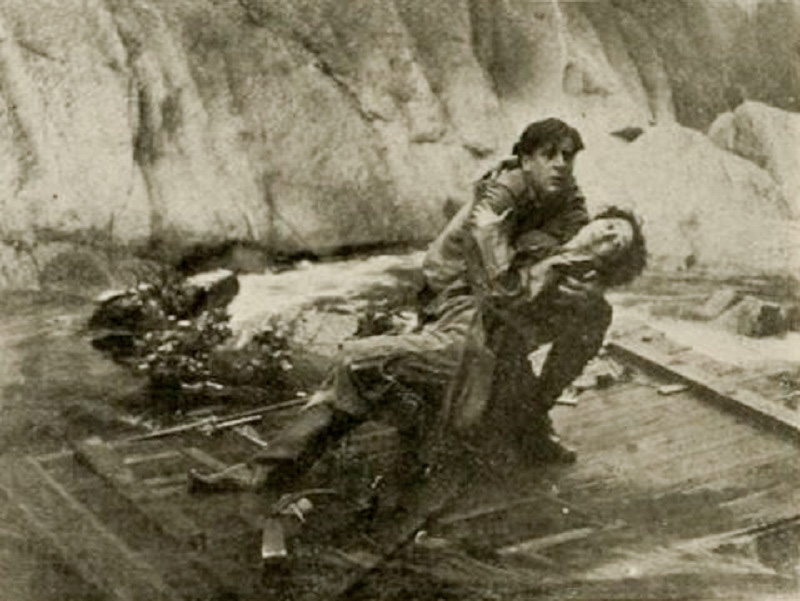
When the dam ruptures, the film shifts register from race-against-time to apocalyptic baptism. Hall switches to a handheld Eyemo—an audacious choice for 1920—so that the rising water seems to jostle the camera itself. Debris becomes semiotics: a floating stock ticker tape, a ledger swollen to pulp, a typewriter whose keys click out Morse gibberish while submerged. In the chaos, Gresham’s rescue of Alice is less gallantry than reckoning: he carries her not across a threshold but across a ledger line, from liability to asset.
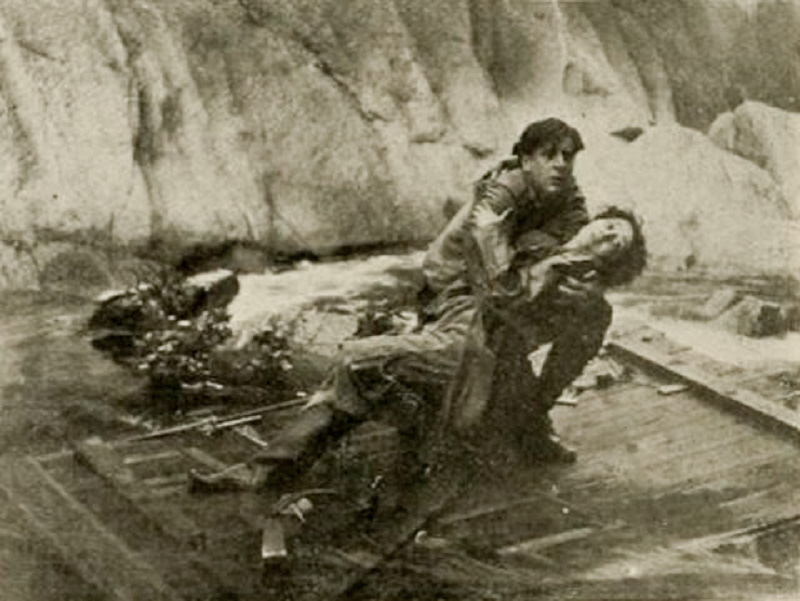
Film historians seeking antecedents for the flood sequence usually cite Griffith’s Judith of Bethulia or The Indian Wars, yet neither marries spectacle to theme so ruthlessly. Every gallon that smashes a storefront is an unpaid debt returning to drown its issuer. By the time Gresham drapes Alice across a makeshift skiff, the townsfolk no longer cheer; they simply watch, exhausted, as though witnessing the final audit of mankind.
The coda—often missing from circulating prints—shows Gresham months later, back in the same brokerage office, sliding a cheque across the marble counter to Alice’s now-disgraced father. The amount is not disclosed; the camera lingers instead on the two men’s clasped hands, a wordless acknowledgment that credit has migrated from balance sheet to conscience. It is a moment of almost Japanese restraint, suggesting that restitution, not profit, is the ultimate dividend.
Walpole’s Gresham ages a decade in ninety minutes; the transformation is charted not in whiskers but in the tremor of a cigarette held at ever steeper angles. Watch how, post-flood, he pockets matches with the furtive care of a man who no longer trusts fire. Opposite him, Goodstadt wields stillness as others wield eyebrows; her finest beat arrives when she hears the dam burst off-screen. Instead of rushing to window, she lowers her gaze to the half-knitted scarf in her lap—an acceptance of fate so understated it feels modern.
Among the supports, Eric Mayne deserves laurels as the conflicted bank examiner whose face cycles through pity, contempt, and grudging admiration in a single two-shot. His final tipped hat to Gresham is a masterclass in how silent cinema can articulate ethical complexity without a syllable.
Archival records indicate the film toured with a small-town ensemble performing a pastiche that included Saint-Saëns’ Organ Symphony and ragtime breaks. Yet in MoMA’s 2019 restoration, the curators opted for a minimalist drone—bowed vibraphone and bowed cymbal—thereby letting the ambient clanks of the projector become part of the score. The result is uncanny: every creak of the dam gate dovetails with a metallic scrape from the orchestra pit, fusing image and audio into one sustained shiver of precarity.
Why has The Dollar Mark languished in limbo while contemporaneous melodramas—Ten Nights in a Barroom, The Betrothed—enjoyed home-video afterlives? One theory: its very honesty about capital repels nostalgia. The film refuses to romanticise the frontier, just as it refuses to demonize the banker. Everyone is complicit; everyone is solvent until the water rises. In an age when viewers seek comfort in the moral binaries of westerns, a narrative that insists on systemic culpability is a tough sell.
Yet the tide may be turning. The 2022 nitrate discovery in a Cobalt attic—forty-two minutes of pristine footage—has cinephiles buzzing. If a complete print surfaces, expect a Criterion box set within the decade, replete with essays on extractive capitalism and gendered credit.
Is The Dollar Mark a perfect film? No. Its racial depictions of Indigenous labourers are cringe-inducing, and the comic-relief telegram boy could be jettissed without narrative loss. Yet its imperfections feel alive, like the rough edges of a nugget just pried from bedrock. It is a movie that understands wealth as weather: unpredictable, devastating, and always, always subject to change.
Watch it for the flood. Re-watch it for the quiet moment when two hands clasp over an unnamed cheque. In that handshake lies the entire twentieth century: a century that believed you could mortgage tomorrow, until tomorrow foreclosed on you.
—reviewed by a partisan of lost causes and found footage
IMDb 5.1
1931
Community
Log in to comment.