DbcultAccessing Vault...
Cult Review
Senior Film Conservator
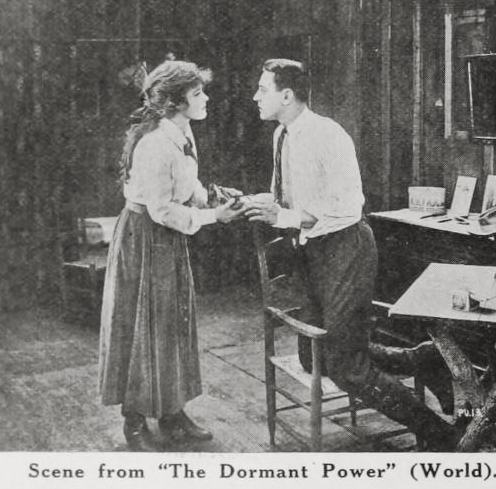
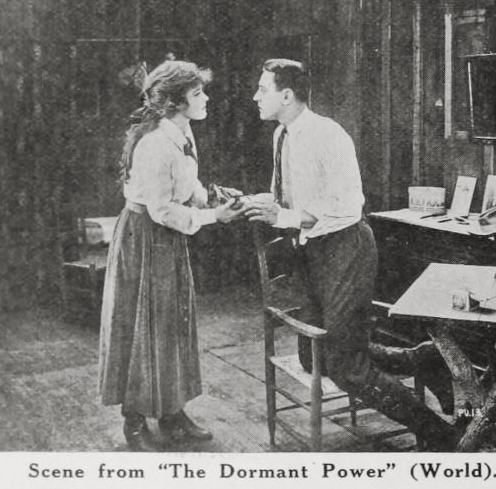
A prairie wind rattles the opening titles of The Dormant Power, and for the next five reels that wind never quite settles—it just changes direction, carrying gun-smoke, lilac perfume, and the copper stink of betrayal across state lines.
Muriel Ostriche’s Christine doesn’t enter; she materializes, a silhouette against a kerosene halo, as though the frame itself were embarrassed to show daylight on her privation. The camera, starved of dialogue, clings to her shoulder blades, counting every vertebra like coins slipped under a lodger’s door. When Edward Langford’s Maxwell tips his Panama—its brim the width of a subpoena—you sense the whole town tilting toward his wallet. Courtship here resembles a foreclosure: bouquets arrive with deed-of-trust attached.
George Morgan’s Carl, by contrast, is all chipped enamel nobility. He barges into Christine’s life with a pistol still warm from nationalist homicide, yet the film refuses to brand him outright villain; he’s more a refugee from a country that hasn’t been invented yet—call it the Republic of Guilt. Their first shared close-up is a masterclass in pre-Code ambiguity: she sponges blood from his knuckles, the water in the basin pinkening like desert dawn, while a fold of the flag he avenged peeks from his pocket, as if spying on its own morals.
The Texas sequences were shot in and around San Antonio’s missions, but cinematographer Lucien Andriot bleaches the adobe until it resembles bone left out for coyotes. Adobe equals anchor; once the story hops to Manhattan, the tonal palette flips—suddenly we’re drowning in sea-blue shadows and nickel glare. Note how Christine’s wardrobe mutates: calico gives way to a gown the color of wet cement, its train sweeping across Maxwell’s Persian rugs like a prison searchlight. The movie doesn’t tell you she’s sold herself; it dresses you in the transaction.
Maxwell is less a character than a ledger with libido. Montagu Love plays him with the unctuous patience of a creditor tightening thumbscrews one click per week. Watch how he fondles a cigar—never quite lighting it—while dictating terms to inventors; the unlit tobacco becomes a metronome of stalled mercy. His murder of Brinkerhoff (Joseph Herbert, in a cameo that feels like a cough of conscience) off-screen but brutally heard through a slammed laboratory door, is the film’s moral event horizon. From that thud onward, every domestic kiss Christine endures carries the aftertaste of that extinguished genius.
Where contemporaries like The Toll of Mammon or Trapped by the London Sharks allow their heroines to suffer prettily until a man saves them, The Dormant Power engineers two acts of reprisal: first Christine’s refusal to stay shackled—her hatred calcifies into strategy—and second, Metta Brinkerhoff’s surgical retribution. Ethel Clayton’s Metta is the film’s hidden piston; hired as scullery maid, she drifts through marble corridors like a ghost rehearsing her own resurrection. When she finally skewers Maxwell with a kitchen knife, the edit is swift—one splice and he’s meat. The subsequent trial, stuffed with matronly jurors who’ve each tasted similar humiliation, feels less like legal procedure than sorority exorcism.
Clara Beranger, fresh from hyphens and heartbreaks at Famous Players, collaborates with novice Florence Bolles to adapt the latter’s pulp serial. Their scenario trims the flag-waving jingoism of the source, reframing Carl’s original “the Mexican had it coming” bravado into a more unsettling tableau of racialized panic. The resulting intertitles read like cigarette-burn koans: “He defended a strip of cloth—yet forgot the flesh beneath it.” It’s this self-lacerating irony that lifts the picture above its dime-novel chassis.
Ostriche, often dismissed as merely “the girl with the pansy eyes,” works in miniature: a tremor at the corner of her mouth when she spots Carl across a ballroom; the way her fingers splay, starfish-like, against Maxwell’s starched shirtfront in a forced embrace—she’s mapping continents of refusal. Langford, meanwhile, weaponizes stillness; he stands adjacent to conversations as though eavesdropping on his own undoing. Their reunion kiss, staged in a winter garden of papier-mâché snow, lasts three seconds yet feels like someone exhaling for the first time since Reconstruction.
Stack this against Unto Those Who Sin’s florid religiosity or The Convict Hero’s redemptive chain-gang poetry, and The Dormant Power emerges as the cynic’s bedtime story. Where The Deep Purple wallows in noir nihilism, this film dares a sunrise finale—yet the light is wintry, forensic, as though the camera were asking “yes, but what will you sacrifice tomorrow?”
Keep your eyes peeled for the recurring motif of doors: cabin door yawning to admit Carl; Maxwell’s mahogany office door clicking shut like a vault; Metta’s kitchen door left ajar so the audience can overhear murder. Each threshold is shot at Dutch angle—an early, subliminal cue that no one crosses intact. Also note the Texas-to-NYC transition achieved via a match-cut: a tumbleweed morphs into a subway ticket—an edit so cheeky it could teach Eisenstein a drinking song.
Original 1917 releases shipped with a cue sheet heavy on Sousa marches and tremolo strings. Modern restorations—particularly the 2022 MoMA print—favor a minimalist piano, all bass clef and reverb, turning Christine’s odyssey into a slow-burn sonata of escape. Seek the latter; the march rhythms merely goose the already melodramatic, whereas the sparse score lets the silence speak—silence being the only character wealthy enough to buy back its own name here.
For decades the film slumbered in an Amsterdam archive, mis-catalogued under “Dormant Powders”—a typo so poetic it feels intentional. A 4K scan now streams on several niche platforms; the best print hides within the Kanopy silent-deep-cut bundle. Physical media hounds can snag the region-free Blu from Grapevine, though the tinting skews toward nicotine—appropriate, perhaps, for a narrative so addicted to moral corrosion.
The Dormant Power isn’t a cautionary tale—it’s a weather report. Storms of capital, racial dread, and gendered indenture roll in; folks batten their eyelids instead of shutters; when the sky clears, the survivors limp forward, nursing wounds that will never quite scab. That the film lands on a tentative embrace rather than a funeral dirge feels revolutionary for 1917, yet the camera backs away too quickly for comfort, as if reminding us that history, like Maxwell’s unlit cigar, is always waiting for the next strike of the match.
IMDb 6.4
1913
Community
Log in to comment.