DbcultAccessing Vault...
Cult Review
Senior Film Conservator
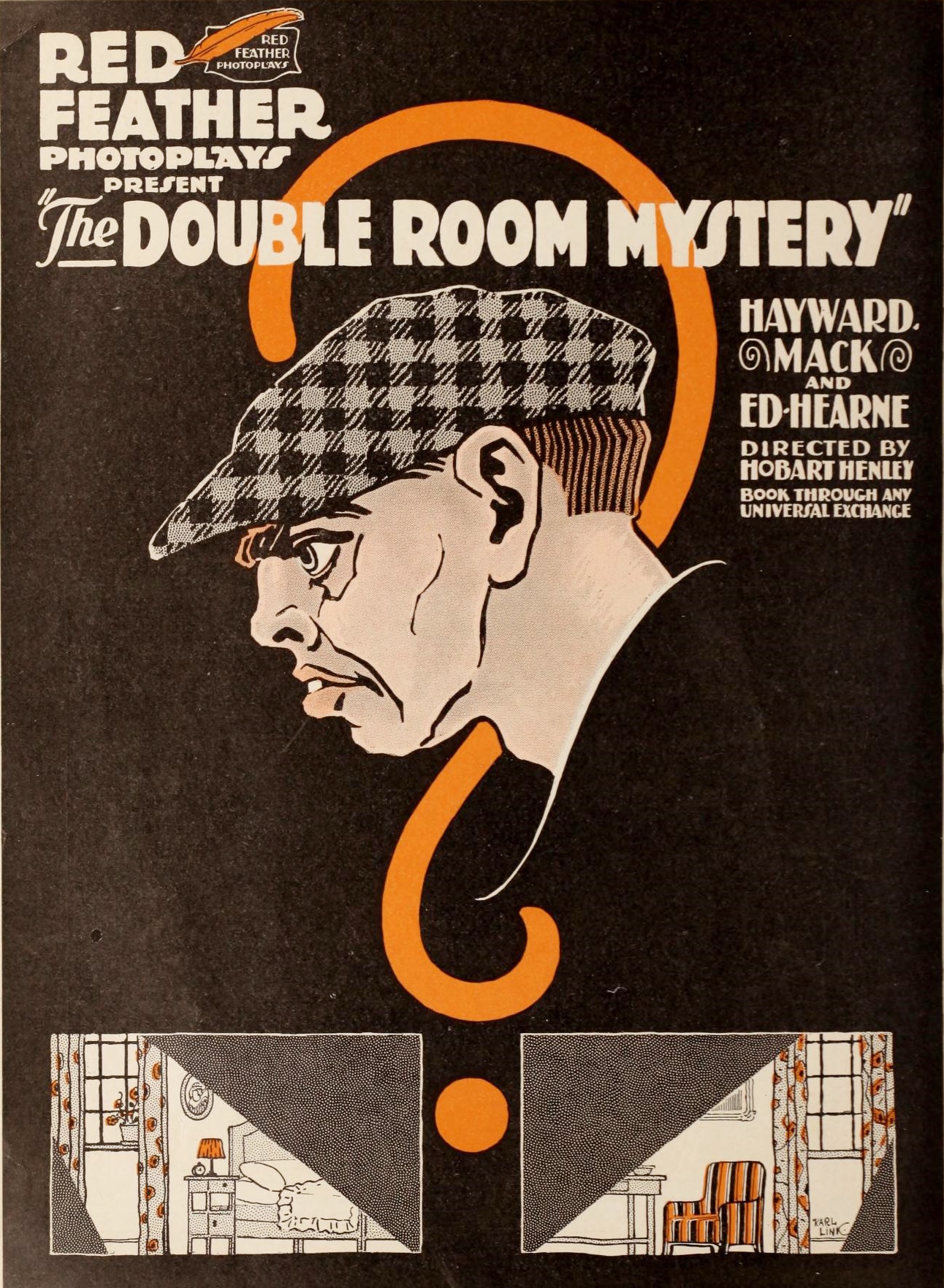
Viewed today, The Double Room Mystery feels less like a nickelodeon trifle and more like a fever dream soaked in coal smoke and cheap perfume. Herron and Clawson’s screenplay, clocking in at a brisk fifteen minutes, crams into its celluloid veins every lurid ingredient that would later ferment into film noir: the shyster lawyer, the tarnished dove, the wronged fall guy, the diamond MacGuffin, the gunshot that reverberates longer than any spoken word. Yet the film predates even The Birth of a Nation by a calendar year, which places it in that giddy Paleolithic era when movies still whispered rather than roared. The result is a curio both primitive and startlingly modern.
From the first iris-in, director Edward LeSaint (working with the blunt tools of 1914: a hand-cranked camera, mercury-vapor arcs, and a single interior set redressed to suggest three separate rooms) establishes a visual grammar of entrapment. Doorways gape like guillotines; windows function less as exits than as picture frames for guilt. When Morris—played with bulldog truculence by Ed Brady—is hauled back into the precinct, the camera holds at medium long shot, allowing the audience to feel the claustrophobia of a world where every wall seems one brick too close.
The vest itself—dingy, frayed, yet pregnant with sparkle—becomes the film’s true protagonist. In close-up (the only genuine close-up the movie affords), the fabric resembles pockmarked skin; the diamonds, once exhumed, glisten like suppurating teeth. That cut, that literal absence where gems once nested, is the moment the narrative pivots from petty larceny to existential larceny: Newman isn’t merely stealing payment, he’s excising trust itself.
Hayward Mack’s Newman oozes the oleaginous charm of a man who has learned that smiles are coin of the realm. Note the way he removes his gloves—slow, deliberate, as though skinning an invisible prey—before offering Georgianna his Faustian bargain. His performance is calibrated for the cheap seats yet riddled with micro-gestures: the involuntary lick of the lips when she signs the bail bond, the fractional hesitation before pocketing the stones. Silent-film acting is often caricatured as semaphore; Mack works in hieroglyphics.
As Georgianna, Gertrude Selby is required to spend half the film trembling like a stepped-on violin string. She obliges, but watch her eyes—huge, lamp-black saucers that slide toward the camera whenever Newman’s back is turned. That flicker isn’t fear; it’s calculation. In those glimmers we glimpse a proto-femme fatale, a woman who realizes, perhaps sooner than anyone, that survival in this universe demands complicity in one’s own objectification.
The actual double room of the title is a narrative trompe-l’oeil: a flimsy partition splits Newman’s chambers from McHugh’s dressing room, a paper-thin membrane across which guilt, gunpowder, and gossip seep. The spatial economy is Hitchcockian decades before Hitchcock. When Morris fires the fatal bullet, LeSaint cuts to an interior shot of McHugh fastening his collar, the gun’s report registering only as a muffled thud and a quiver of the shared wall. We understand, instinctively, that violence in this world is never witnessed head-on; it filters through floorboards, transoms, half-open transoms—through story itself.
Indeed, the film’s most sly self-reflexive joke is that two newspapermen—McHugh and the late-arriving Bennett—vie not to solve the crime but to brand it. The scoop becomes another loot to be fenced. When McHugh handcuffs Morris, he does so with the proprietary air of a collector pinning a rare butterfly. His promise to send Willy and Georgianna off to a bucolic uncle plays less like charity and more like a curtain fall on a narrative he now owns.
Visually, the palette is limited but expressive. The surviving 16 mm print (held by the Library of Congress) is tinted amber for interiors, sea-green for exteriors, with a crimson flash for gunfire. These washes, rather than seeming gimmicky, evoke the lurid penny dreadfuls that lined newsstands of the era. One can almost smell the pulp paper, the cheap aniline ink.
Yet for all its proto-noir trappings, The Double Room Mystery is also a moral fable about class. Diamonds—those crystallized condensations of labor—pass from miner to thief to lawyer to journalist, accruing narrative value while shedding ethical weight. Georgianna’s “cheap rings,” by contrast, are dismissed by every male character as bauble, yet they ignite the plot’s machinery. The film quietly insists that value resides not in objects but in the stories we graft onto them.
Compare this to the diamond heist in Big Jim Garrity, where the stones function merely as glittering MacGuffins, or the inheritance chest in Langdon’s Legacy, which operates as patrilineal glue. Here, the diamonds are liquid guilt, circulating like a venereal disease through the body politic.
The final irony: Morris, the self-professed mastermind, is captured not by badge or code but by slapstick—Willy’s teetering tower of furniture, a bottle to the cranium. The law, in 1914, is still amateur night, a carnival of accidents. Order, such as it is, reasserts itself through farce, not justice.
Is the film a masterpiece? Hardly. Its tempo stumbles, its intertitles read like telegram copy, and the surviving print bears more scratches than a alley cat. Yet its raw nerves anticipate the grafted cynicism of Tainted Money and the voyeuristic dread of Le Cirque de la Mort. It is a seed crystal: flawed, cloudy, but possessed of the lattice that will one day support The Maltese Falcon and Out of the Past.
For the modern viewer, the thrill lies in recognizing how fully-formed these tropes already were: the femme fatale as working-class survivor, the lawyer-crook symbiosis, the journalist as voyeur-hero, the gunshot that echoes longer than any reformation. Watch it at 1 a.m. with the lights off and the volume dialed to the hiss of nitrate. You will smell coal smoke. You will feel the floorboards flex. And you will understand that every noir that followed is merely a shadow cast by this flickering, ferocious little sparrow of a film.
Where to see it: 16 mm print screened occasionally at MoMA’s Treasures from the Archive series; also streaming via Library of Congress’ National Screening Room (public domain, 1080p scan). Runtime 14:52. Accompaniment recommended: a solo piano plunking out a slow rag in C minor, with plenty of room for dissonance.
IMDb —
1921
Community
Log in to comment.