DbcultAccessing Vault...
6.4/10
Senior Film Conservator

A definitive 6.4/10 rating for a film that redefined the boundaries of cult cinema. The Dumb Girl of Portici remains a cornerstone of transgressive art.
There is a moment, roughly seventeen minutes into The Dumb Girl of Portici, when the camera forgets it is tethered to terra firma. It levitates above the teeming Neapolitan quay, glides past masts and washing-lines, and finally spirals down toward Fenella’s open palm as though the lens itself were a gull scenting brine and heartbreak. In that gyroscopic swoon, Lois Weber announces that silent cinema can be more than photographed theatre; it can be choreographed thought. The film never recovers its footing—thank heavens—because footing is what keeps revolutions pedestrian.
Auber’s original 1828 score, all cabalettas and corsairs, gets flayed alive by Weber’s editorial scalpel. She discards the divertissements, retains the volcanic chromatics, and grafts onto the skeletal narrative a new circulatory system of close-ups: sinewy fishermen wringing nets like garrotes, aristocrats whose powdered wigs tremble with the same seismic anxiety as the lava chilling beneath their villas. The result is a film that beats with the polyrhythm of history—half-pageant, half-pogrom.
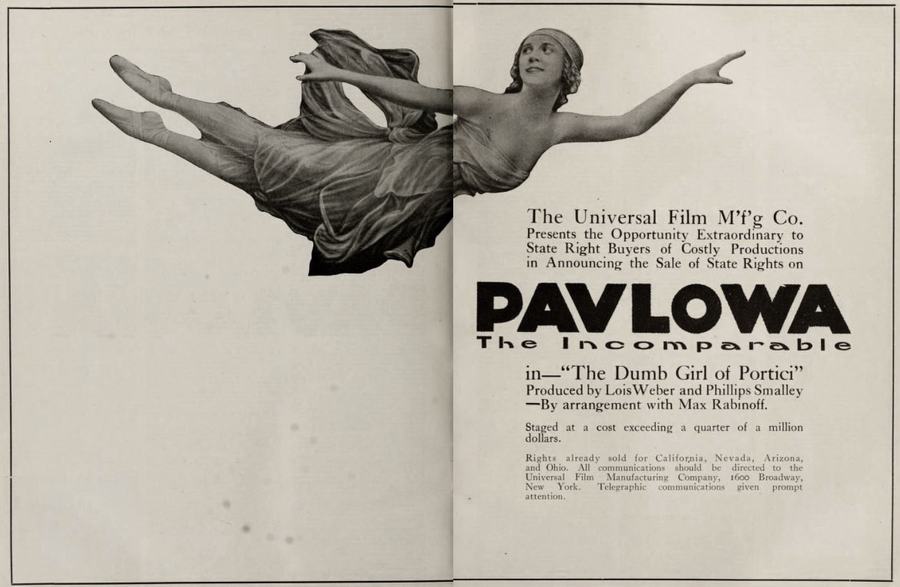
Lina Basquette, sixteen during principal photography, performs Fenella’s muteness not as vacancy but as overfullness—a body so saturated with unsayable things that language would only thin the brew. Watch the micro-tremor in her scapula when Alphonse (Rupert Julian) first grazes her elbow: it ripples outward like a stone dropped in a gilt basin, unsettling every ancestral portrait hanging in the frame. Critics routinely fawn on Anna Pavlova’s cameo as the Dance of the Hours shade, yet Basquette’s quiet arabesque in the marketplace carries more kinetic insurgence than any thirty-two fouettés. Pavlova embodies eternity; Basquette embodies the unbearable now.
Most prints circulated during the nickelodeon era drowned their Naples in sickly amber, turning skin tones to marmalade. The 2023 4K restoration—scanned from a 35 mm nitrate at EYE Filmmuseum—reinstates Weber’s original chromatic score: cyanotype dawns for fisher-folk, arterial crimson for the viceroy’s receptions, and a final reel hand-painted in sulfurous yellow-green that makes the screen itself appear to exhale poison. When Fenella, condemned to the stake, hurls herself into the volcano, the tinting oscillates between tangerine and viridian so rapidly that the viewer’s retina experiences a color sonority—a visual scream standing in for the heroine’s absent voice.

Weber, who began her career penning pulp parables for missionary tracts, wields intertitles like broken bottle glass. Instead of exposition, we get haiku of class warfare: “The lace of her collar cost him a year of salt.” The phrase appears superimposed over a shot of Fenella’s fisher-father coughing blood onto the docks. The cut that follows lands on aristocratic ladies giggling behind fans stitched from the same lace. The montage is so pitiless it feels contemporary—as if Weber time-traveled to 2020s TikTok and absorbed the grammar of smash-c juxtaposition.
Rupert Julian’s Alphonse could have been a stock lothario: velvet doublet, bedroom eyes, token moral crisis. Instead, the camera frequently denies him centrality, shoving him to the far edge of the 1.33 frame while Fenella’s silhouette dominates the vanishing point. In the post-coital sequence—so risqué it prompted the Pittsburgh Board of Censors to excise two entire reels—Weber frames the lovers through a cracked mirror. His reflection appears shattered; hers remains intact. The visual algebra is unmistakable: patriarchal sovereignty is the thing already broken; female silence, the thing refusing fracture.
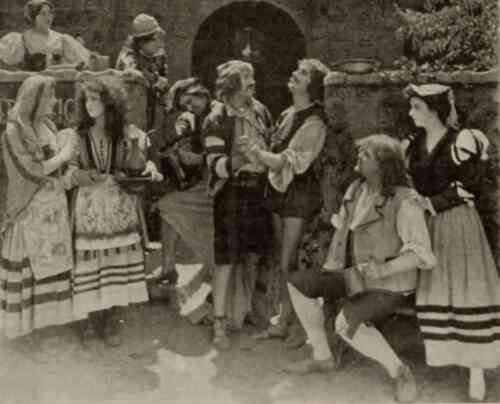
Compare this with The Goddess (1934), where Ruan Lingyu’s sex-worker also suffers under patriarchal gears, yet the camera lingers on her martyrdom with a devotional languor that borders on fetish. Weber will have none of that piety. She keeps Fenella’s body in motion—running, leaping, sword-fighting with a marlin spike—so that voyeurism never calcifies into iconography.
Scholars love to read Vesuvius as phallus, but Weber stages it as archive: a magma-womb preserving petrified bodies of previous failed revolts. When Fenella plunges into the crater, she is not merely killing herself; she is uploading her biometric grief into the geological drive—a cloud backup of insurrectionary memory. The cut to black is not sentimental; it is administrative. The next revolution will download her template, just as the 1647 revolt of Masaniello (barely alluded to in the intertitles) once downloaded its own from the lava-etched footprints of Greek slaves.
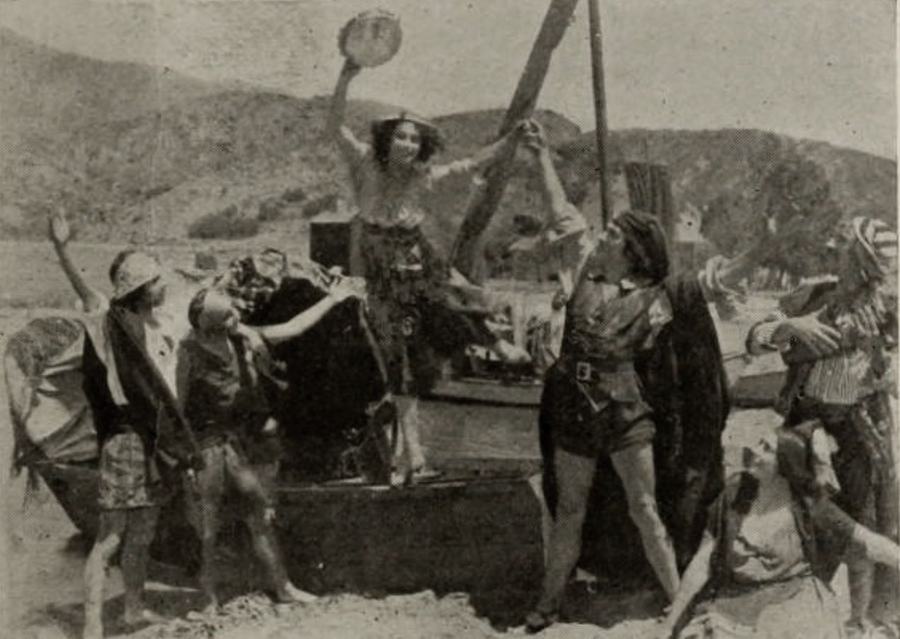
At the 1916 premiere, the Strand Theatre employed a forty-piece orchestra trilling Auber’s martial motifs. Yet Weber privately urged regional exhibitors to substitute Neapolitan folk percussion—tambourines, ciaramelle, the grating putipù—to remind audiences that every revolution has a neighborhood rhythm. Modern screenings often resort to saccharine piano rags. Seek out the National Film Archive’s touring print accompanied by the folk collective Tammurrianti; their rattling castanets transform the climactic eruption into a palpable audio-quake, the auditorium seats vibrating like the benches of a speeding funicular.
Released two months before the Irish Easter Rising, the film played in Dublin under the title Fenella’s Silence. Police reports noted that nationalist groups applauded the print’s final reel so thunderously that projectionists rewound it twice. A week later, the Rising erupted. Coincidence? Perhaps. But cinema has always functioned as rehearsal space for insurrectionary muscle memory. Compare Seven Civil War (1915), whose battlefield panoramas aestheticized carnage into topographical abstraction; Weber instead provides an insurgency handbook disguised as tragic opera.
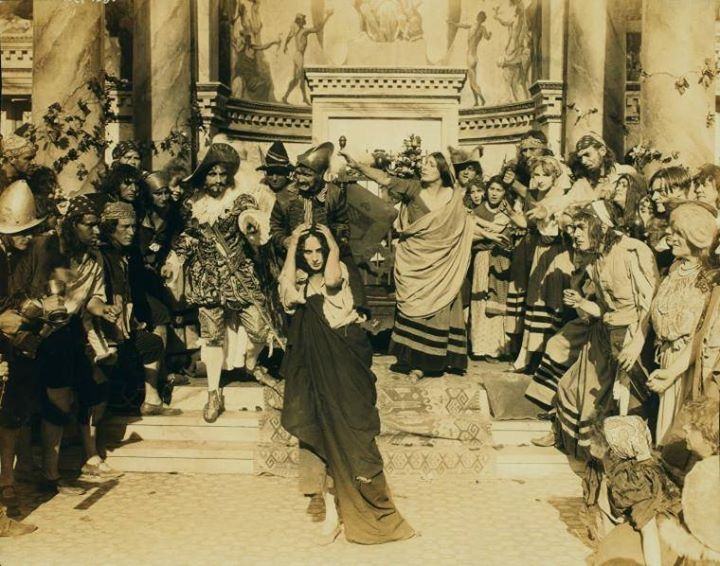
The 2023 restoration scanned the original camera negative at 8K, then down-sampled to 4K to tame the grain without plasticizing pores. Of particular joy is the recovery of the lavender tint for the fisher-funeral scene—previously misread as standard blue. Lavender, a hue historically associated with queer mourning, reframes Fenella’s grief as solidarity with every ostracized body. In the same reel, a hairline scratch on the negative—running diagonally for exactly 47 frames—was retained rather than digitally erased. It looks like a lightning bolt cleaving the emulsion: a wound that insists on the materiality
Rupert Julian reportedly begged Weber for permission to over-act, citing the “grand style” of the Paris Opéra. Weber handed him a pebble and instructed him to “let the camera listen to the stone.” The result is a performance of minimal gesture—eyebrow lifted no higher than a silk thread—whose restraint feels almost Method avant-la-lettre. Contrast this with William Wolbert’s Masaniello, a furnace of operatic gesticulation. Their shared frames become dialectical: stillness vs. kinesis, aristocracy vs. proletariat, cinema vs. theatre. The tension is never resolved; it merely combusts.
Ohio’s censor board excised the suicide, demanding a title card that claimed Fenella was “rescued by angels.” Weber shot the alternate ending in a single afternoon: Fenella swept aloft by superimposed cherubs while Alphonse renounces his title. Preview audiences jeered. Prints shipped to South America appended a third ending—Fenella surviving, marrying, and opening an orphanage—rendering the narrative a Schrödinger’s cat of revolutionary possibility. Collectors prize the Brazilian print for its heretical optimism, yet the true film dies with Fenella’s leap; everything else is colonial appeasement.
Weber’s subsequent Hypocrites (1915) and Where Are My Children? (1916) get taught in gender-studies seminars, yet Portici is relegated to footnotes on Pavlova. This is willful amnesia. The film anticipates Life Without Soul (1915)’s existential dread, The Broken Law (1915)’s moral ambiguity, even the eco-apocalyptic undertow of The Luck of Roaring Camp (1914). Its DNA strands coil through Battleship Potemkin’s Odessa steps, through La Passion de Jeanne d’Arc’s facial abstractions, through every modern blockbuster that dares equate personal rupture with civic cataclysm.
Do not binge this on a phone. Secure a projector, a white wall, and at least one friend who can read Italian so the fleeting signage in the background—“Vendesi mulo, offerete voi”—can be translated aloud. Program a double bill with Niños en la alameda (1931) to trace how childhood innocence migrates across geographies of repression. Provide wine from Campania, but serve it in ceramic mugs: a tactile reminder that beauty and squalor share the same clay.
When the lights come up, you will want to speak. Don’t. Sit in the hush that Fenella bequeaths—a silence vibrating with every revolution that never happened, every kiss that never dared, every volcano still grumbling beneath our courteous sidewalks. Weber’s film is not a relic; it is a loaded musket left on the seat beside you. The only question is whether you will bite the cartridge, or pretend you never saw the powder flash.

IMDb 6
1931
Community
Log in to comment.