DbcultAccessing Vault...
6.7/10
Senior Film Conservator
A definitive 6.7/10 rating for a film that redefined the boundaries of cult cinema. The Golden Pince-Nez remains a cornerstone of transgressive art.
There is a moment, roughly midway through The Golden Pince-Nez, when Holmes lifts the eponymous spectacles toward the camera and the gold rim catches the arc-light in such a way that the lens flares into a miniature solar eclipse. For two heartbeats the frame is swallowed by a white-hot corona; then the image subsides, leaving only the thin metallic crescent and the detective’s hooded eyes. In that micro-eclipse lies the entire philosophy of this 1922 Stoll short: knowledge as annihilating illumination, identity as negative space.
Stoll’s adaptation—number seventeen in their Adventures of Sherlock Holmes series—arrives like a moth-eaten love letter to Edwardian paranoia. Director Geoffrey Malins, better known for wartime documentaries such as Britain Prepared, here trades artillery shells for the quieter ordnance of repression. The result is a chamber piece shot through with battlefield residue: every drawing-room conversation feels court-martialed, every glance a potential execution.
Pince-nez are inherently uncanny: they clamp the human face like a surgical vise, bridging the gap between jewelry and prosthesis. To lose them is to be exiled from one’s own sight. Conan Doyle intuited this; Malins visualizes it. When the murdered amanuensis Willoughby Smith is discovered, his palm still curled protectively around the stranger’s spectacles, the gesture reads less like a clue than a posthumous confession: I finally saw, and it killed me.
Eille Norwood, gaunt as a El Greco saint, lets his Holmes glide across this moral astigmatism with surgical detachment. Where Pep or Testimony rely on kinetic bravado, Norwood weaponizes stillness. Watch him in the library of Yoxley Old Place: he doesn’t interrogate the maid so much as allow silence to do the interrogating, his fingers drumming a barely audible morse on the mahogany tabletop until the girl’s composure fractures like over-iced crystal.
Cinematographer René Guissart renders the Sussex countryside as a bruised watercolor: slate skies, umber hedgerows, the occasional sulfuric splash of a lantern. Interiors are painted in nocturnal indigos, relieved only by the sulfurous flare of matches or the citrine glow of Holmes’s night-lamp. The palette is so self-consciously chiaroscuro that when the flashback to Russia arrives—rendered through a sepia iris—it feels like an intruder from another century, a memory bleeding through parchment.
Compare this chromatic austerity to the candy-striped frivolity of Fair and Warmer or the prismatic ethnography of The Daughter of Dawn. Malins refuses exoticism; even the Russian episode is staged like a provincial pageant, its snow-covered dacha claustrophobic rather than expansive. The world, the film insists, is always smaller than the crime it contains.
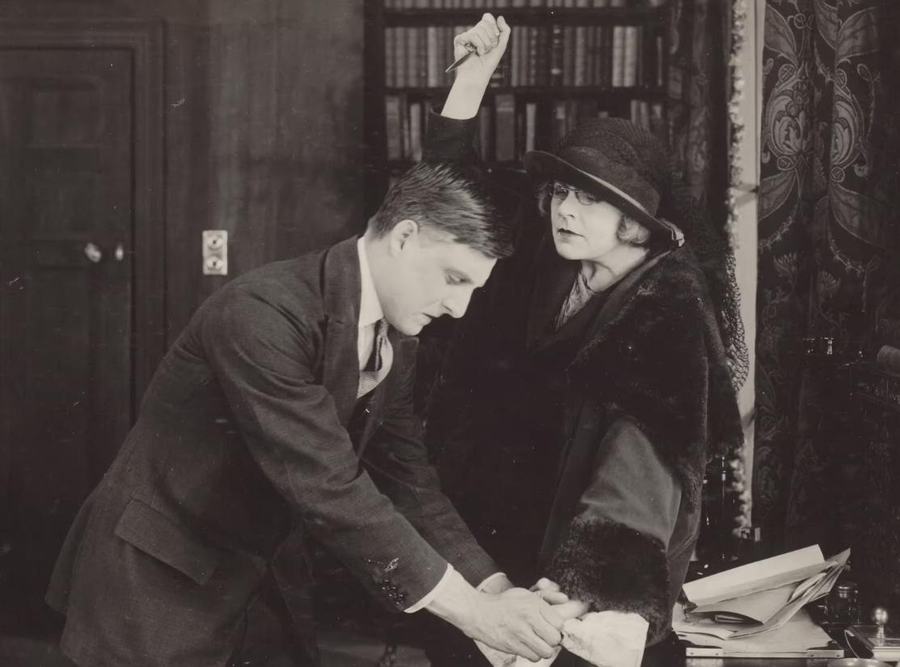
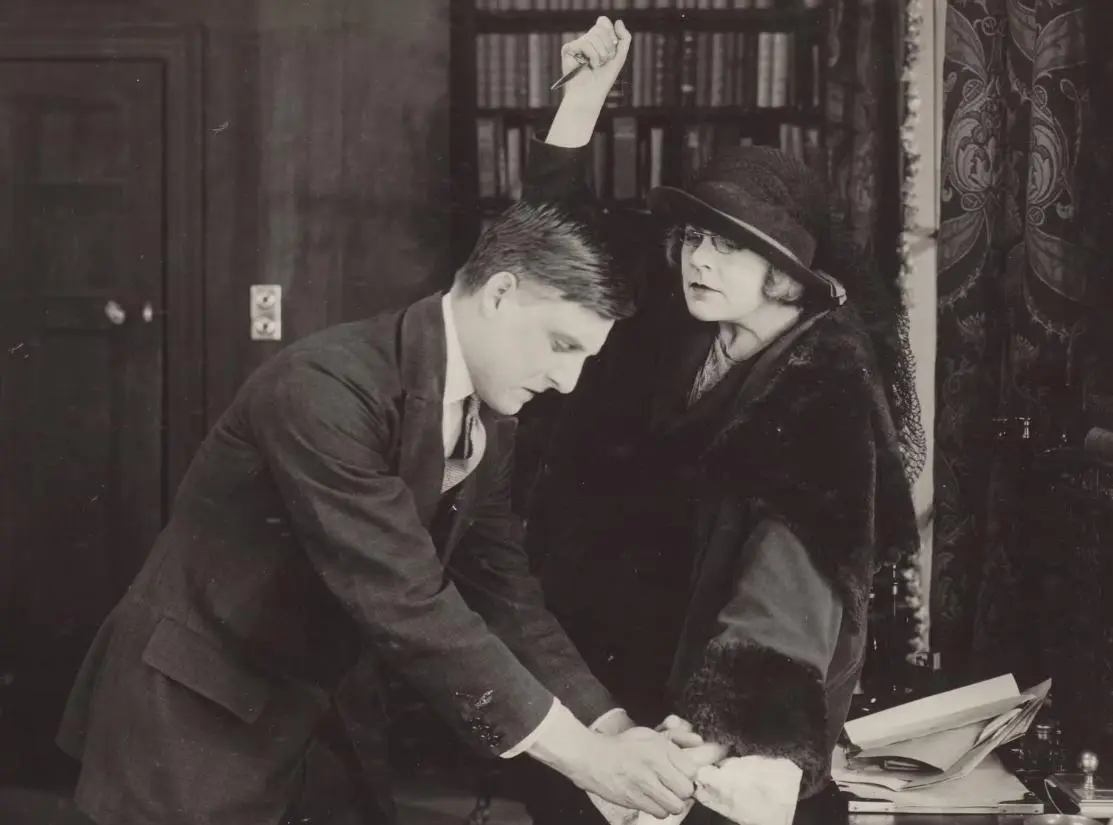
Norma Whalley’s Professor Coram—billed obliquely as “The Professor’s Wife”—delivers a masterclass in Victorian masquerade. She enters swaddled in black bombazine, voice pitched low, shoulders angled like a chess piece poised to fork queen and king. The script trims Conan Doyle’s backstory (no philanthropic Anna, no bigamous scandal) but compensates by turning every frame into a slow-motion striptease of identity. When she finally removes the pince-nez in close-up, the gesture is less an unmasking than a divestment of skin; the lenses fog with her breath, momentarily erasing her eyes and, by extension, her culpability.
This is 1922, only four years after British women over thirty won the vote, and the film vibrates with a society negotiating the terror of female intellect. Coram’s crime is not murder; it is authorship. She has authored a narrative—an academic treatise, a clandestine love affair, a revenge plot—thereby usurping the masculine prerogative of creation. Holmes’s ultimate act is not justice but bibliography: he consigns her story to silence, sealing the manuscript inside the same black-edged envelope that once contained the Tsar’s clemency.
Because the film is silent, the spectator becomes an accomplice in ventriloquism. When Smith gasps “The professor—it was she,” we hear it as an internal echo, a subvocal tremor that reverberates inside the skull. Malins amplifies this by cutting to an extreme close-up of the victim’s mouth, lips parted in a rictus that resembles both orgasm and apostasy. The absence of synchronized sound paradoxically hyper-sensitizes us to acoustics: the scratch of nib on paper, the moist click of the pince-nez spring, the susurrus of taffeta as Coram glides across the threshing-floor.
Contemporary audiences, jaded by Dolby Atmos, may find this speculative soundtrack quaint. Yet compare it to the deliberate silence that punctuates Åh, i morron kväll—there, silence is existential; here, it is forensic. One senses that every hush has been storyboarded with the precision of a bomb-disposal manual.
Hubert Willis essays a Watson so unobtrusive he risks vanishing into the wainscoting. Where Norwood’s Holmes is all blades and angles, Willis is upholstery—soft, dependable, resolutely un-dramatic. Critics often dismiss this iteration as superfluous, yet the performance serves a strategic function: Watson’s bland decency throws into relief the detective’s moral chloroform. Watch the pair ascend the spiral staircase to Coram’s study—Holmes two steps ahead, Watson puffing slightly, hand brushing the banister as though steadying both body and conscience. The moment lasts three seconds, but it encapsulates the entire epistemological chasm between them: one man climbs toward truth, the other toward comprehension.
At 26 minutes, the film is a masterclass in narrative compression. Transitions are effected through match cuts on circular motifs: the pince-nez lenses dissolve into the twin barrels of a revolver; the smudge of ink on a letter becomes the bruise under Smith’s eye. Such visual rhymes suggest a universe governed by malignant pattern, a cabalistic crossword where every answer spawns a fresh clue.
This editorial philosophy anticipates by a decade the Soviet montage of Jesse James Under the Black Flag, though Malins’s purpose is not agitprop but ontological vertigo. The faster the images collide, the more porous reality becomes; by the time the final intertitle arrives—“The tragedy of intellect is that it outlives the heart”—the spectator has been intellectually checkmated.
Seen today, the film flickers like a palimpsest onto which a century of gender theory, post-colonial critique, and surveillance studies has been grafted. The Russian manuscript—never fully translated—becomes a MacGuffin of displaced nationalism, a Tsarist relic haunting a post-Versailles Europe. The pince-nez themselves, mass-produced in Birmingham factories, embody the paradox of colonial modernity: an object both bespoke and ubiquitous, intimate yet anonymously industrial.
Cinephiles will detect pre-echoes of The Waxen Doll and The Tiger Man, where spectacles operate as fetish objects. Yet whereas those films eroticize eyewear, Pince-Nez medicalizes it: to see too clearly is to diagnose one’s own annihilation.
Restored by the BFI in 4K from a 35mm nitrate print, the film now circulates on niche streaming platforms where it is binge-watched between TikTok skits and ASMR unboxings. Such re-contextualization would have appalled Norwood, who believed the cinema screen should be “a window into the soul, not a mirror for the mob.” Yet perhaps this is the final, ironic twist: the pince-nez, designed to correct myopia, has itself become a lens through which a myopic century peers back at its own blind spots.
So the next time you find yourself scrolling at 2 a.m., algorithmic ennui gnawing at your synapses, give yourself twenty-six minutes with this brittle, brilliant relic. Let the gold rim flare into eclipse. Let the final intertitle linger like a diagnosis. And when the screen cuts to black, notice how your own reflection—trapped between the device’s gloss and the room’s darkness—looks suddenly, uncannily, like a silhouette wearing pince-nez that do not belong to you.

IMDb 6.1
1933
Community
Log in to comment.