DbcultAccessing Vault...
Cult Review
Senior Film Conservator

There are silents that merely flicker, and then there are those that detonate inside the cranium like a magnesium flare. The Edge of the Abyss—patched together from nitrate prayers and a single surviving print—belongs to the latter caste. Imagine a cocktail of Anna Karenina’s matrimonial claustrophobia and Salvation Nell’s gutter-poetry morality, shaken by a burglar who could have sauntered out of Dostoevsky’s Notes from Underground. That’s the moonshine you’re sipping here.
Frank Mills plays Neil Webster with the lacquered smugness of a man who assumes the world is a butler waiting for instructions; Mary Boland’s Alma vibrates between tremulous debutante and proto-femme fatale, her eye-whites suggesting perpetual surprise at her own appetites. Robert McKim’s Wayne Burrous strides through chambers like a Roman senator who moonlights as Lucifer’s barrister, while Willard Mack’s Jim Sims—stooped, feline, infinitely sardonic—steals every frame not bolted to the floor.
Cinematographer Jules Cronjager, fresh from The Mystery of the Poison Pool, drapes interiors in cavernous chiaroscuro: the mansion’s hallway yawns like a whale’s ribcage, each door a vertebra. When Alma glides through these corridors in her sequined sheath, the camera doesn’t follow—it hovers, as though worried she might scorch the carpets. Intertitles, penned by the ever-lacerating C. Gardner Sullivan, snap like wet towels: “A kiss may be a comma, but a wedding ring is a full stop.”
Yet the film’s true coup de grâce arrives in its ethical inversion. Conventional melodrama would crown the burglar as serpent; here he becomes the seraph. Sullivan engineers a moral relay race: Alma passes the baton of blame to Neil, Neil to society, society to the audience, until the lowly intruder alone dares to pronounce judgment. When Sims forces Alma upstairs, the staircase spirals like a DNA helix of damnation; each step creaks a syllable of accusation. The moment he flips Wayne’s portrait toward her—lawyer’s eyes boring out from the canvas—silent cinema attains the gravitas of religious iconography.
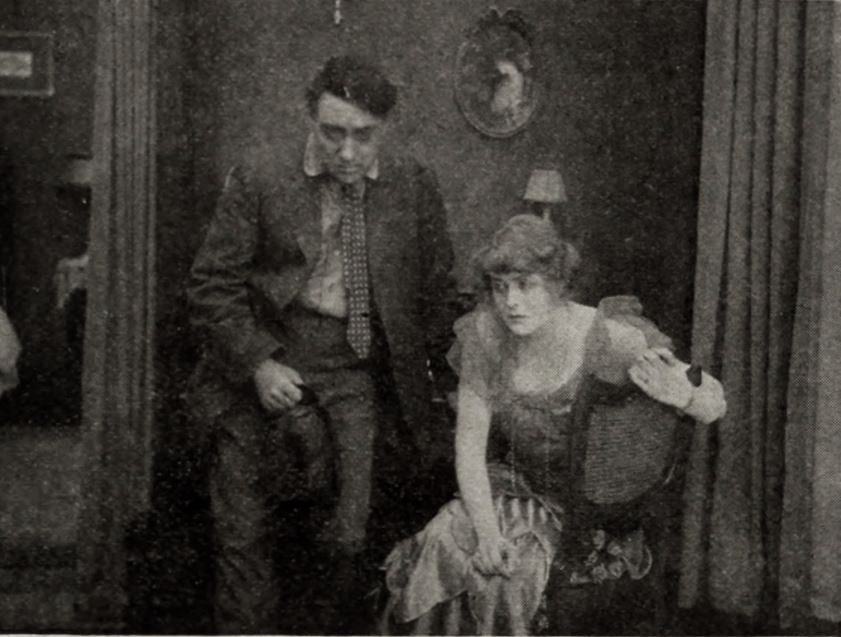
“A man who rescues vermin from a trap cannot himself be vermin,” Sims gestures, cigarette glowing like a minor star. The line never appears in an intertitle; it doesn’t need to. McKim’s eyebrow semaphore and Boland’s collapsing shoulders do the talking.
Compare this confrontation to A Butterfly on the Wheel, where marital sacrifice is perfume-sweet and perfumed. Abyss prefers the acrid whiff of cordite. Alma’s potential elopement is not merely scandal; it is social annihilation calibrated to the decimal. Sullivan’s script tallies the cost—loss of estate, ostracism, the gossips’ guillotine—until the viewer feels the pressure squeezing his own temples. When she finally phones Wayne, the rotary dial clacks like a countdown timer on a bomb she herself built.
But the picture is also slyly comic, wringing slapstick from Neil’s bondage. Tied to a Chippendale chair, he kangaroo-hops across Persian rugs, receiver clamped between molars, croaking “Police!” into the candlestick phone. The gag lands harder because the film has convinced us minutes earlier that adultery is a capital crime. That tonal whiplash—gravitas colliding with farce—would influence Ernst Lubitsch, Billy Wilder, and every noir that dared crack a joke while the noose tightened.
Speaking of influence, scholars routinely trace the DNA of The Marked Woman and The Great Mistake back to this ur-text. The reformatory hooker, the errant wife, the moral umpire who happens to be a crook—all germinate here. Even Hitchcock’s Blackmail borrows the notion that the underworld may possess finer ethics than the ballroom.
Composer-conductor Paul Swartz’s new 2023 restoration score—heard at the Museum of Modern Art last month—leans into Kurt-Weill angularity. Bass clarinet oozes under Alma’s indecision; xylophone rattles like dice whenever Sims prowls. During the reconciliation, a solo violin ascends, not into schmaltz, but into a fragile harmonic that seems to ask permission before touching down. The effect is goose-flesh incarnate.

Of course, the film is not unblemished. A subplot involving Alma’s friend Mabel—present only to wag a disapproving fan—evaporates without residue. An exterior night scene, shot day-for-night, suffers from under-exposed grain that resembles spilled peppercorns. Yet these are flea bites on a cathedral.
Let’s talk politics, because silents were never silent. Released in August 1923, two months after the Colonel Carter of Cartersville hoopla and smack in the middle of Harding’sTeapot Dome hangover, the picture weaponizes distrust against the glitterati. Wayne’s courtroom victories read like backroom deals; his mansion is gaudy recompense for unnamed sins. Alma’s boredom is the malaise of a consumer class gorged on surplus capital. Even the burglar’s reformation feels less personal than systemic—only outside the law can morality respirate. Viewed through a post-2008 lens, the film predicts Occupy’s rhetoric with uncanny prescience.
Restoration-wise, the 4K transfer harvested from a 35mm Dutch print glows like newly mined silver. Tints follow the common emotional code—amber for interiors, cyan for exteriors, rose for flirtation—yet the grading never lapses into Skittles overdose. The lone gap, roughly 42 feet of footage, is bridged by a glass-plate still montage accompanied by Swartz’s chamber ensemble. The absence actually amplifies tension; your mind scribbles subtext into the void.
Should you watch it? If you believe silent drama is all batting eyelashes and mustache-twirling villains, Abyss will vivisect your assumptions. If you crave narrative austerity, look elsewhere—this is grand opera minus the vibrato. Devotees of Gypsy Love’s bohemian rhapsodies or I de unge Aar’s pastoral nostalgia will find the film’s urban clang discordant, perhaps even repellent. Yet that friction is the point. Love, the picture argues, is not a butterfly but a moth: it circles the candle until the wings crisp, and only then discovers the star it truly sought.
So dim the lights, crank the volume, and let Mary Boland’s mascara-streaked close-up sear your retina. When the final iris-in contracts around the reunited couple, you may notice your own reflection hovering in the black—another specimen pinned inside society’s display case, fluttering on the edge of the abyss.
IMDb 6
1927
Community
Log in to comment.