DbcultAccessing Vault...
Cult Review
Senior Film Conservator
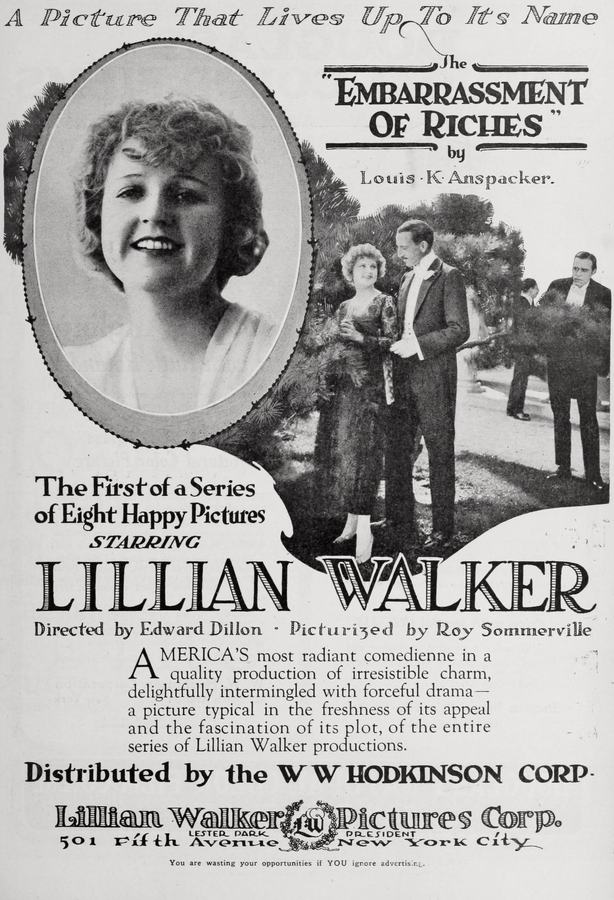
In the sprawling panorama of early 20th-century cinema, few narratives capture the intricate dance between social strata and personal authenticity with the compelling gravitas of The Embarrassment of Riches. This cinematic endeavor, a poignant exploration penned by the astute minds of Louis K. Anspacher and Roy Somerville, transcends mere melodrama to offer a trenchant critique of societal expectations, the intoxicating allure of wealth, and the enduring power of genuine affection. It is a film that, even decades removed from its original exhibition, resonates with a timeless relevance, prompting viewers to ponder the true cost of identity in a world obsessed with appearances. Its narrative sophistication and thematic depth position it as a significant work, compelling audiences to look beyond superficial charm and delve into the more profound human condition.
At its heart, The Embarrassment of Riches unfurls the remarkable transformation of Lizzie Holt, portrayed with nuanced vulnerability by Reeva Greenwood. We first encounter Lizzie amidst the relentless din and suffocating confines of a New York sweatshop, a setting vividly rendered to underscore the stark realities faced by the working class. Her existence is one defined by arduous labor, meager recompense, and the ever-present specter of poverty. The film unflinchingly depicts the grim, almost dehumanizing conditions of this environment, where individual aspirations are often crushed under the weight of ceaseless toil. This initial depiction serves as a powerful socio-economic baseline, grounding the audience in the harsh realities from which her dramatic ascent will spring. It’s a world away from the genteel drawing-rooms often depicted in contemporary films, aligning more closely with the stark realism found in works like The Eternal Grind, which similarly cast a critical eye on industrial hardship and the plight of the urban poor.
The catalyst for her metamorphosis arrives not through diligent effort or revolutionary zeal, but through the capricious hand of fate: an unexpected inheritance. This sudden windfall catapults Lizzie from the grimy anonymity of the sweatshop floor into the rarefied air of high society, reinventing her as the distinguished Miss Elizabeth Holt. Greenwood’s portrayal of this transition is particularly noteworthy, capturing not just the superficial changes in attire and demeanor, but the profound internal struggle of a woman navigating an entirely alien landscape. The initial novelty of her newfound status soon dissipates, however, giving way to a profound disillusionment. The glittering facades of the elite conceal a vacuity, a shallowness that repels Elizabeth's innate sense of purpose. She finds herself trapped in a world of idle chatter, ostentatious displays, and a pervasive lack of genuine connection, a stark contrast to the raw, albeit harsh, authenticity of her former life. This internal conflict is exquisitely handled, preventing her transformation from becoming a mere Cinderella story and instead imbuing it with a deeper, psychological resonance. She discovers that riches, far from being a panacea, can be an isolating burden, an "embarrassment" in the truest sense of the word, highlighting the film's central thematic paradox.
Driven by an unshakeable moral compass and an inability to reconcile herself with the superficiality of her new milieu, Elizabeth seeks a more meaningful existence. Her journey leads her to a settlement house on the lower East Side, a bastion of social reform and humanitarian effort. This pivot is crucial, marking Elizabeth's active rejection of passive wealth and her embrace of social responsibility. It's a powerful statement about agency and purpose, echoing the spirit of other strong female characters grappling with societal expectations, perhaps even finding a distant kinship with the moral fortitude exhibited in A Law Unto Herself. Here, amidst the genuine struggles and triumphs of the underprivileged, Elizabeth finds a resonance that the grand ballrooms could never provide. This setting allows the film to deftly weave in threads of social commentary, highlighting the vast disparities between the opulent uptown and the struggling downtown, and questioning the true value of philanthropy when divorced from genuine understanding.
It is within the bustling, earnest environment of the settlement house that Elizabeth encounters John Russell, played with compelling conviction by Carlton Brickert. Russell is depicted as the quintessential idealist, a man whose principles are as unyielding as his disdain for the wealthy elite. His character serves as a moral counterpoint to the perceived decadence of the upper classes, embodying the very virtues – integrity, empathy, and a commitment to justice – that Elizabeth secretly yearns to uphold. The burgeoning romance between them is fraught with an inherent tension, a delicious dramatic irony, as Elizabeth finds herself deeply attracted to a man who, unknowingly, despises everything her newfound identity represents. Brickert delivers a performance that perfectly captures the earnest, sometimes rigid, idealism of a man committed to societal betterment, making his eventual conflict all the more impactful.
To circumvent John’s ingrained prejudice and to protect the nascent tenderness of their relationship, Elizabeth makes a pivotal, and ultimately precarious, decision: she identifies herself as Miss Holt's secretary. This act of deception, born of necessity and a desire to be loved for her true self rather than her fortune, establishes the central dramatic conflict of the film. It's a classic trope, yet handled here with an earnestness that elevates it beyond cliché. The audience is privy to Elizabeth's internal anguish, her constant tightrope walk between her two identities, and the fear of exposure that perpetually hovers over her. This narrative device allows the film to explore themes of authenticity and the societal constructs that often dictate personal value, forcing Elizabeth to confront her own definitions of self-worth and genuine connection.
The plot thickens with John Russell's unwavering commitment to civic improvement. His latest crusade targets ward boss Ted Phelan's illicit gambling house, a den of vice strategically located next door to the very settlement house where Elizabeth dedicates her time. Edward Keenan, as Ted Phelan, imbues the character with a cynical charm that perfectly encapsulates the corrupt underbelly of urban politics, a theme not dissimilar to the political machinations explored in The Senator. Phelan is not merely a villain but a product of his environment, a man who understands the levers of power and influence in a city grappling with rapid growth and social stratification. John's tireless efforts culminate in a dramatic raid, a sequence executed with commendable tension, leading to the successful closure of the establishment. This moment is a triumph for John, a vindication of his idealism, and a testament to his unwavering commitment to justice.
However, fate, in its cruelest irony, chooses this very moment to unravel Elizabeth’s carefully constructed masquerade. During the raid, several of Elizabeth's erstwhile acquaintances from her "slumming party" – a misguided excursion by the privileged into the perceived exoticism of poverty, a particularly egregious example of societal hypocrisy – find themselves caught in the dragnet. In their panic, these socialites, including characters portrayed by Lillian Walker and Harriet Ross, turn to Elizabeth, the supposed "secretary," for aid, inadvertently exposing her true identity to a stunned John Russell. The scene is a masterclass in dramatic revelation, the emotional impact palpable as John's idealism clashes violently with the reality of Elizabeth's deception. The performances here, particularly by Brickert and Greenwood, convey the raw shock and betrayal that threaten to shatter their burgeoning love. It's a moment of profound vulnerability and crisis, a test of character for both protagonists, forcing them to confront not only each other but also their own deeply held beliefs and prejudices.
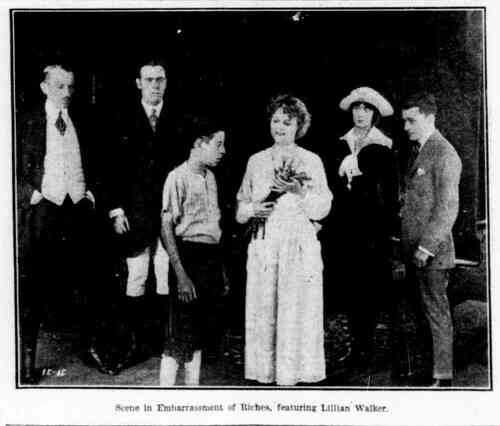
The aftermath of the revelation is a period of intense emotional turmoil. John, confronted with the perceived hypocrisy of Elizabeth, is on the precipice of abandoning their future together. His deeply held convictions about the corrupting influence of wealth make it almost impossible for him to reconcile the compassionate woman he loves with the heiress he despises. This internal conflict is the film's most potent exploration of prejudice, demonstrating how even an idealist can be blinded by preconceived notions, allowing class bias to overshadow genuine affection. The film doesn't shy away from the pain of this moment, showcasing the genuine heartbreak and confusion that envelops both characters as they grapple with the chasm that has suddenly opened between them.
Yet, it is in this crucible of doubt that Elizabeth's true character shines brightest. With eloquent sincerity and an unwavering gaze, she confronts John, not with excuses, but with an earnest declaration of her love and a profound articulation of her genuine self. She argues that her actions, far from being a calculated deceit, were born of a desire to connect with him on a level unburdened by the superficiality of her inherited status. Her love, she asserts, is authentic, untainted by the "embarrassment of riches" that initially defined her. This pivotal scene, rendered with powerful emotional clarity by Greenwood, is the emotional anchor of the film, a testament to the power of communication and the willingness to see beyond surface-level judgments. It echoes the transformative power of love and self-discovery found in films like Princess Virtue, where characters shed societal roles to embrace their true selves, proving that genuine affection can indeed bridge the widest social divides.
Beyond the compelling narrative, The Embarrassment of Riches benefits immensely from its robust cast and the keen eye of its direction. Reeva Greenwood, as Elizabeth Holt, delivers a performance of remarkable depth, navigating the character's journey from a humble worker to a conflicted heiress with grace and conviction. Her ability to convey both vulnerability and inner strength, often simultaneously, is crucial to the film’s success, making Elizabeth a relatable and admirable protagonist. Carlton Brickert, as John Russell, provides a strong, principled counterpart, his idealism never veering into caricature, but always feeling grounded in a genuine moral compass. The chemistry between Greenwood and Brickert is understated yet potent, allowing their emotional journey to feel earned and believable, drawing the audience deeply into their romantic plight.
The supporting cast further enriches the tapestry of the film. Edward Keenan's portrayal of Ted Phelan is a standout, providing a necessary antagonist whose corruption feels less like pure evil and more like a pragmatic, if morally bankrupt, approach to survival within the urban landscape. His performance adds a layer of gritty realism to the film's social commentary. The contributions of John Costello, Lillian Walker, Harriet Ross, Howard Truesdale, Edward Roseman, Peggy Lundeen, Henry Sedley, John T. Dillon, and William Sloan all contribute solid performances, each adding texture to the vibrant social ecosystem depicted. The ensemble work ensures that the world of the film feels lived-in and authentic, whether in the opulence of the drawing-rooms or the grit of the settlement house, creating a rich backdrop for the central drama.
The screenwriters, Louis K. Anspacher and Roy Somerville, deserve commendation for crafting a narrative that is both entertaining and profoundly thought-provoking. They skillfully balance the romantic elements with biting social commentary, avoiding simplistic resolutions and instead opting for a more nuanced exploration of class and identity. Their script allows for moments of genuine introspection and emotional weight, preventing the film from descending into mere spectacle. The thematic depth here is comparable to the nuanced societal critiques found in films such as Common Ground, which similarly grappled with the complex interplay of human relationships against a backdrop of stark social divisions, underscoring the universal nature of these themes.
The Embarrassment of Riches is more than just a period romance; it is a powerful indictment of the superficiality of inherited wealth and a vibrant celebration of genuine character. The film masterfully dissects the societal hypocrisy that often judges individuals by their fortunes rather than their moral fiber. It challenges the audience to look beyond outward appearances and to value sincerity, empathy, and social conscience above all else. This message remains remarkably potent, perhaps even more so in an era where social media often amplifies the performative aspects of identity, making the film's call for authenticity resonate deeply across generations. It suggests that true societal progress hinges not on the accumulation of wealth, but on the cultivation of empathy and understanding between disparate groups.
The film’s exploration of a woman navigating vastly different social worlds, striving to maintain her integrity, offers a compelling prototype for countless narratives that would follow. Elizabeth’s journey is one of self-discovery and moral clarity, a testament to the idea that true worth is not measured by the size of one’s inheritance, but by the depth of one’s character and the commitment to one’s ideals. Her choice to dedicate herself to the settlement house, even when it risks her romantic prospects, speaks volumes about her inner strength and conviction. It’s a journey of self-actualization that resonates strongly with characters in films like Dulcie's Adventure, where personal growth is intricately tied to navigating new environments and challenges, often forcing protagonists to redefine their place in the world.
In conclusion, The Embarrassment of Riches stands as a significant cinematic achievement, a film that deftly combines romantic drama with incisive social commentary. Its narrative arc, propelled by strong performances and intelligent writing, explores the enduring tension between wealth and virtue, perception and reality, and the profound journey towards authentic selfhood. It’s a film that reminds us that while riches can open doors, true fulfillment lies in the courage to live by one’s convictions and the capacity to love without prejudice. Its enduring legacy lies not just in its engaging plot, but in its timeless examination of what truly constitutes a rich life, urging viewers to consider the moral currency of their own existence and the societal structures that often obscure it. The nuanced portrayal of class dynamics and personal integrity ensures its place as a thought-provoking classic.
IMDb —
1928
Community
Log in to comment.