DbcultAccessing Vault...
Cult Review
Senior Film Conservator
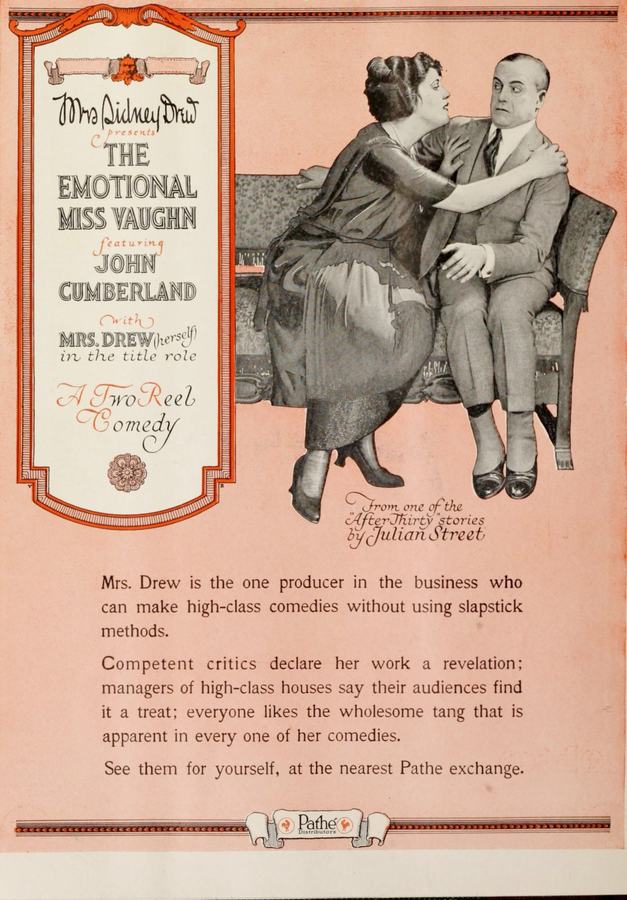
To witness The Emotional Miss Vaughn (1917) is to step into a meticulously crafted vacuum of early 20th-century social anxieties. At its core, the film is not merely a situational comedy but a sharp-witted dissection of the male gaze and the performative nature of the 'New Woman.' Directed and written by the formidable Mrs. Sidney Drew, who also stars as the eponymous actress, the film serves as a cautionary tale for the bored bourgeois husband, represented with a delightful, bumbling pathos by John Cumberland. The narrative trajectory—a man seeking escape from the perceived stagnation of his domestic life only to be terrified by the radical reality of his fantasies—is a recurring trope in the Drews' filmography, yet it finds a particularly acidic expression here.
The cinematic landscape of 1917 was a crucible of shifting moralities. While films like The Spindle of Life explored the rigid stratifications of class, and Inside the Lines dealt with the external pressures of global espionage, the Drews focused their lens inward. They were the masters of the 'polite comedy,' a subgenre that scrutinized the middle-class drawing room with the precision of an entomologist. In The Emotional Miss Vaughn, the conflict arises from the collision between Jimmie’s sentimentalized memory of a former sweetheart and the formidable, professional reality of what that woman has become: an actress of the 'emoting' school.
The brilliance of the screenplay, co-written by Julian Street and Tom Bret, lies in its use of the 'play within a play' mechanic. When Jimmie approaches Miss Vaughn, he is looking for a romanticized relic of his youth. Instead, he encounters a woman who has mastered the art of emotional manipulation for the stage. Her decision to 'cure' him by reciprocating his advances is a stroke of psychological genius. She doesn't just offer him love; she offers him a suffocating, radical, and highly theatrical version of it. By reciting her lines from a contemporary play—saturated with 'free love' doctrines—she transforms the quiet intimacy Jimmie craves into a loud, ideological battleground.
This 'free love' element is particularly fascinating when viewed through a historical lens. In 1917, the concept was a genuine cultural flashpoint, often associated with the anarchist and feminist movements of Greenwich Village. By having Miss Vaughn weaponize this rhetoric, the film satirizes the conservative fear of the 'unbound' woman. Jimmie isn't just afraid of the emotional intensity; he is terrified by the dissolution of the social structures that protect his comfortable, patriarchal existence. The moment he realizes that being with Miss Vaughn means abandoning the safety of his 'wife and babies' for a world of erratic passion and ideological instability, his infatuation evaporates.
John Cumberland’s performance as Jimmie is a masterclass in physical restraint and facial elasticity. Unlike the broader slapstick of his contemporaries, Cumberland relies on the subtle shift of the eyes and the nervous twitch of the mustache to convey a soul in turmoil. His transition from the smug confidence of a would-be adulterer to the sheer, unadulterated panic of a man who has bitten off more than he can chew is hilarious and remarkably human. One can see echoes of this character type in other films of the era, such as Mules and Mortgages, where the comedy stems from the protagonist's inability to handle the complexity of his environment.
Mrs. Sidney Drew, however, is the true anchor of the piece. Her portrayal of Miss Vaughn is a layered performance of a woman performing. She must convince Jimmie of her sincerity while simultaneously winking at the audience, ensuring we understand the absurdity of her 'emoting.' The theatricality she employs—the sweeping gestures, the dramatic pauses, the intense gaze—is a parody of the very style of acting that was popular in more serious dramas of the time, such as Vengeance Is Mine or the heavy-handed moralism of Seeds of Dishonor.
Technically, The Emotional Miss Vaughn exhibits the characteristic polish of the Drew-V-B-K productions. The interior sets are lush, providing a stark contrast to the psychological chaos unfolding within them. The framing is deliberate, often pinning Jimmie against the corners of the frame as Miss Vaughn dominates the center, visually representing his shrinking agency. While it lacks the sprawling ambition of The Historic Fourth of July in Paris or the pastoral charm of Wee Lady Betty, its intimacy is its greatest strength. It captures the claustrophobia of a domestic crisis with uncanny precision.
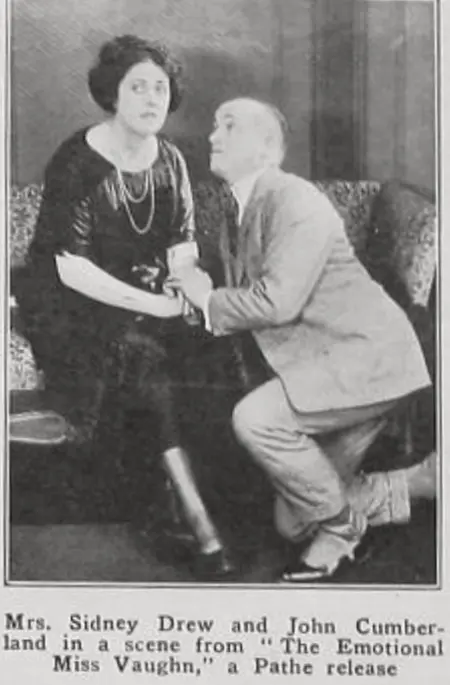
The pacing of the film is relentless. Once Jimmie enters Miss Vaughn's orbit, the narrative accelerates toward its inevitable conclusion. The 'free love' speech is the film's centerpiece—a dizzying monologue that, even in the silent format, feels audible through its sheer visual energy. The intertitles are sharp and satirical, capturing the high-flown language of the stage and contrasting it with Jimmie’s increasingly frantic internal dialogue. It is a precursor to the screwball comedies of the 1930s, where language becomes a weapon of mass confusion.
Why does a film like this endure in the memory of a cinephile? Perhaps because it touches on a universal truth about the human condition: the grass is always greener until you realize the lawn is on fire. Jimmie’s desire for the 'actress'—the symbol of glamour and emotional freedom—is a rejection of the responsibilities of his own life. Miss Vaughn’s 'cure' is to show him that the glamour is a job, the emotion is a script, and the freedom is a terrifying lack of structure. She forces him to confront the reality that he is, at heart, a man of the status quo.
In the broader context of 1917 cinema, which saw the release of such diverse works as the epic Arizona or the experimental Anniversary of the Revolution, The Emotional Miss Vaughn stands out for its intellectual agility. It doesn't rely on grand spectacles or moralizing sermons. Instead, it uses wit and performance to explore the friction between our public personas and our private selves. It shares a certain DNA with the European sensibilities found in Under Kærlighedens Aag, focusing on the psychological weight of love and social expectation.
The film’s conclusion—Jimmie’s 'hasty retreat'—is both a comedic victory and a poignant commentary on the limitations of his character. He returns to his wife and babies not necessarily because he has rediscovered his love for them, but because he has discovered his fear of anything else. It is a cynical, yet honest, ending that elevates the film above standard moralistic fare. The Drews were never afraid to show the cracks in the bourgeois facade, and here, they do so with a surgical elegance.
In comparison to the more traditional romance of Out of the Drifts or the historical melodrama of An Enemy to the King, The Emotional Miss Vaughn feels remarkably modern. Its skepticism regarding romantic ideals and its understanding of 'identity as performance' anticipate contemporary postmodern themes. Even the whimsical fantasies of Il sogno di Don Chisciotte or the surrealism of Il giardino incantato seem distant from the grounded, sharp-tongued reality of the Drews’ world.
Ultimately, the film is a testament to the creative power of Mrs. Sidney Drew. As a writer, director, and star, she wielded complete control over the narrative, using her platform to satirize the very industry she dominated. The 'Emotional' Miss Vaughn is not just a character; she is a critique of the theatrical tropes of the era. By portraying an actress who uses her talent to manipulate a man into better behavior, Drew flips the script on the 'damsel in distress' or the 'femme fatale.' Miss Vaughn is neither; she is a professional, a strategist, and a woman who knows exactly how to use the 'free love' doctrine to keep her life free of unwanted distractions.
Final Verdict: A sparkling gem of silent comedy. The Emotional Miss Vaughn remains a vital piece of cinema history for its sharp writing, exceptional performances, and its surprisingly modern take on the complexities of desire and domesticity. It is a must-watch for anyone interested in the evolution of the American comedy and the pioneering work of women in early Hollywood.
IMDb 4.9
1924
Community
Log in to comment.