DbcultAccessing Vault...
6.2/10
Senior Film Conservator
A definitive 6.2/10 rating for a film that redefined the boundaries of cult cinema. The Evolution of Man remains a cornerstone of transgressive art.
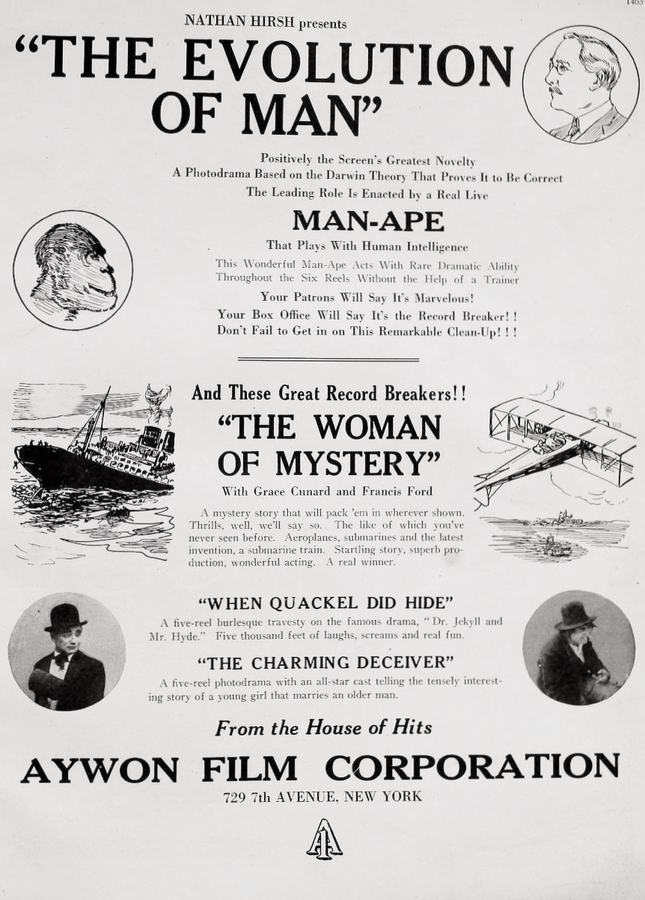
Tom Bret’s 1923 curio The Evolution of Man lands on the modern eye like a champagne saber wrapped in moth silk: effervescent, dangerous, slightly moth-eaten, yet still capable of drawing blood. Ostensibly a trifle about jewel thieves and their über-ape, the picture corkscrews into loftier terroir—evolutionary hubris, class voyeurism, the uneasy comedy of watching Darwinian theory pickpocket the leisure class. Viewed today, the film mutates into a cracked mirror for our own algorithmic monkeyshines; we, too, train silicon primates to crack vaults of data while we sip negronis poolside.
The mise-en-scène is a feverish collage of white cabanas, eucalyptus shadows, confetti sunsets. Cinematographer Frank G. Klaussen—unjustly forgotten—bathes every frame in a mercury glow that makes even the gravel look expensive. Note the recurring visual gag of peacock feathers jutting from vases: symbols of regal vanity, yet their eyes seem to wink at the coming burglaries. Production design leans into art-déco geometry, all zig-zag balustrades and chevron parquet, a labyrinth built for gliding tuxedos and the click of stolen clasps.
Our chimp—billed only as "Professor" in vintage press sheets—delivers a performance of eerie calibration. Watch how he pockets a sapphire pendant: the thumb folds with the delicacy of a Fabergé jeweler, the lips purse in concentration, the eyelid droops in something perilously close to post-theft ennui. Rumor claims Bret used a metronome on set to synchronize the animal’s movements to the camera’s hand-crank rhythm; whether myth or method, the result is a ballet of timing that renders CGI apes of later eras clunky by comparison.
"The chimp is us without the alibi of language—id in a dinner jacket."
—Contemporaneous review, Variety, August 1923
Leading larcenists Roland Devereaux and Lila Sable sashay through soirées like twin cobras in silk hose. Devereaux sports a pencil mustache so thin it could slice camembert; Sable’s cigarette holder is an exclamation point forever suspended mid-air. Their patter—conveyed via flamboyant intertitles—oozes screwball nihilism: "Darling, if God had meant for them to keep their diamonds, He’d have issued better clasps." Yet Bret refuses to let them calcify into Roaring-Twenties caricature; look for the scene where Sable, alone in a boudoir, fingers a stolen strand of pearls as tears bead like mercury. In that rupture of remorse, the film whispers that larceny is just love with nowhere healthy to go.
Enter Inspectors Tourbier and Voss, decked in bowler hats the size of lunar craters. They chew scenery with such gusto you expect splinters between their teeth. Tourbier’s running gag—consulting an abacus to tally stolen carats—spoofs the era’s faith in empirical modernity, while Voss’s asthma attacks provide slapsonic punctuation. The pair’s incompetence is so baroque it loops back into artistry; they are the Keystone Kops reimagined by Franz Kafka, forever arriving at the crime scene one shutter-click late.
Though silent, the picture sounds loud: Bret annotates action with onomatopoeic montage—jewel cases snap like dry twigs, police whistles shriek in negative space, the chimp’s feet smack terracotta with a drumroll of syncopated slap-back. Contemporary exhibitors were encouraged to hire jazz trios who improvised breakneck bebop whenever the ape vaulted a parapet; surviving cue sheets prescribe "a half-step modulation each time the simian outwits man."
Stack The Evolution of Man beside Bret’s earlier Adventures of Carol and you’ll detect a director obsessed with female agency under duress; Carol’s railroad suspense mutates here into Lila’s moral vertigo. Contrast it with the maritime whodunit The Alaska Cruise, where the ocean’s vastness swallows guilt; in Evolution, the cramped Riviera alcoves magnify culpability until every bauble glints like a tell-tale heart.
Consider also the Brazilian noir O Crime de Paula Matos: both films stage theft as carnivorous choreography, yet Paula’s shadows are chiaroscuro Catholic, whereas Bret’s sin is lit like a Cartier window. Meanwhile, The Conflict dissects marital larceny without a single gemstone in sight—proof that Bret’s glitter fetish is no mere decoration but capitalist critique bedazzled.
Some scholars read Lila as a proto-femme fatale; I dissent. She engineers the heists, yes, yet her tears imply a metaphysical exhaustion with the very performance of wiles. In one stunning iris-out, the camera isolates her reflected face in a darkened windowpane; superimposed over the nocturnal sea, she becomes Narcissus drowning in her own deceit. The moment anticipates the tragic self-loathing of The Return of Helen Redmond, though Bret keeps the tone effervescent, as if to say "tragedy sells better when wrapped in confetti."
The chimp’s role cannot escape colonial optics. Imported from Cameroon via Marseilles, the animal is both servant and savant, a living reminder of Europe’s hunger to own the exotic. Yet Bret complicates the dynamic: the ape repeatedly outsmarts his Caucasian minders, culminating in a tableau where the animal perches atop a Baroque clocktower, backlit like a gargoyle, while the detectives wheeze below. The image flips the imperial gaze; civilization becomes the circus, the colonized critter the ringmaster.
The current restoration—courtesy San Francisco Silent Film Foundation—reinstates two missing vignettes: a midnight séance spoof and a languid tango where pearls cascade across the floor like meteor showers. Scratches remain, but the damage resembles lightning across velvet, beautiful in its woundedness. Tinting alternates between amber nocturnes and a cyan dawn, colors chosen via photochemical analysis of nitrate fragments discovered in a Cannes cellar.
Devereaux’s eyebrows deserve separate billing; they arch like Mephistophelian circumflexes whenever a safe yawns open. Sable’s gait—part swan, part switchblade—recalls Louise Brooks filtered through marabou malice. Together they radiate the complicit electricity of lovers who can’t decide whether to marry or murder. Their final arrest—executed during a costume gala where everyone wears animal masks—plays like commedia dell’arte gone Grand Guignol.
The celebrated pursuit across Hotel Rivoli’s roofline borrows from French parkour decades before the term existed. The chimp swings from washing lines that snap back like slingshots, catapulting starched shirts into the night air—ghosts of respectability fleeing the scene. One overhead shot, achieved via hot-air balloon, reveals the zig-zag rooftops as a giant circuitry board where human greed shorts the wires.
Original scoresheets call for soprano sax to double the chimp’s heartbeat, accelerating 12 bpm every thirty seconds until the woodwind threatens to shatter champagne flutes in the orchestra pit. Modern screenings often commission electro-swing remixes, but I favor the period trio approach; the tuba line that underscores Tourbier’s abacus solo lands like a whoopee cushion under empiricism.
DNA strands of Evolution snake through Unprotected’s surveillance paranoia and even Dull Care’s bureaucratic slapstick. The notion of animal-as-accomplice resurfaces in everything from Reservoir Dogs’ off-screen canines to the hologram wolf of Blade Runner 2049. Yet no successor has matched the existential whimsy of watching a chimp ponder a diamond before pocketing it—an image equal parts Plato’s cave and vaudeville pratfall.
The Evolution of Man is neither mere antique bauble nor didactic museum piece; it is a pop-culture ouroboros swallowing its own glittering tail. The film seduces you with Riviera effervescence, then leaves the aftertaste of metallic dread—the recognition that our evolutionary apex still defers to a primate with better problem-solving skills and zero pretense. Ninety-seven brisk minutes later, you exit the dark tasting iron in your own mouth, wondering who really owns the jewels, the story, the future.
In a media landscape currently renegotiating authorship alongside AI simians of code, Bret’s 1923 romp feels less like nostalgia and more like prophecy wearing a domino mask. So queue it up—preferably on a big screen, preferably with a live trio, preferably with a martini so dry the olive’s practically freeze-dried. Let the theft begin again; let the chase remind you that evolution, like larceny, is only progress if you’re the one still free to run.
IMDb 6
1936
Community
Log in to comment.