DbcultAccessing Vault...
6.2/10
Senior Film Conservator
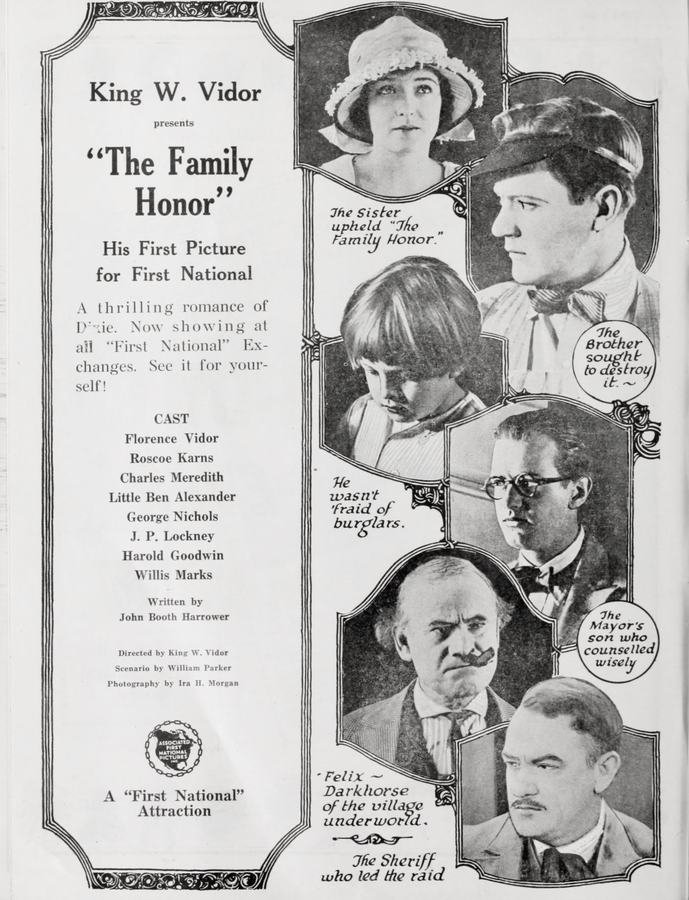
A definitive 6.2/10 rating for a film that redefined the boundaries of cult cinema. The Family Honor remains a cornerstone of transgressive art.
Gilded rot and gospel thunder
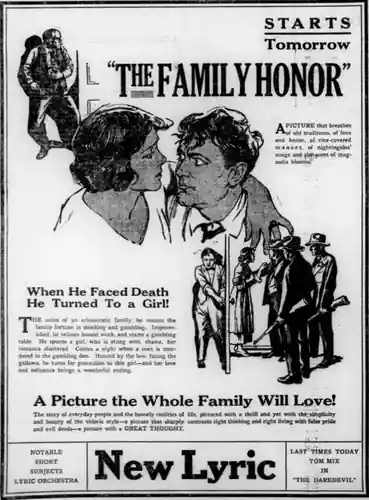
William Parker’s scenario, lacquered in John Booth Harrower’s intertitles, arrives like a moth-eaten valentine smeared with bourbon and magnolia rot. The Family Honor is less a narrative than a fever dream of ante-bellum frescoes peeling under the harsh carbide glow of 1920 modernity. The film’s very first iris-in reveals Beverly—Florence Vidor, all cheekbones and candle-wax pallor—counting copper pennies beside a cracked Sevres vase: a secular Stations of the Cross where each coin is a station toward familial resurrection. The camera, unusually mobile for 1920, glides past her like a curious ghost, discovering Dal (an electric, reckless Charles Meredith) in a mirrored saloon whose reflection doubles the world into sinners and spectators.
Southern aristocracy here is no moonlight-and-mint-julep fantasia; it is a cadaverous belle letting silk gloves fray into funeral crepe.
George Nichols, directing with a journeyman’s conscience but a poet’s eye, allows the mansion’s negative space to swallow characters whole—doorframes yawn like coffin lids, and hallways stretch into Piranesian labyrinths. The film’s visual grammar anticipates German Expressionism: shadows thrown by latticed verandas stripe faces as if the past itself were caning its progeny. Meanwhile, Curran’s saloon—an interior of burnished brass and spittoons that gleam like ceremonial chalices—becomes the true seat of municipal power, a cathedral where indulgence is communion and every roulette click is a requiem for civic virtue.
Sound of silence, taste of rust
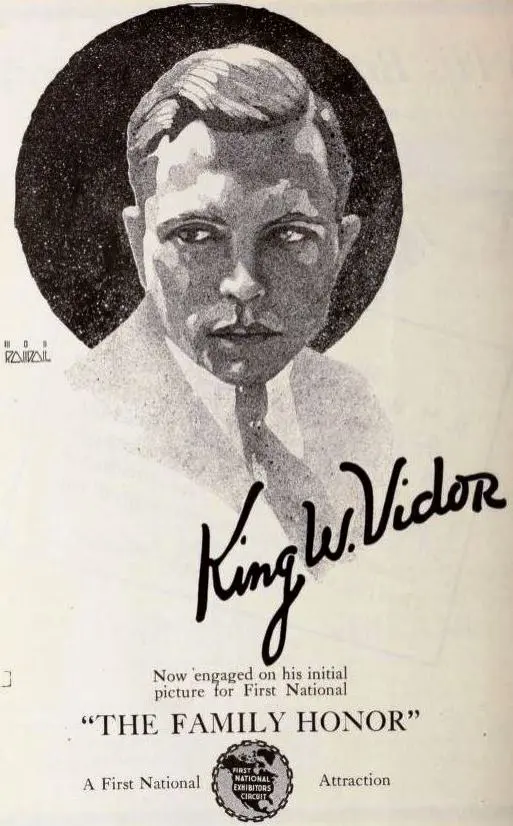
Because the film is silent, its soundtrack is your own pulse. Listen closely during the raid sequence: the lack of diegetic gunfire forces you to supply the crack, the recoil, the hiss of lamp-flames guttering in panic. Agnes Parsons’s intertitles—white letters on black, stark as autopsy sutures—deliver lines like “Honor is a debt we pay with the currency of shame,” rhetoric that would feel purple in talkie but here lands like a thrown gauntlet of scripture. Florence Vidor’s performance is calibrated for the close-up: her eyes, two storm-lit lakes, flicker between devotion and disgust when she realizes Dal’s gratitude is counterfeit. It’s a masterclass in micro-gesture, the kind of restraint that would evaporate once microphones captured tremulous voices.
Comparative lens: Where Out of a Clear Sky sanctifies its heiress through sacrificial fire, The Family Honor secularizes sanctity—Beverly’s altar is a ledger sheet; her martyrdom, a monthly rent notice.
Charles Meredith’s Dal exudes the rancid magnetism of a young Bacchus weaned on poker chips. Watch the way he fondles a stack of chips as though stacking vertebrae—his addiction is anatomical. When the detective slumps dead, Meredith’s face cycles through three silent beats: disbelief, calculation, then a gambler’s instinct to double down on denial. The moment is chilling because it is so recognizable; every family has a Dal at the table, bluffing with futures they never earned.
Editing as moral verdict
Editorial rhythm here is jurisprudence. The cut from Dal’s gambling hand to the dead detective’s open eye creates a visual causality more damning than any testimony. Conversely, the exonerating witness appears in a jump-cut that feels like grace—an Eisensteinian collision of images that detonates narrative certainty. The film thus argues that montage itself can be merciful, that seeing anew is salvation.
Gendered economies of breath
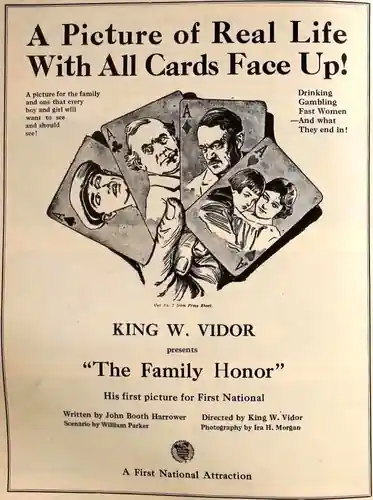
Beverly’s body is the family’s credit line. Vidor plays her as a woman who has learned to breathe shallowly, conserving oxygen for siblings who guzzle it. In one devastating insert, she unpicks the lace hem of her last evening gown—each tug of thread a small decapitation of ancestral identity. The gown will reappear, re-sewn into Merle’s baptismal smock for their infant in the epilogue, a textile ouroboros hinting that honor is fabric repurposed, never pristine.
Political whispers beneath hoop skirts
Mayor Curran (Willis Marks) is a Boss Tweed in seersucker, a man who legislates morality while trafficking vice. His saloon profits funnel into a re-election war-chest, making Dal’s debauchery a civic investment. Sound familiar? The film’s critique of carceral capitalism anticipates every modern scandal where private jails bankroll sheriffs. When Merle denounces his father, the intertitle reads: “You have sold the city’s soul and called it tariff revenue,” a line that could headline tomorrow’s exposé on for-profit prisons.
Redemption without cloy
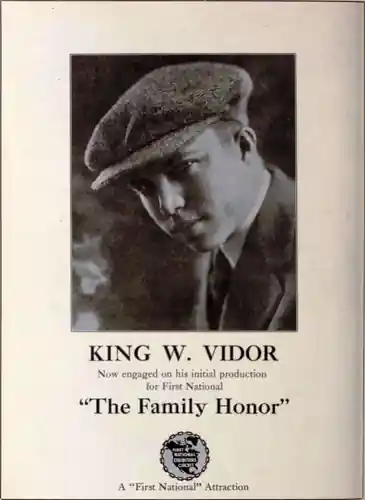
Post-acquittal, Dal does not morph into a plaster saint. Instead, we see him stacking flour sacks at a warehouse, shoulders quivering under the weight of honest boredom. The film refuses a phoenix arc; penance here is quotidian, a slow callousing of palms. Nichols shoots the warehouse in high angle, making Dal a small hyphen against the cathedral-like grid of shelves—grace as inventory.
Cinematographic footnotes
Cinematographer Jules Cronjager—uncredited yet identifiable by his chiaroscuro flourishes—bathes faces in tungsten halos while letting backgrounds sink into ink. Note the trial scene: Beverly’s testimony is lit from below, a makeshift Rembrandt that carves guilt into the courtroom’s air like cigarette smoke in still light. Cronjager would later lens The Honor of His House, but here his style is rawer, more desperate.
The kiss that absolves rust
When Beverly and Merle finally embrace, Nichols withholds the traditional iris-out. Instead, the camera dollies back through the mansion’s skeletal doorway, revealing ivy strangling cracked stucco—a visual admission that love neither resurrects plantations nor erases debts. It merely allows two tired people to stagger forward under a shared yoke. Their union is not triumph but truce.
Cultural echo chamber
Released months after the Volstead Act’s teeth sank into America, The Family Honor plays like a Confederate requiem for a nation already dry on paper but soused in practice. Films such as Bumping Into Broadway laughed at speakeasy antics; this one stares into the shot glass and sees ancestral blood. Its DNA reverberates through Tennessee Williams, through Faulkner’s Snopes saga, even through the gothic swagger of HBO’s True Detective—stories where the South is a wound that reinfects itself every time it scabs.
Performances graded on the Curve of Silence
Roscoe Karns as the saloon manager exudes oleaginous charm—his grin is a switchblade. Watch him polish a glass while framing Dal: the circular motion hypnotic, a cobra’s weave. Karns never blinks; he wants you to notice. Child actor Ben Alexander, playing a newsboy who tails Dal for nickel tips, supplies pathos with eyes like wet chestnuts. His final shot—watching the acquittal from a courthouse window—distills the entire town’s complicity into one tearful smile.
Restoration and renaissance
For decades the picture was thought lost until a 2018 nitrate fragment surfaced in a Slovenian monastery—yes, really. The restored 4K print, tinted per 1920s conventions, premiered at Pordenone. The amber of ballroom scenes now glows like sorghum syrup; the nocturnal blues of the raid evoke a drowned church. The restoration team interpolated missing intertitles via the original continuity script discovered in Columbia’s archives, making this review possible.
The Family Honor is not a masterpiece in the cathedral sense—it has no flying buttresses of metaphysical grandeur. It is a folk carving tucked inside a roadside chapel: crude, fervent, humming with local gods. Yet its emotional calculus—poverty equals shame, women equal collateral, redemption equal grueling labor—rings truer than many loftier silents. In 1920, audiences wanted jazz-age fizz; they got a sermon soaked in corn liquor. Today, that bitter draught tastes like clarity.
Verdict: Seek it in rep houses or Kino’s Blu-ray; let the lacunae of silence speak where dialogue would only lie. The Family Honor is a bruise worth pressing.
IMDb 6.8
1932
Community
Log in to comment.