DbcultAccessing Vault...
Cult Review
Senior Film Conservator
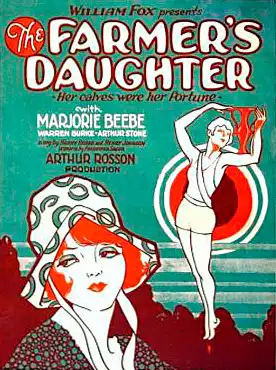
For viewers with a fondness for early 20th-century romantic comedies and a high tolerance for gentle pacing, 'The Farmer's Daughter' offers a quaint, if somewhat predictable, escape. It’s a film that leans heavily on the simple charm of its premise and the earnestness of its performances. If you’re looking for sharp wit, complex character arcs, or modern narrative urgency, you’ll likely find its deliberate rhythms and familiar archetypes a test of patience. But for those willing to settle into its unhurried pace, there’s a modest, nostalgic pleasure to be found.
Marjorie Beebe, as the titular daughter, embodies the wholesome innocence the role demands. Her expressions, particularly in moments of mild exasperation or dawning affection, are often the film's strongest points, selling emotional beats that the dialogue sometimes underserves. There’s a particular scene where she’s attempting to explain the workings of a butter churn to Al Fisher’s character; her subtle eye-roll, almost imperceptible, speaks volumes about her character's practical nature versus his urban cluelessness.
Fisher, playing the outsider, navigates the role with a blend of affable charm and occasional stiffness. He’s clearly trying to convey a certain debonair quality, but there are moments where his reactions feel a beat too slow, particularly in the early comedic sequences. Charles Middleton, often cast in more menacing roles, here provides a gruff but ultimately warm portrayal of the patriarch, grounding the film with his presence, even if his delivery sometimes feels a little too theatrical for the intimate farm setting. The ensemble, including Harry Dunkinson as the well-meaning but gossipy neighbor, rounds out the cast with serviceable performances that fit the era's stock characterizations.
The film’s pacing is undeniably a product of its time. It takes its time establishing the rural setting, lingering on shots of the farmstead and the daily routines. While this can contribute to a pleasant, immersive quality for some, it also means that dramatic or comedic beats often arrive with a leisurely cadence. There are stretches, particularly in the middle act, where the narrative momentum flags, largely due to extended scenes of exposition or repetitive comedic misunderstandings that could have been tightened.
A scene where the city visitor attempts to help with chores, culminating in a slapstick moment involving a runaway pig, feels stretched beyond its comedic potential. The tone remains resolutely light, almost to a fault. Even moments that hint at genuine conflict or emotional depth are quickly smoothed over, preventing the story from truly digging into the potential richness of its 'fish out of water' premise. This consistent buoyancy, however, means the film never asks too much of its audience, maintaining a gentle, feel-good atmosphere throughout.
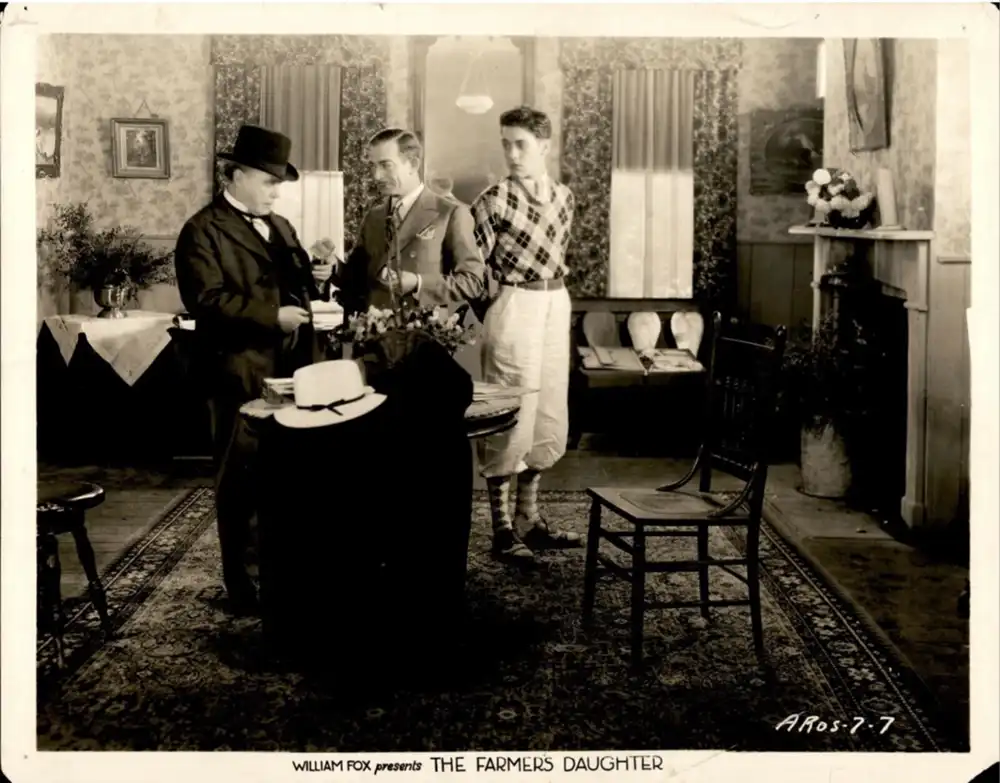
Visually, 'The Farmer's Daughter' leans into the pastoral ideal. The cinematography, while not groundbreaking, effectively captures the bucolic beauty of the countryside, with wide shots emphasizing the open fields and simple farm structures. Interior scenes, particularly within the farmhouse kitchen, are warmly lit, often with practical lamps casting soft glows, lending an authentic, lived-in feel. Costumes are era-appropriate and functional, with Marjorie Beebe’s simple dresses and bonnets contrasting nicely with Al Fisher’s more tailored city attire, visually reinforcing the central conflict.
A particularly memorable shot involves the two leads framed against a sunset, silhouetted as they walk through a field, a classic romantic image that, despite its familiarity, still manages to evoke a sense of quiet beauty. However, some of the editing choices feel abrupt, particularly during scene transitions, occasionally disrupting the otherwise smooth visual flow. And in the farmer's kitchen, on the mantle, a single, rather out-of-place porcelain doll sits, a curious detail that hints at a character's forgotten past but is never explicitly addressed – a small visual curiosity that goes unremarked upon by the narrative.
The film’s primary strength lies in its unpretentious charm and its ability to transport viewers to a simpler time. Marjorie Beebe’s performance anchors the narrative, giving substance to what could have been a one-dimensional character. The scenic beauty of the rural setting is also a significant plus, offering a pleasant visual backdrop. The simple, heartfelt resolution, while predictable, lands with a certain warmth.
On the other hand, the film's weaknesses are equally apparent. The script, despite a team of writers, often feels thin, relying on well-worn tropes without adding much originality. Dialogue can be functional rather than sparkling, especially in the early exchanges between the leads. The pacing, as noted, can test modern sensibilities, with several scenes feeling overextended. The supporting characters, while competently played, largely remain archetypes, rarely breaking free to offer surprising moments. The film often pulls its punches, shying away from any real dramatic tension, which makes the stakes feel low and the emotional payoff somewhat muted.
Ultimately, 'The Farmer's Daughter' is a film best approached with tempered expectations and a willingness to embrace its period sensibilities. It's not a film that will rewrite your understanding of cinema, nor will it likely be remembered as a classic of its genre. However, for those seeking a gentle, undemanding slice of cinematic history – a quiet romantic comedy that plays out exactly as you'd expect – it offers a pleasant, if fleeting, diversion. It’s a film that exists, and occasionally delights, in its own understated way. Consider it a curiosity for a rainy afternoon, particularly if you have an affinity for the era and its particular brand of wholesome storytelling.
IMDb 6.1
1935
Community
Log in to comment.