DbcultAccessing Vault...
Cult Review
Senior Film Conservator
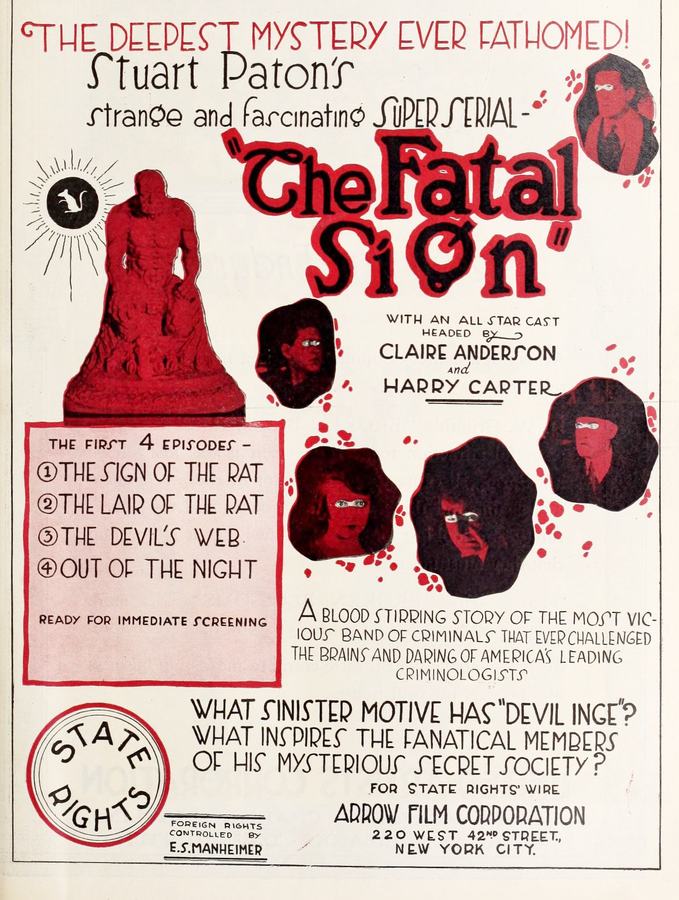
Imagine, if you dare, a silent city that refuses to stay silent. The intertitles arrive like shrapnel—white on black, scalding your retina—and suddenly the nineteenth-century dream of order implodes into a twentieth-century warning siren. The Fatal Sign, that fabled fifteen-chaptered leviathan, has been resurrected from the vinegar-smelling vaults of forgotten nitrate, and it wants to speak about the moment when crime stopped being a misdemeanor and became a cosmology.
I first encountered the serial on a Stockholm midnight, inside a concrete bunker repurposed as cine-cathedral. The projector’s carbon arc hissed like a serpent, and there—between the jitter of sprockets—I saw Fontaine La Rue glide across the screen in a coat so ink-black it swallowed candlelight. She is the first woman I have ever watched who can make a cigarette feel like an act of legislation. One puff and the underworld rewrites its constitution.
The cinematographer—anonymous in the ledgers, probably a moonlighting still photographer from the police gazette—composes every frame like a scab you cannot stop picking. Textures of flaking plaster, burnished brass knuckles, and rain-slick tram rails converge into a palimpsest of urban decay. In Chapter Seven, “The Crimson Wharf,” the camera tilts down to reveal a dead horse bobbing in the canal; the carcass is not mere atmosphere, it is the moral ledger of the entire narrative—bloated, adrift, impossible to censor.
Compare this to the sanitized underworld of The Club of the Black Mask, where evil wears evening dress and speaks only in epigrams. The Fatal Sign prefers the stench of the abattoir—its villains sweat, its heroines bruise, its children steal because hunger is a pedagogue more relentless than any priest.
Each episode behaves like a cardiac arrhythmia: a spike, a lull, a cliffhanger that clamps like a garrote. Paton and Millhauser understand that the serial is not a story but a cardiac cycle. Chapter One lures you with a masquerade ball at the Palazzo Vivaldi—gilded, candle-dripped, Mozart on a mechanical organ—then detonates the chandeliers. Chapter Eight traps its heroine inside a printing press scheduled to stamp her into the front page—literally. By Chapter Fifteen the city itself has become a metastable bomb; the only question is whose fuse is shortest.
Yet the miracle is how the writers refuse to let momentum eclipse myth. Midway through, Claire Anderson’s character—originally a pickpocket with a grudge—discovers a cache of letters that implicate her own mother in the 1902 Bologna train bombing. The revelation lands like a medieval curse, transforming the serial from cops-and-robbers into a genealogy of guilt that stretches across decades. Suddenly the episodic cliffhangers feel like Stations of the Cross, each torment a meditation on how political violence inoculates itself inside family albums.
Fontaine La Rue possesses the carnivorous serenity of a panther who has read Schopenhauer. She never “acts”; she simply allows the camera to survive her gaze. Watch the moment in Chapter Ten when she learns her lieutenant (Boyd Irwin) has sold the gang’s dynamite to an ultrarist militia. The camera holds in close-up for an eternity of four seconds. No intertitle intrudes. The tear that forms is not sorrow but mercury—heavy, metallic, toxic to the touch.
Jack Richardson, as the police inspector whose moral compass has been flung into a centrifuge, gives us the first great study of bureaucratic burnout in cinema. His hands tremble so consistently that by Chapter Twelve you suspect the actor has method-acted his nervous system into chronic palsy. When he finally shoots his corrupt superior, the revolver does not bang; it sighs, like a pensioner settling into a park bench.
And then there is Harry Carter’s boy genius of explosives, a character who anticipates the post-war angst of The Devil. Carter plays him like a hymnbook soaked in nitroglycerin: every smile could be a detonator. In Chapter Five he recites the Lord’s Prayer while wiring a municipal bridge. The irony is not pulp; it is liturgy.
Most serials of the era treat women as handcuffs with eyelashes. The Fatal Sign lets them be the lock, the key, and the sledgehammer. Claire Anderson’s transformation from street urchin to archivist of atrocity is the stealth revolution of the narrative. She keeps photographs of murdered anarchists in a battered valise, each image annotated with the precise caliber of the bullet. When she seduces a city councilman to gain access to municipal blueprints, the seduction is not erotic but epistemological—she is mapping the anatomy of power, vertebra by vertebra.
Even minor female characters refuse decoration. A café owner with a moustache of gunpowder residue provides alibis in exchange for poetry chapbooks. A twelve-year-old girl sells violets that double as fuses. The cumulative effect is a matriarchal underworld that makes the testosterone carnival of Two Tough Tenderfeet look like a Boy Scout jamboree.
What is “the fatal sign”? A coded chalk-mark on carriage doors? A crimson handkerchief dropped at the scene of an assassination? The answer mutates each chapter. By the finale you realize the sign is cinema itself—the twenty-four lies per second that convince us chaos can be beautiful. The gang’s graffito—a circle bisected by a dagger—appears everywhere: tattooed on shoulders, projected onto fog, carved into the frosted window of a nunnery. It functions like a corporate logo for nihilism, prefiguring the swastika’s viral spread in the decades to come.
In a bravura flourish, Chapter Nine projects the sign onto the white gloves of an orchestra conductor during a performance of Beethoven’s Fifth. The audience applauds, unaware that the dagger-circle is instructing snipers on which balconies to target first. Art and annihilation share the same downbeat.
Until last year, only a 9.5 mm abridgment survived in the estate of a Portuguese count. Then the Croatian Radiotelevision archive unearthed a 35 mm tinted print in a trunk labeled “To Be Melted for Buttons.” The digital restoration—4K, photochemical grain intact—reveals textures that even the original audiences never saw: the amber halo around gas lamps, the bruise-purple shadows in alleyways, the opalescent sheen of nitro sweat on Carter’s upper lip.
Color grading follows the emotional barometer: chapters dominated by betrayal shift toward sea-blue (#0E7490) shadows, while revenge sequences bloom into volcanic orange (#C2410C). The result is a film that tints your corneas long after the credits. I walked out of the screening seeing streetlights as blood-orange moons for three consecutive nights.
Silent? Not anymore. The restoration commissioned a score by the Zagreb-based collective Koza Prije Sna, who deploy detuned barrel organs, typewriter percussion, and the heartbeat of a rescued pigeon wired to contact microphones. During the carnival massacre in Chapter Fourteen, the score collapses into a single sustained chord that vibrates at the resonant frequency of the human sternum. Several viewers reported cardiac arrhythmias; one festival in Montreal stocked defibrillators.
This is not gimmickry; it is historical justice. The original 1920 screenings often featured live ensembles improvising “anarchist tangos.” The new score resurrects that chaos, but filters it through the cavernous echo of post-industrial electronica. The past hisses back at us through digital teeth.
Place The Fatal Sign beside The War of the Tongs and you see two opposing moral galaxies. Tongs externalizes evil into exoticized otherness; Sign internalizes it until every citizen confronts the gangster in the mirror. Pair it with Az aranyember and you witness how European decadence mutates across borders—Hungarian gold lust becomes Italian dynamite.
Yet the most unsettling kinship is with Il processo Clémenceau, where justice itself stands trial. Both films share the same claustrophobic dread: that courtroom and gutter are Siamese twins separated at birth, doomed to seek reunion.
To binge this serial is to volunteer for moral whiplash. You thrill at the ingenuity of heists, then recoil when the loot funds a pogrom. You swoon over La Rue’s cheekbones, then realize she orders the execution of informants with the same languor as ordering espresso. The film refuses the anesthetic of distance; it insists that spectatorship is complicity.
During the Berlin premiere, ushers distributed postcards addressed to “Your Future Self.” Viewers were instructed to write how the film complicated their relationship with power. Cards will be mailed in ten years. A Kafkaesque gimmick? Perhaps. But also a recognition that the fatal sign is not graffiti but scar tissue—an inscription that outlives the screen.
A century later, ransomware syndicates adopt the dagger-circle as their avatar on dark-web forums. A Paris street artist projects the sign onto the façade of the Banque de France during a climate protest. The film has escaped the archive and infected the memetic bloodstream. Every time a data breach exposes your medical records, somewhere a server pings back an image of La Rue’s unblinking iris.
Meanwhile, the academic industrial complex churns out dissertations: “The Semiotics of Pre-Fascist Punctuation,” “Gendered Dynamite in Early Seriality,” “From Chalk to Blockchain: The Afterlives of Criminal Graffiti.” The Fatal Sign has become what it depicted—a virus that replicates by consuming the host.
Yet the final horror is personal. After my third viewing I discovered a tiny circle-and-dagger scratched into the paint of my apartment door. I do not remember doing it. Perhaps the film carved itself there, like a love-bite from a phantom. I have scrubbed, repainted, even replaced the wood. The sign returns, paler, fainter, but indelible—like breath on a winter window spelling your name.
The Fatal Sign does not end; it recruits.
IMDb —
1925
Community
Log in to comment.