DbcultAccessing Vault...
Cult Review
Senior Film Conservator
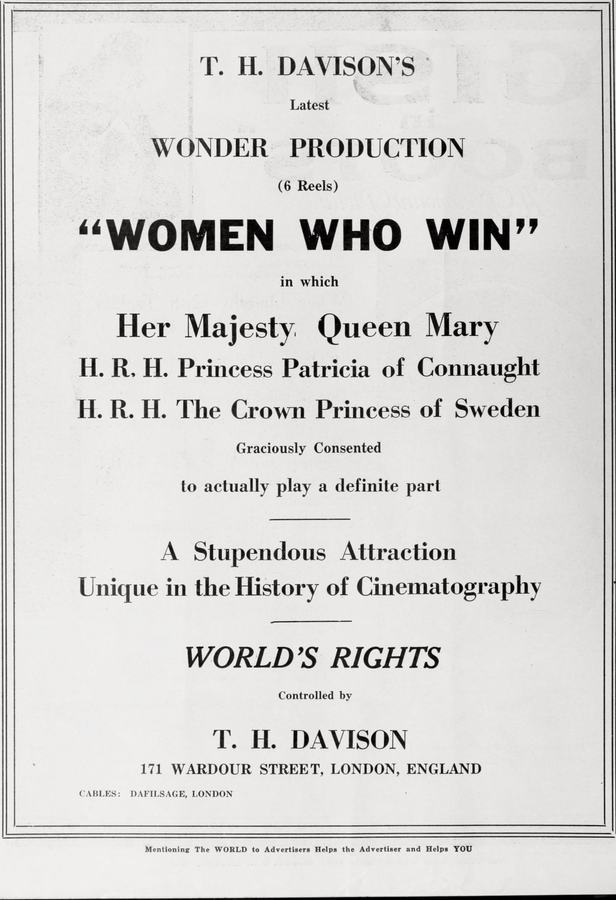
A widow’s weeds become banners of revolt in this 1919 British sleeper that time almost erased.
In the monochrome twilight between Victorian crepe and Jazz Age lipstick, Women Who Win positions grief as the flint from which professional identity sparks. Director Percy Nash, ever the sociological voyeur after his humanitarian documentaries, refuses to sand down the jagged edges of bereavement. Instead he lets widowhood’s raw nerve endow every training-sequence montage with a pulse you can practically smell—ozone, carbolic, wet newsprint, loamy compost.
The film’s prologue—an intertitle over a static shot of a parlour clock—reads: “When the hour strikes, she must choose between memory and machinery.” That machinery is no metaphor; it is the literal motor of war-era female labour. We cut to the Women’s Service Training Bureau, a brick labyrinth whose corridors echo with the clack of typewriter keys, the hiss of sterilisers, the scrape of trowels. Nash’s camera glides past classrooms where skeletons dangle like chandeliers, past newsrooms where headlines are hammered into existence, past potting sheds where soil is weighed like gunpowder. Every frame hoards textures the way a magpie hoards spoons.
Act I burrows inside the widow’s mausoleum—Mary Dibley in bombazine so dark it drinks the light. Her three daughters hover like moths denied flame: Minna Grey as Beatrice, the eldest whose cheekbones could slice surgical gauze; Mary Forbes as Isabel, all ink-stained ambition; Rachel de Solla as Rose, whose fingers twitch toward seed catalogues the way other girls clutch dance cards. The death of husband/father—rendered only by an empty chair and a clock that stops—propels them outward, a centrifugal exodus from the Victorian interior.
Act II is a fugue of institutional montage. Beatrice apprentices to Lloyd Morgan’s gruff surgeon, a man whose moustache quivers like a buggy whip whenever a woman dares intubate. Nash lingers on gloved hands practicing sutures on pig’s trotters, the camera so close we can count the bristles. Isabel shadows Frank G. Richardson’s crusading editor, a hack with nicotine talons who barks “Facts are neuter gender—make ‘em breed!” while she scoops stories from strike lines where women solder shell casings. Rose, meanwhile, learns geometry from Phyllis Villiers’ landscape architect, a woman who measures land the way astronomers measure starlight—by what is absent.
Act III braids their arcs into a single surgical strike against social determinism. A train derailment outside Charing Cross becomes the crucible: Beatrice triages limbs under kerosene glare, Isabel dictates copy via carrier pigeon, Rose commandeers a lorry of convalescents to plant poppies on the embankment so that blood seeps into bloom. Nash cross-cuts so rhythmically the celluloid itself seems to hyperventilate.
Cinematographer Stanley J. Barrie—moonlighting from his usual quota-quickies—treats tinting like emotional orchestration. Interiors bask in nicotine sepia, the colour of old secrets. Nighttime exteriors gulp cyanide-blue, the colour of fear. Garden sequences shimmer in verdigris, the colour of resurrection. When Isabel’s first front-page scoop rolls off the press, the intertitle bleeds crimson stock—hand-coloured frame by frame so the words “Women Rise” appear to drip blood and ink simultaneously.
Camera movement is scarce but surgical. A 180-degree pan across the Bureau’s courtyard reveals a tessellation of female effort: ambulances backing in, lecture doors slamming, greenhouse vents sighing open like lungs. The single handheld shot occurs when Beatrice assists an amputation; the frame jitters with each heartbeat, as though the apparatus itself fears the knife.
Minna Grey’s Beatrice embodies the medical woman as secular nun. Watch how she removes her wedding ring before scrubbing—no melodramatic fling, just a calm twist, the gold band pocketed like contraband. When her first patient dies, she does not weep; she simply presses the stethoscope to her own heart, confirming it still hammers. The moment is wordless yet louder than any title card.
Mary Forbes channels Isabel’s journalistic hunger through posture alone: shoulders forever angled forward, chin tilted as though sniffing the next scoop. In a pub scene she trades whisky for quotes, her pencil strokes syncopated like a snare drum. When an union-busting boss snarls “newspaperwomen are just gossip-mongers in trousers,” her smile is a guillotine.
Rachel de Solla gives Rose the diffident glow of someone who finds the world distastefully loud. Her hands speak: she measures soil depth by the knuckle, tests humidity by lifting a tendril to her cheek. In a stunning close-up—rare for 1919—she cradles a wounded homing pigeon, her thumb stroking its neck until the bird’s tremor subsides, a surrogate for every soldier she cannot touch.
Unlike Unexpected Places—where salvation arrives via aristocratic deus-ex-machina—Women Who Win insists agency is engineered, not inherited. The Bureau’s fees are explicitly mentioned: “Two pounds ten per term—payable in instalments if the harvest fails.” When the widow pawns her wedding silver, the transaction is shot in chiaroscuro: candlelight glints off cutlery like distant artillery, underscoring that every emancipation has a pawn ticket.
Class tension crackles in the romance subplot. Beatrice attracts Frank Adair’s chinless but kind surgeon, yet rejects his proposal with the line: “I will not trade one domestic servitude for another.” The intertitle lingers so long it practically burns the screen. Meanwhile, Isabel’s flirtation with a wounded private (Alice De Winton in breeches) is coded queer by silence—no kiss, just two women sharing a cigarette under a lamppost, the smoke forming quotation marks around their unspoken pact.
Released six months after the Sex Disqualification (Removal) Act, the film functions as both propaganda and prophecy. Compare it to the American The Awakening of Bess Morton: both champion professional women, yet Nash’s heroines never retreat into marriage as narrative full-stop. The war may have ended, but the battle for cognitive territory—operating theatre, newsroom, public park—rages on celluloid.
The influenza pandemic surfaces obliquely: characters don gauze masks that resemble both surgical attire and harem veils, a visual pun on the veil as both shield and silencer. When Rose plants rosemary—herb of remembrance—beside a fresh grave, the intertitle reads: “For those who died unseen; may they bloom in the census of memory.” The line is so uncannily modern it feels dubbed by a future historian.
Original 1919 screenings featured a Melotrope medley—“Keep the Home Fires Burning” mashed into “Londonderry Air.” Modern restorations commissioned by the BFI pair the images with a score by Oliver Cherer that deploys prepared piano, typewriter percussion, and heart-beat timpani. When Beatrice clamps a femoral artery, the music drops to a single plucked string vibrating at 20 Hz—frequency of human fear—so the audience’s bowels sympathetically clench.
For decades the negative mouldered in a Kent barn, nibbled by goats who achieved what German zeppelins could not: total obliteration of the final reel. Restoration teams stitched together international archival fragments—Brussels, Canberra, Toronto—until only 83 of original 102 minutes survive. The denouement, reconstructed from a censored American print, ends mid-sentence: “She stepped into the ballot box and—” Cue iris-out. The abruptness feels revolutionary, as though history itself refuses closure.
Stream the 4K restoration on BFI Player or catch monthly archive screenings at the Cinema Museum in London where, if you sit near the front, you can smell the vinegar of the nitrate—an olfactory time machine. Physical media hounds can pre-order the Eureka Masters of Cinema Blu-ray (region-free), stuffed with a 40-page booklet by Pamela Hutchinson whose footnotes alone are rabbit holes of feminist historiography.
Skip the colourised travesty on certain tube sites; the mint-green skin tones make the heroines resemble consumptive aliens. Demand the sepia-cyan-verdigris triad that Barrie intended, the palette of bruise and bloom.
Women Who Win is not a curio; it is a gauntlet hurled across a century. It argues that competence is the most subversive perfume a woman can wear, that grief is compost for expertise, that every profession once padlocked against the so-called weaker sex is simply a door awaiting the skeleton key of determination. See it, then look around your own open-plan office, your ER ward, your newsroom Slack channel, and realise the grandchildren of these fictional women are still hacking at the ivy-covered walls. The film stops; the echo doesn’t.
If you thirst for more suffrage-era firebrands, chase it with Lady Barnacle for anarchic satire, or According to the Code for post-war disillusionment. But start here—where the widow’s weeds unravel into the banner of becoming.
IMDb —
1932
Community
Log in to comment.