DbcultAccessing Vault...
Cult Review
Senior Film Conservator
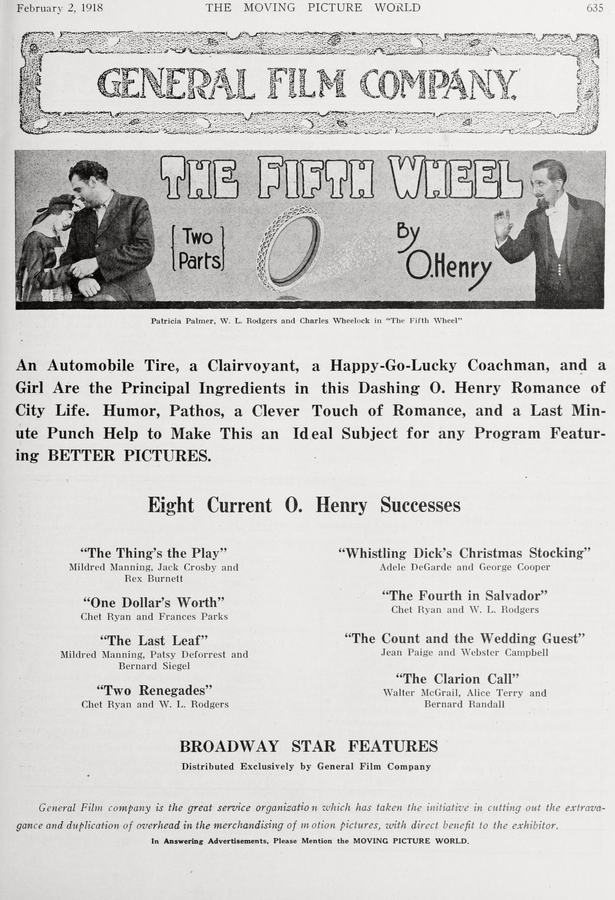
Emerging from the frostbitten twilight of 1918 cinema, The Fifth Wheel remains a crystallized drop of O. Henry's trademark irony, distilled through the nascent language of moving pictures. Director Chet Ryan, working from George H. Plympton's adaptation, orchestrates a ballet of social collisions where the frozen desperation of New York's underclass scrapes against the gilded absurdity of its elite. This isn't merely a period curio but a surgical examination of fate's cruel humor, where a discarded automobile tire becomes the axis upon which multiple destinies spin. The film's power lies in its ruthless economy—every frame thick with unspoken hierarchies, every glance heavy with the weight of winter and want.
Ryan's camera treats Madison Square not as mere backdrop but as a frozen hellscape of social collapse. The Bed Liners aren't romanticized victims but a Greek chorus of shattered dignity, their breath hanging in the air like ghosts of abandoned futures. Into this tableau strides Lydia Yeamans Titus as Annie—a performance vibrating with fierce practicality that electrifies the screen. Watch how her fingers clutch at her thin shawl when confronting Thomas, the physical manifestation of sacrifices made for love in a merciless world. Charles Wheelock's Professor Cherubusco emerges as cinema's early archetype of the grifting spiritualist, his palace of deception contrasting violently with the Bed Line's starkness. The scene where he ushers women into the side room operates as devastating parody of Gilded Age mysticism—the Chaldean Chiroscope prophecy revealed as meaningless syllables draped over capitalist theater.
"What Cherubusco sells isn't foresight but the opium of coincidence dressed as destiny—a commodity more valuable than gold to those drowning in uncertainty."
The genius of Plympton's adaptation lies in its visualization of O. Henry's verbal wit. Where the written story relies on narrative voice, the film translates irony through Walter Rodgers' haunting performance as the disowned heir. His shabby neatness speaks volumes—buttons fastened with threadbare precision, collar frayed yet upright—a walking monument to ruined gentility. When Thomas retrieves the tire, note how Rodgers frames the action: the automobile doesn't stop because the wealthy driver cares about his property, but because he spots exploitable raw material in McQuade's connection to the Van Smuythes. The subsequent feast scene becomes excruciating comedy, McQuade's fumbling with tea biscuits mirroring his dislocation from both the streets he came from and the opulence he cannot navigate.
Beneath the surface mechanics of plot lies a devastating critique of class as supernatural force. Cherubusco doesn't merely predict Walter's rediscovery—he manufactures it through cold calculation, recognizing McQuade's utility as connective tissue between worlds. The film's second act revelation operates as brutal farce: the "fifth wheel" prophecy fulfilled not by divine intervention but by random automotive negligence. Ryan emphasizes this through contrasting textures—the rubber tire's vulgar materiality against Cherubusco's silk robes, the grease on Thomas' hands staining the clairvoyant's damask tablecloth. This collision of realms reaches its apex when Annie appears amidst the Bed Liners like a grenade of hope, Patricia Palmer investing her with earth-mother vitality that shatters the frozen despair.
Consider the technical audacity of the recognition scene: Annie's eyes dart from Thomas to Walter, the camera tightening as realization blooms. Palmer's scream—"Mr. Walter!"—lands not as melodramatic excess but as visceral rupture of social barriers. Her subsequent vow to fund Cherubusco with her life savings is the film's masterstroke of tragicomedy. The professor's "greatness" stems not from supernatural power but from understanding how desperation warps perception—a theme echoing in later social satires like Pay Day or Bread. Where those films explore economic hardship directly, The Fifth Wheel dissects the psychological toll of precarity—how the starving mind clings to mysticism as life raft.
Modern viewers might compare Thomas' trajectory to Chaplin's tramp, but McQuade lacks the buoyant resilience of cinematic cousins. His return to the Van Smuythes isn't triumph but surrender to the feudal system that discarded him. Ryan underscores this through visual motifs: the recurring shots of carriage wheels (now replaced by automobiles) crushing snow into grey slush, the geometric prison of mansion windows versus the Bed Line's formless void. This aesthetic anticipates German expressionism's angular dread, particularly in The Black Box, though grounded in American realism.
Claire Toner's brief appearance as Walter's unseen wife resonates through absence—her character exists as spectral motivation, much like the wives in A Desert Wooing. But it's Titus who dominates the emotional landscape. Observe how she navigates hierarchy: shoulders bowed before Cherubusco, then squared when organizing the men's return. Her physicality bridges the maternal determination of D.W. Griffith heroines and the pragmatic sensuality soon to flourish in flapper cinema.
The Chaldean Chiroscope scenes operate as meta-commentary on film itself. Cherubusco's darkened chamber mirrors the movie theater—both peddling illusions to the credulous. His invocation of "the fifth wheel" parallels early cinema's fascination with mystical hokum seen in Satan in Sydney, yet here the scam is laid bare. The tire's reappearance isn't destiny but capitalist carelessness repackaged as divine will.
Contemporary reviews in Moving Picture World praised the film's "startling verisimilitude," particularly in its winter-bound location work. That chill permeates the celluloid—you feel the lethal cold in the actors' stiff movements, see the vapor of their breath as tangible proof of suffering. This environmental authenticity creates dissonance with Cherubusco's world, where wine glugs with liquid warmth but human connection freezes solid. The final sequence—Annie shepherding both men onto a streetcar—achieves profound melancholy beneath its happy ending. Notice Walter's hollow stare as the trolley departs, suggesting reunion cannot erase months of destitution. Such psychological realism feels decades ahead of its time, foreshadowing the disillusionment in post-WWI European cinema like Sorvanets.
Unlike later adaptations that soften O. Henry's edges, The Fifth Wheel embraces his savage compassion. The "twist" isn't designed for audience delight but to expose how systemic inequality distorts human connection. When Annie offers her $11.85 to Cherubusco, the film indicts not her naivete but the society that makes charlatans necessary. This aligns with O. Henry's broader literary mission—exploring how capitalism fractures community—yet achieves new potency through cinema's immediacy. The close-up of Annie's coins hitting Cherubusco's palm carries more thematic weight than pages of exposition could.
In the landscape of 1918 cinema, the film stands apart from both the melodramatic excess of A Modern Magdalen and the patriotic fervor of Scotland Forever. Its spiritual kin might be Idols—another tale of exploited faith—but The Fifth Wheel wields irony like a scalpel rather than a bludgeon. The film's legacy lies in this tonal precision, influencing everything from Preston Sturges' comedies of reinvention to the Coen brothers' tales of hapless protagonists caught in cosmic jokes. Yet it remains tragically overlooked—a frozen rose in cinema's attic, petals still sharp with frost.
What resonates most today is the film's refusal of redemption arcs. Thomas isn't reformed—he's reclaimed like lost property. Walter's restoration to family feels less like victory than re-entrapment in the gilded cage he escaped. Even Annie's triumph is poisoned by her continued servitude to systems that nearly destroyed both men. The final shot—the streetcar swallowed by New York's gloom—suggests no happy endings, only temporary respites bought at usurious emotional rates. This uncompromising vision makes The Fifth Wheel not just a relic, but a reflection of our own age's spiraling inequities. Like Cherubusco's prophecy, its relevance was accidental, unforeseen, and devastatingly true.
IMDb 6.1
1917
Community
Log in to comment.