DbcultAccessing Vault...
Cult Review
Senior Film Conservator
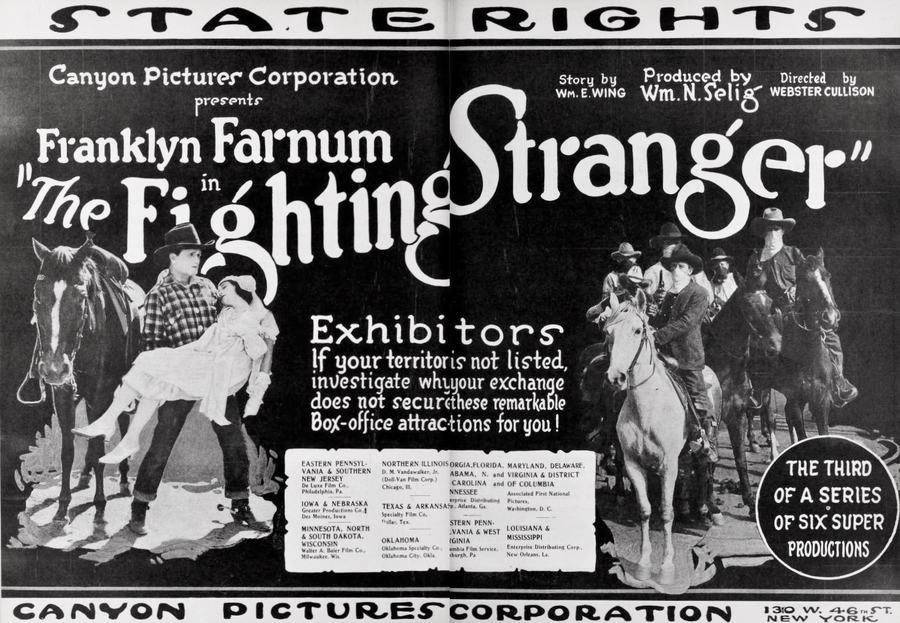
In the pantheon of early silent Westerns, few figures possess the enigmatic gravity of Franklyn Farnum’s “Australia Joe.” The Fighting Stranger, a 1921 production directed by Webster Cullison and penned by the prolific William E. Wing, operates as a fascinating study in cinematic subversion. While the era was often defined by the moral clarity of white-hatted heroes, this narrative chooses a more circuitous route toward righteousness. We are introduced to Joe not as a bastion of the law, but as a man emerging from the grim confines of a prison cell—a visual and narrative shorthand for a character who has already been discarded by polite society.
The initial movements of the film are steeped in the aesthetics of the crime procedural. Joe’s immediate descent into a bank robbery isn't framed with the frantic energy of a desperate man, but with the cold, surgical precision of a professional. This sequence sets the stage for a broader commentary on the nature of identity in the American West. Much like the protagonists in The Busher, who find themselves caught between rural expectations and professional aspirations, Australia Joe is a man performing a role for an audience of thieves.
As the action shifts westward, the scope of the film widens from simple larceny to systemic corruption. The gang Joe joins is not merely a band of outlaws; they are the administrative muscle for a mysterious “man higher up.” This trope, common in the socio-political anxieties of the 1920s, reflects a growing distrust of institutional power that was also explored in films like Fanatics. The theft of town-hall papers signifies a move from physical wealth (bank gold) to the control of legal reality. In this frontier, the pen and the deed are far more dangerous than the six-shooter.
The cinematography captures this transition with a stark, almost documentary-like focus on the town's geography. The town hall becomes a fortress of secrets, and Joe’s infiltration of it is a masterclass in tension. William E. Wing’s screenplay cleverly weaves Joe’s personal journey with this macro-level conspiracy. We see Joe observing the “man higher up” not with the reverence of a subordinate, but with the clinical eye of a predator. The villain’s attempt to marry the daughter of a man he framed is the quintessential melodramatic pivot—a device that heightens the emotional stakes while grounding the political intrigue in a domestic tragedy, reminiscent of the plight found in A Child for Sale.
Franklyn Farnum’s performance is the linchpin of The Fighting Stranger. Unlike the stoic archetypes of William S. Hart, Farnum brings a certain theatricality to Joe. He must play a criminal well enough to deceive the criminals, yet retain a glimmer of humanity that keeps the audience invested. This layering of performance is a sophisticated demand for a 1921 feature. It echoes the themes of hidden nobility found in The Four Feathers, where the outward appearance of cowardice or criminality masks a deeper commitment to duty.
The reveal—that Joe is a Secret Service agent—serves as the film’s grand catharsis. However, it is not merely a plot twist. It is a recontextualization of every action we have witnessed. The bank robbery becomes a controlled exercise; the prison stint, a deep-cover necessity. This narrative strategy forces the viewer to re-evaluate their own judgment of character, a theme that resonates with the moral complexities of The Silent Battle. Joe isn't just a fighter; he is a chess player in a world of checkers.
While the film is ostensibly a Western thriller, its emotional resonance relies heavily on Flora Hollister’s portrayal of the victimized daughter. Her character represents the innocent citizenry caught in the crossfire of institutional greed. The threat of her marriage to the villain isn't just a romantic obstacle; it represents the total absorption of the private sphere by the corrupt public sphere. In this regard, the film shares a DNA with the Victorian-inflected dramas like Sweet Lavender, where social standing and marital contracts are the primary battlegrounds of the soul.
Hollister’s chemistry with Farnum is subtle. There is a sense of mutual recognition—two individuals who are, in different ways, prisoners of circumstance. When Joe finally intervenes in the wedding, it is an act of liberation that transcends the legal requirements of his job. He is not just serving the Secret Service; he is restoring the moral equilibrium of the frontier. This act of gallantry is a sharp contrast to the darker, more expressionistic explorations of human nature seen in Genuine: The Tragedy of a Vampire, which was released around the same period but occupied a completely different psychological landscape.
The Fighting Stranger is an early indicator of the Western’s evolution into the modern crime procedural. By incorporating the Secret Service, the film connects the lawless West to the federal authority of Washington D.C., much like the global reaches of empire seen in With Our King and Queen Through India. It suggests that the frontier is no longer a place outside of the law, but a place where the law must operate in shadows to be effective. The use of the “Australia Joe” moniker is also telling; it implies a worldliness, a man of the British Commonwealth perhaps, or at least someone whose experiences extend far beyond the dusty trails of the American territories.
The technical execution of the town-hall robbery deserves particular praise. The lighting within the municipal building uses high-contrast shadows to heighten the sense of voyeurism. We are watching Joe watch the villains. This visual layering mirrors the narrative layering of his identity. It’s a far cry from the lighthearted antics of Kiss and Make Up; this is a film that takes its tension seriously. The stakes feel heavy, the consequences of failure permanent.
Looking back from a century’s distance, the film stands as a testament to the versatility of the Western genre. It manages to be a redemption story, a spy thriller, and a romance all within the span of a few reels. The thematic preoccupation with framing and false accusations links it to the redemptive arcs of Fires of Faith, while its focus on a singular hero taking on a corrupt system echoes Hell-Roarin' Reform.
The ending, where Joe reveals his badge, is a moment of pure cinematic joy. It validates the audience’s hope that this charismatic bandit was, in fact, a man of honor. It’s a reveal that would become a staple of the genre, but here, in 1921, it feels fresh and daring. The film doesn't just end with a shootout; it ends with a restoration of truth. In a world where papers can be stolen and men can be framed, the ultimate victory is the revelation of the real self.
Franklyn Farnum may not have the name recognition of Buster Keaton or Charlie Chaplin today, but in The Fighting Stranger, he proves himself a formidable screen presence. He navigates the film’s complex tonal shifts with an easy grace, ensuring that Australia Joe remains one of the most compelling “strangers” to ever ride into a cinematic town. Whether he is cracking a safe or stopping a wedding, Farnum’s Joe is a reminder that in the Old West, the most dangerous weapon was often a well-kept secret.
IMDb 5.3
1930
Community
Log in to comment.