DbcultAccessing Vault...
Cult Review
Senior Film Conservator
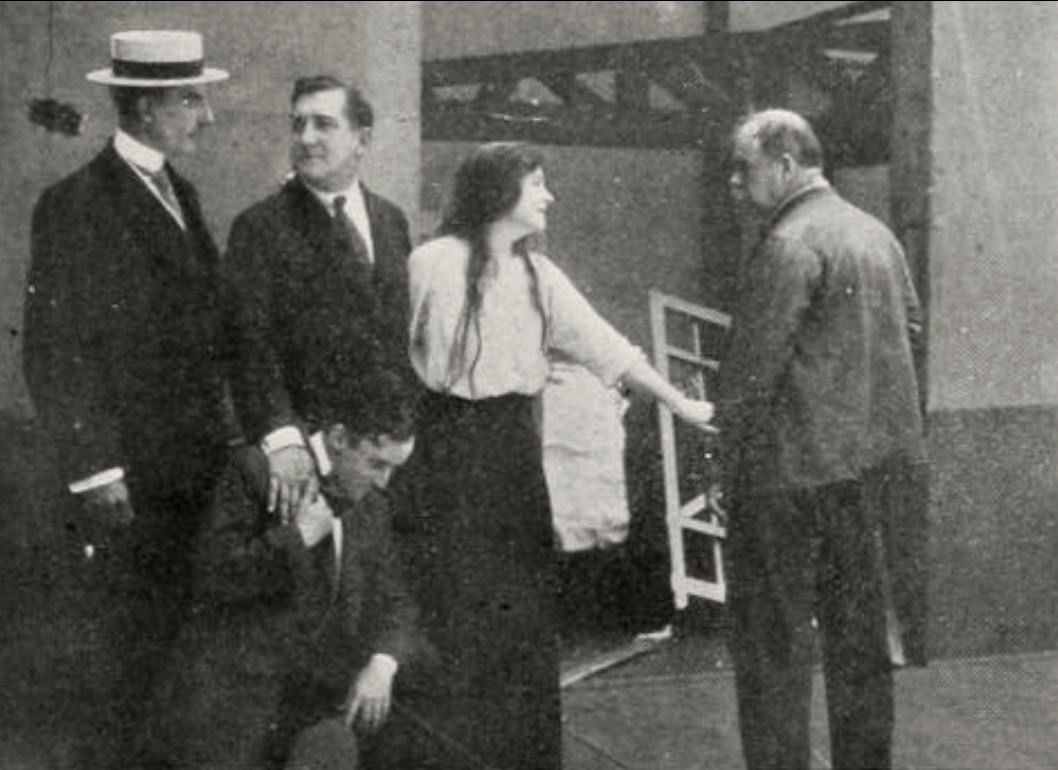
Melodrama, in the silent era, was never merely loud—it was orchestral, a fever-dream played on the nerves of an audience still unaccustomed to moving shadows. The Cotton King arrives like a sulphur-tinged wind, reeking of raw cotton, coal smoke, and the coppery tang of moral corrosion. What could have been a dry parable about commodity speculation mutates, under Sutton Vane Sr.’s pen, into a baroque tapestry of lust, revenge, and karmic boomerangs.
The film’s first act is a hypnotic ballet of ledger-books and telegrams. We watch the syndicate—faces half-lit by guttering gas-jets—sketching out a future where cotton is rarer than conscience. Their hubris is filmed in low-angle shots that stretch them into grotesque colossi, a visual premonition of the collapse to come. When Osborne refuses to join their cabal, the narrative pivots from board-room to battlefield: the market itself becomes a character, a ravening deity that devours futures at whim. The decision to visualise price fluctuations through intercut images of bales toppling like dominoes is primitive yet uncannily effective, predating Eisenstein’s intellectual montage by a full decade.
George Nash’s Osborne exudes the laconic magnetism of a man who has already foreseen his own ruin and decided to meet it with a shrug. His costume arc is subtle: white linen suits gradually give way to charcoal wool, as if the soot of the mills is adhering to his very soul. Nash lets silence do the heavy lifting—eyelids that droop like blinds at dusk, a half-smile that could be either benevolence or contempt. The performance is calibrated for the front row and the back row simultaneously, a necessity in the days before close-ups became confessionals.
If Osborne is a stoic, Richard is a libertine stitched from bad intentions and champagne. Frederick Truesdell plays him like a man forever sniffing his own wilting bouquet of narcissism. Watch the way he toys with a silk handkerchief while Elsie’s grandmother starves—an idle prop that becomes a metronome of cruelty. His moral nadir arrives not with the forged telegram, but with the casual way he pockets Elsie’s love-letters, folding them into origami cranes he later burns one by one. The film refuses to grant him the dignity of a motive beyond appetite; he is capitalism’s id unleashed.
Lillian Cook’s Elsie is the moral filament that keeps the narrative from plunging into nihilism. The camera lingers on her hands—raw, reddened, yet capable of cradling a stray cat with infinite tenderness. Her deathbed scene, shot in a single take that lasts a full ninety seconds, is a masterclass in micro-gesture: a tear that hesitates at the corner of her eye like a diver on a precipice, finally falling just as the iris dissolves to black. Modern viewers may bristle at the Madonna/Magdalene dichotomy, yet within the era’s strict iconography Cook injects a quiver of rebellion: her final whispered confession is less apology than indictment.
Julia Stuart’s Hetty could have been mere plucky ingénue, but the screenplay grants her a surprising volta. When Richard attempts to force her into marriage, she does not faint; she laughs—an icy, broken-glass laugh that ricochets off the mahogany panels. The elevator shaft sequence, often dismissed as pulp suspense, is in fact a birth canal: she descends into darkness and re-emerges blinking into a world where her desire, not her dowry, is the currency. The film stops just short of feminism, yet the tremor is there, like the first crack in a dam.
Cinematographer Eric Mayne employs chiaroscuro the way a miser fondles coins. Interiors are pools of tungsten yellow, while exteriors—especially the river at dawn—are drained to a cadaverous blue, as if the natural world itself is convalescing. Note the repeated motif of mirrors: Osborne glimpsing his reflection in a broker’s polished helmet, Richard preening in a cracked pier-glass that slices his face into cubist shards. The motif crescendos in the deserted house where Osborne is held captive: a dusty cheval mirror reflects both captive and captor, collapsing victim and villain into one fungile frame.
Though the original score is lost, contemporary cue-sheets suggest a Wagnerian leitmotif for each moral species: Osborne is heralded by a truncated Siegfried horn-call, Richard by a grotesque parody of Toreador. Modern restorations have paired the film with new compositions by Les Misérables’ arranger, interpolating Delta-slide guitar to underscore the cotton-field ethos. The dissonance—European romanticism colliding with American vernacular—mirrors the film’s own uneasy marriage of melodrama and social critique.
For viewers entranced by The Cotton King’s market machinations, Business Is Business offers a sardonic counterpoint, replacing cotton with tulips and tragedy with absurdist satire. Those drawn to its gothic undertow may find kinship in The Fatal Night, where a single mis-routed telegram likewise detonates a man’s cosmos. And if Elsie’s sacrificial death leaves you shattered, Madeleine revisits the trope of woman-as-redemptive-scapegoat, though through the lens of Scottish jurisprudence rather than Southern gothic.
Upon release, trade papers praised the film’s “verisimilitude to cotton-broker argot,” while moral leagues balked at its depiction of out-of-wedlock pregnancy. Today the movie survives only in a 35-mm nitrate print at the Bibliothèque nationale, its edges chewed by time like boll weevils on a leaf. Yet its DNA persists: the trope of the forged telegram resurfaces in noir classics; the elevator-as-execution-device reappears in Double Indemnity. Most crucially, The Cotton King anticipates the 2008 housing crash narrative—proof that bubbles, like sins, are perennial.
Great melodrama does not ask us to admire its stitches; it demands we feel the wound beneath. The Cotton King stabs, then cauterizes, then stabs again, leaving scars that itch every time we check today’s commodity tickers. In the flicker of that antique projector we glimpse our own reflection—greed, lust, redemption—woven into a fabric as fragile, and as enduring, as cotton itself.
Verdict: A rediscovered gem whose threads of speculation and salvation remain unbroken after a century. Seek it out, but bring gloves—the spindles still spin sharp.
IMDb 6
1927
Community
Log in to comment.