DbcultAccessing Vault...
7.6/10
Senior Film Conservator
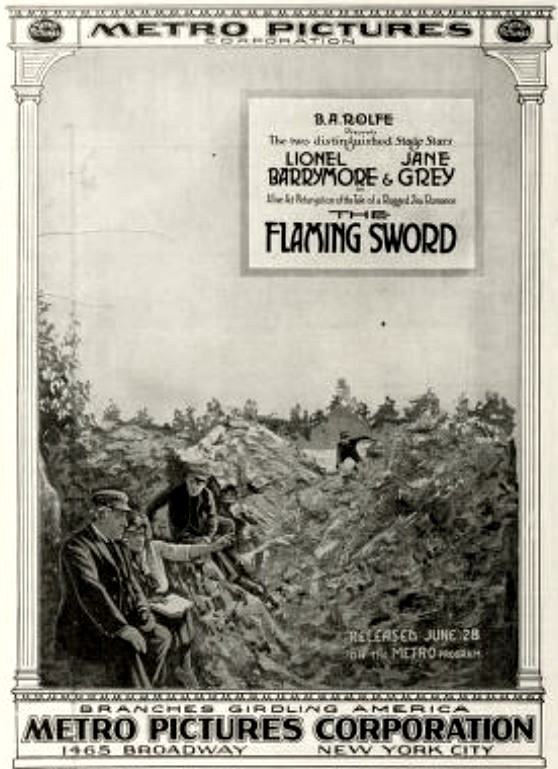
A definitive 7.6/10 rating for a film that redefined the boundaries of cult cinema. The Flaming Sword remains a cornerstone of transgressive art.
The Flaming Sword is less a narrative than a fever chart: mercury climbing, plummeting, climbing again, its red line scored across the parchment of a man who believes himself already a ghost. Director George Gibbs—working from his own briskly cynical novelette—opens on a banquet hall drenched in chiaroscuro, tuxedoed leeches toasting their host’s insolvency. Candles gutter like shortened lifelines; champagne flutes foam with the hysteria of the soon-to-be obsolete. Lionel Barrymore’s Steve, eyes raccoon-ringed by sleepless guilt, recites a valedictory that feels half Hamlet and half Wall Street suicide note. The camera, hungry for textures, lingers on a crystal decagon of brandy trembling in his grip—an omen that the film will return to images of containment, of spirits sloshing against glass borders they can never rupture.
Cut to the waterfront: a lone skiff swallowed by studio-built mist, the sail a triangle of palpitating white against carbon-black nitrate. This maritime exodus—filmed in a single dusk-for-night take—prefigures the existential drift that Scandinavian cinema would chase years later in Hämnaren. Yet unlike the Scandinavian revenger, Steve does not crave death so much as a blank horizon where the ledgers of sin dissolve. The ocean, that giant unblinking eye, instead delivers him to an island that looks birthed from the margins of an Arthur Rackham illustration: cliffs like broken incisors, a lighthouse tower skewering low clouds, and Meera—Edith Diestel’s virginal isolate—robed in sea-lichen greens, hair whipped into Medusan tendrils.
Diestel plays Meera with the unselfconscious wonder of someone who has never seen a mirror; when she first spies the unconscious Steve, her pupils dilate as though beholding a comet. Their ensuing rapport—rendered largely in tactile close-ups: calloused palm against alabaster wrist, salt crystals glittering like mica on collarbone skin—eschews the infantilizing tropes that maroon so many Northwoods melodramas. Meera is no child of nature spouting noble-savage platitudes; rather, she is a cartographer of solitude, mapping Steve’s desolation against her own. One exquisite shot silhouettes the pair inside the Fresnel lens room, the lantern’s rotating beam slicing through darkness to paint their faces with fleeting bars of phosphorescence—an optical metaphor for the film’s own stroboscopic morality.
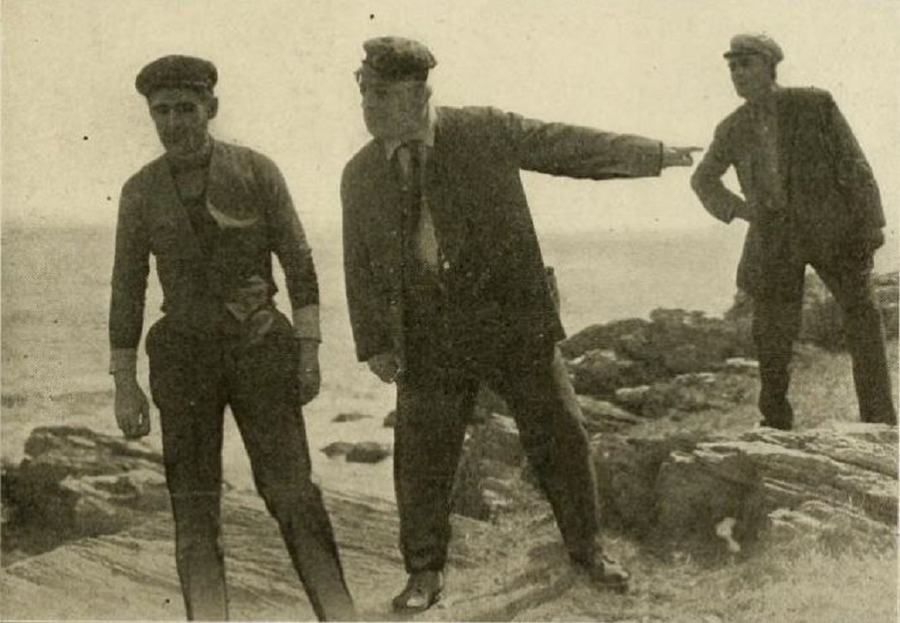
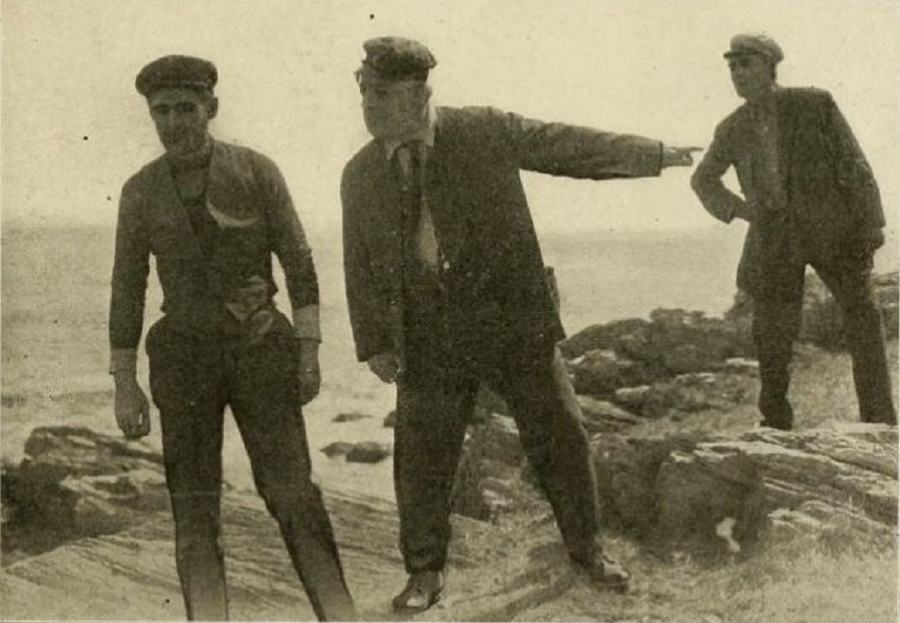
Barrymore, midway through the story, must pivot from shipwrecked wretch to surrogate son, and finally to unwilling heir of ancestral guilt. The actor’s instrument is primarily his back: when Calhoun (Charles Prince) learns the visitor’s parentage, Barrymore’s spine seems to telescope, vertebrae retracting like a threatened porcupine. It is silent-era physicality at its most eloquent, worthy of comparison to the spinal metamorphosis Lon Chaney would later weaponize in The Iron Strain. The script’s central contrivance—that Calhoun’s life-ruining enemy was precisely Steve’s estranged father—could have played as musty coincidence. Instead, Gibbs stages the revelation inside a cramped chart room, maps flapping like startled gulls, the lighthouse’s foghorn providing an elemental Greek-chorus groan that swells until it drowns out dialogue titles. The device retrofits fate into geography: sins as archipelagoes, bloodlines as tectonic plates.
Enter Maisie—Jane Grey’s flapper Fury—arriving by hired sloop in the film’s most baroque sequence. She steps onto jagged rocks wearing a satin evening cloak, its hem sodden with brine, as though she has portaged the city’s decadence to this hermitage. Grey delivers her confession—that Steve is “hers” by some unspoken urban covenant—with the clipped cruelty of a woman who has weaponized gossip all her life. The lie detonates Calhoun’s already scarred heart; his collapse is filmed from inside the lighthouse stairwell, the camera looking down as his body corkscrews into shadow. For a 1915 release, the moment is startlingly modern: no orchestral swell, no intertitle moralizing, just the thud of flesh on iron grating and the echo of a lantern chain clanging like a death knell.
What rescues the picture from melodramatic inertia is its commitment to moral relativism. Maisie’s retraction—whispered to Meera while gulls screech overhead—carries no absolution; the damage arteries through the plot like lye in well water. Calhoun’s subsequent forgiveness is staged as a tableau: the old man, half-paralyzed, tracing a finger across Steve’s palm, a mute acceptance that progeny need not carry the paternal curse. The final sail toward New York is shot at magic hour, the sloop skimming a molten path. Rather than close on a clinch, Gibbs favors a long shot: Steve and Meera as silhouettes, city skyscrapers rising like crystallized regret on the horizon. The image reframes the entire narrative as a Möbius strip: escape and return, damnation and grace fused in one continuous loop.
Technically, the surviving 35 mm print (rescued from a Maine barn in 1978) reveals cinematographer George W. Hill’s avant-garde flair for double exposures. In the storm sequence, wave foam is superimposed over Steve’s delirious face; each breaker becomes a visual palimpsest of conscience. Contrast this with the relatively sedate maritime footage in Shore Acres, and you appreciate how The Flaming Sword pushes the medium’s syntax. The tinting strategy—amber for interiors, viridian for ocean nights, rose for amorous close-ups—predates the more famous chromatic orchestration of The Cup of Life by a full year. Unfortunately, the 2014 2K restoration was limited to the incomplete Library of Congress reels; roughly seven minutes remain lost, including (rumor claims) a brief striptease by Maisie that censors slashed in 1917.
The intertitles, lettered in a spidery Art-Nouveau font, deserve special praise. They eschew the declarative bombast common to early features, opting instead for haiku-like compression: “The sea kept his secret—until the tide changed.” Such economy allies the film with the elliptical modernism later perfected by Scandinavian silent cinema, cousins to the laconic cards found in La voix d’or. Contemporary reviewers carped that the story’s resolution felt rushed; Variety’s 1915 notice griped, “one reel too many at the start, one too few at the finish.” Yet that briskness now reads as merciful. In an era when melodramas such as A Factory Magdalen belabored every twist, The Flaming Sword trusts the viewer to intuit subtext in a glance, a tremor, a sail dwindling to speck.
Performances oscillate between the operatic and the whispered. Barrymore’s eyes—bulbous, sorrow-laden—carry the weight of an entire class’s dissolution, prefiguring John Gilbert’s haunted roués of the late twenties. Edith Diestel, a Danish dancer plucked from Broadway, conveys Meera’s awakening through micro-gestures: an index finger tapping her own collarbone, as though verifying the existence of a pulse. Charles Prince, saddled with the thankless “avenging patriarch” archetype, nevertheless etches pathos into his final scene: his left hand clawing at a wool blanket while the right, surprisingly gentle, gifts Steve a pocket compass—an acknowledgment that direction, not destination, constitutes mercy.
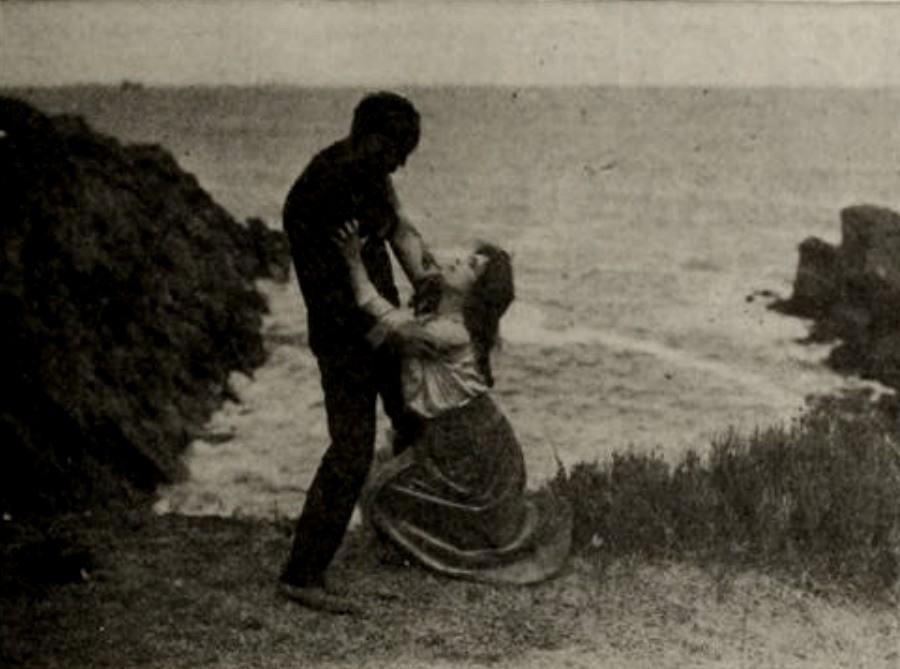
Themes? Take your pick: the bankruptcy of the leisure class, the Anthropocene’s indifferent brutality, the heredity of ethical debt. Yet the film’s most piercing current is erotic existentialism—desire as proof of being. Meera’s fascination with Steve’s chest hair (she timidly touches it, then darts away) mirrors Steve’s awe at her untamed eyebrows. In that mutual inspection, the island becomes not Eden but a laboratory where two anatomies of loneliness synthesize a new grammar of intimacy. Compare this with the rather chaste courtship in The Ring and the Man, and you sense how close early Hollywood skirted to the erotic candor European cinemas would soon flaunt.
Is the movie flawless? Hardly. The comic-relief servant Tooko—played by Japanese actor H. Togo in cringe-inducing yellowface—pops up with monkey-grimaces, a grim reminder that even progressive silents trafficked in racial caricature. And the narrative’s gender politics, though forward for 1915, still frames Meera’s agency through male rescue. Yet even these blind spots fascinate; they expose the cultural fault lines over which early cinema limped toward enlightenment.
In the current renaissance of archival restorations—think Vendetta’s 2023 4K bloom—The Flaming Sword demands rediscovery. Its DNA reverberates through everything from Sullivan’s Travels to The Piano, its island-as-mirror trope recycled by filmmakers who likely never knew their predecessor. Critics who revere the maritime fatalism of Paris Apaches or the familial vendettas in Brother Officers will find here a missing link, a celluloid Rosetta Stone decoding how American silent cinema could fuse pulp with poetry, storm with soul.
So, should you stream, rent, or fly across continents to catch a rare 16 mm print in a Bologna archive? Absolutely. Bring a flask of something smoky, a heart condition for tempests, and enough hindsight to appreciate how 1915 already suspected that redemption is never a cathedral but a raft, lashed together from splinters of folly, regret, and—if the tide is kind—love.
IMDb 6.8
1932
Community
Log in to comment.