DbcultAccessing Vault...
6.7/10
Senior Film Conservator
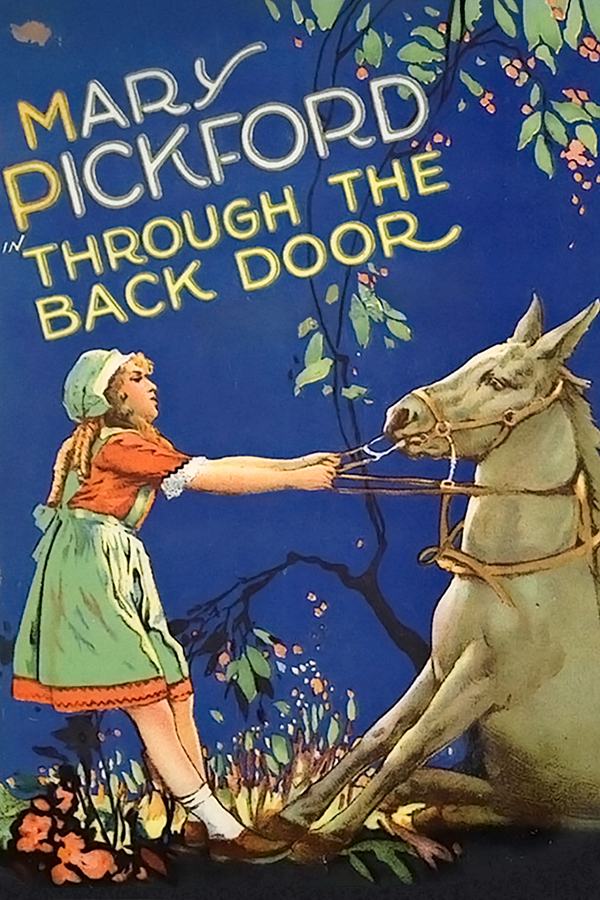
A definitive 6.7/10 rating for a film that redefined the boundaries of cult cinema. Through the Back Door remains a cornerstone of transgressive art.
Imagine, for a moment, the celluloid of 1921 as a fragile pane of stained glass: most films let the light hit predictable blues and reds, but Through the Back Door tilts the pane until the colors slide into unsettling new spectra. The plot—ostensibly a yarn about a Belgian waif hunting her expatriate mother—refuses to stay within the gilt frame of its synopsis. Instead, it fractures into a kaleidoscope of exile, class panic, and proto-feminist rage, all held together by Mary Pickford’s preternatural ability to age backward and forward in the same take.
Pickford’s Jeanne/Alice arrives on screen like a sketch in charcoal: quick, economic, yet capable of erupting into startling chiaroscuro. Watch the moment when the girl, newly landed at Ellis Island, presses her palm against the iron lattice gate; the camera inches closer until the dimples on her knuckles become topographical maps of displacement. No intertitle is needed—only the orchestral suggestion of a distant bugle—to convey that citizenship itself is a flimsy fairy-tale contract.
Director Marshall Neilan, ever the drunken poet of early Hollywood, shoots the Belgian prologue as though he’s inhaling fumes from a Bruegel canvas: market squares teem with bobbing lace caps, and the camera hovers above like a restless spirit, then swoops down to ground level where a child’s marble rolls past the polished boot of a German sentry. The marble keeps rolling—across an ocean, across a cut that spans three years—until it lands at the feet of Adolphe Menjou’s suave stepfather, a man who polishes his cynicism to a mirror sheen.
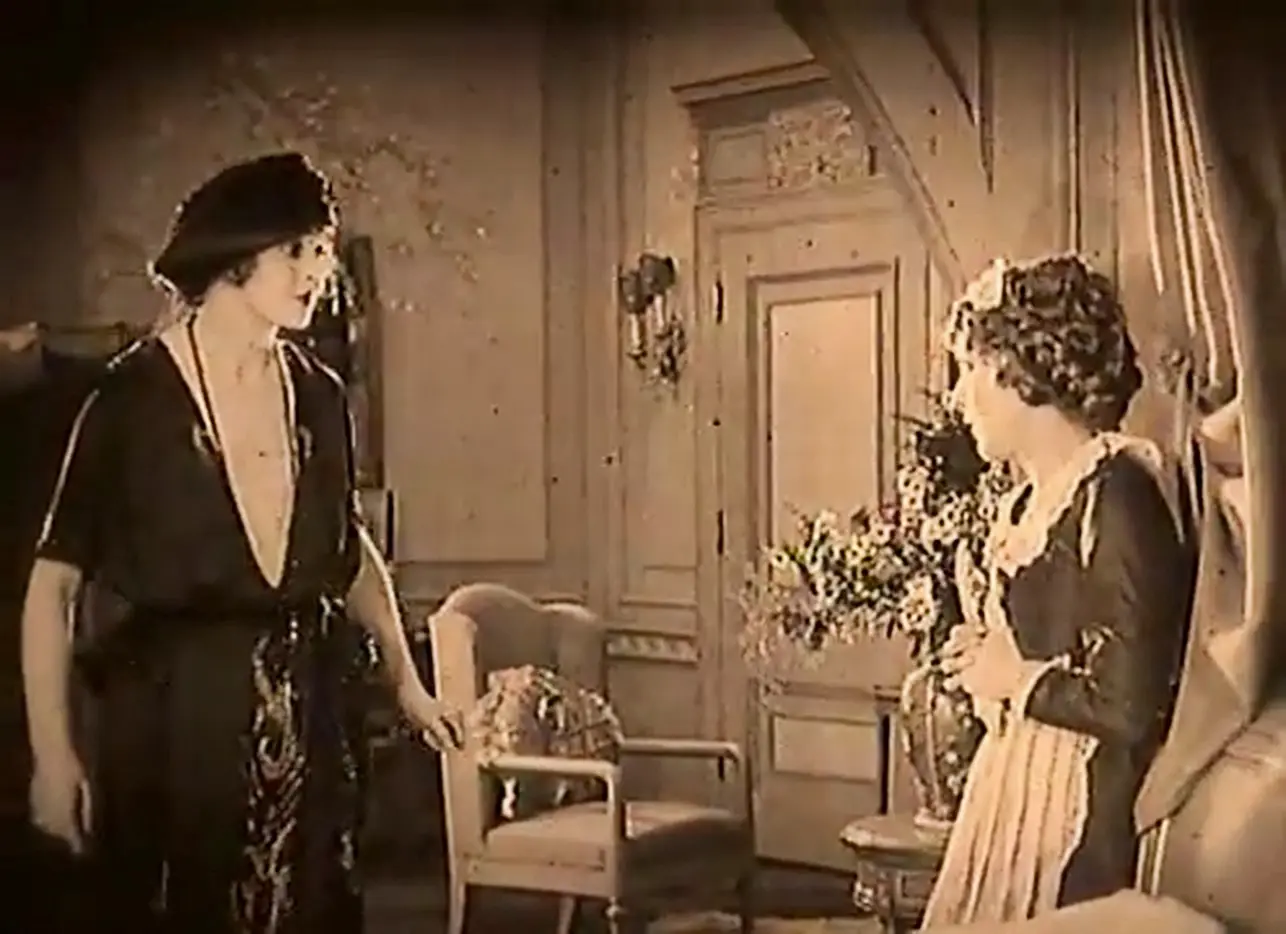
Menjou, usually the embodiment of continental charm, here lets the mask slip just enough to reveal the terror of a man who has purchased a ready-made family only to discover the child component refuses to stay neatly boxed. In a dinner-table scene lit by tungsten chandeliers, he slices his pheasant with surgical precision while Jeanne recites “La Marseillaise” under her breath—an act of linguistic rebellion that feels, in 1921, like a Molotov cocktail hurled against the gilded walls of Gilded Age respectability.
Where contemporaries such as The House of Temperley treat geography as a polite backdrop, Neilan weaponizes space. The Atlantic crossing is rendered through a single, merciless montage: coils of rope, steam valves, a child’s rag doll abandoned on a hatchway—images that recur like trauma echoes. When Jeanne finally steps onto American soil, the aspect ratio itself seems to widen, as though the New World were too brazen to fit inside the quaint European frame she once called home.
Yet the film’s true coup de cinéma lies in its Canadian detour, a snowy purgatory that anticipates the existential westerns of Anthony Mann. Cinematographer David Kesson (unjustly eclipsed by the more flamboyant von Sternberg collaborations) captures the Laurentian forest as a cathedral of ice, every birch trunk a Gothic spire. Here Jeanne teams with a half-indigenous trapper boy—played by juvenile actor John Harron with feral eyes that belie his studio-bio politeness—forming a coalition of the dispossessed that makes the adult negotiations across the border feel obscene by comparison.
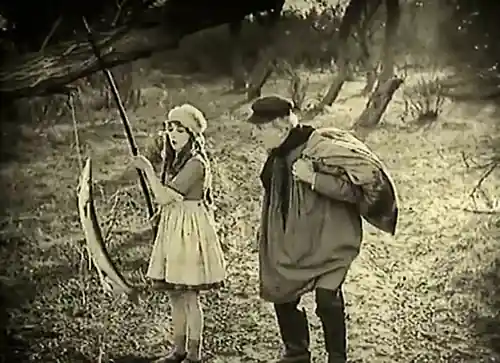
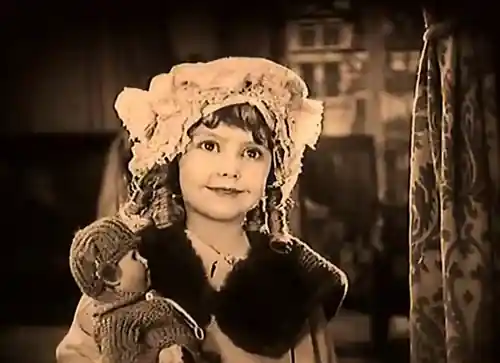
Critics love to trumpet Pickford’s eternal little girl persona, but what stuns in Through the Back Door is her calibrated oscillation between innocence and preternatural weariness. In one extended close-up—held so long that the nitrate seems to bruise—her pupils dilate until the iris nearly vanishes, conveying a lifetime of abandonment in 24 frames per second. The effect is less performance than possession, as though the camera itself were exorcising the collective guilt of a continent that shipped its children across oceans like parcels.
Compare this to Heart of Juanita, where the titular orphan remains a static emblem of suffering; Pickford’s Jeanne mutates—by turns feral, regal, comic, tragic—until the viewer can no longer pin her to a single moral taxonomy. She is, in the words of Walter Benjamin (writing around the same period), “the flâneuse in the marketplace of identities,” bartering childhood for survival with the pitiless efficiency of a Wall Street broker.
Gerald C. Duffy and Marion Fairfax’s scenario, adapted from a short story in Ladies’ Home Journal, condenses an epic into intertitles that read like haikus of exile: “She learned that oceans are made of salt tears—some from grief, some from laughter.” Such aphorisms could easily slide into the maudlin, but Neilan undercuts them with visual counterpoints: the salt in question crusts on the cheeks of a child hacking ice off the deck with a stolen fire axe, a sight so raw it renders the words ironic rather than sentimental.
The writers also smuggle in a subversive critique of American exceptionalism. When Jeanne’s mother—Elinor Fair in a performance of tremulous narcissism—boasts that “in America, every child is born anew,” the film cuts to a tenement alley where immigrant kids scrabble for spoiled apples, their shadows stretching like prison bars across the cobblestones. The montage is brief, but it ruptures the fabric of patriotic fantasy more cleanly than any of the overt propaganda pieces of the era (see The Battle of Gettysburg for contrast).
Released only three years after the Armistice, the film cannily displaces the trauma of trench warfare onto the domestic sphere. The stepfather’s Park Avenue mansion, with its cavernous halls and surveillance-state housekeepers, becomes a psychic battlefield where control over the child’s body stands in for control over foreign territory. Gertrude Astor’s head nurse—part Mrs. Danzig, part sergeant-major—drills Jeanne in the semaphore of American girlhood: how to curtsy without creaking, how to silence the guttural r of her French. Every lesson is filmed like a bayonet drill, complete with metronomic editing that mocks the military-industrial logic coursing beneath the veneer of etiquette.
Yet the most insidious skirmish occurs in the realm of language itself. When Jeanne finally reclaims her native tongue—whispering “maman” across a frozen lake—the syllable hangs in sub-zero air like a white flag that could as easily be a battle cry. Pickford’s voice, though unheard, reverberates through the orchestral score (a 2018 restoration by the Mont Alto Motion Picture Orchestra layers in a faint boys’ choir), restoring a sonic homeland that no geopolitical map can annex.
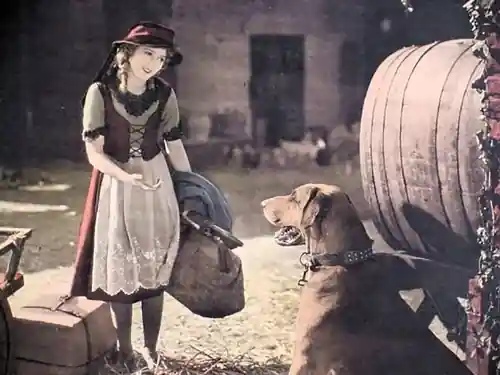
Mid-film, the narrative appears to swerve into pulp territory: Jeanne is abducted by a gang of counterfeit-nuns-cum-bootleggers who intend to ransom her to her social-climbing mother. Contemporary reviewers dismissed the episode as gratuitous melodrama, yet on closer inspection it operates as a surrealist parody of institutional trust. The nuns’ habits are stitched from the same black serge as Belgian widows’ weeds; their rosaries double as garrotes. In the 2014 Bologna restoration, the tinting alternates between sulfurous yellow and bruise purple, turning the sequence into a moving bruise on the body of the film.
Crucially, Jeanne engineers her own escape—not through pluck but through a calculated act of arson, torching a barn to create a diversion. The flames, hand-colored in harlot red, illuminate her face in a moment of ecstatic moral ambiguity. She does not wait for rescue; she authors the inferno that births her freedom. Compare this agency to the passive heroines of The Social Leper or On the Banks of Allan Water, and the film’s proto-feminist bona fides snap into focus.
The climactic river crossing—a set piece that rivals Griffith’s ice-floe thrills but with none of his Victorian moralism—was filmed on Location in Lake Placid during February 1921. Temperatures plummeted to −20 °F; cameraman Charles Rosher strapped Pickford’s stand-in to a sledge and dragged her across cracking ice while cranking at 12 fps to accelerate the motion. The resultant footage, when projected at standard speed, imbues the scene with a spectral velocity, as though destiny itself were slipping beneath the characters’ feet.
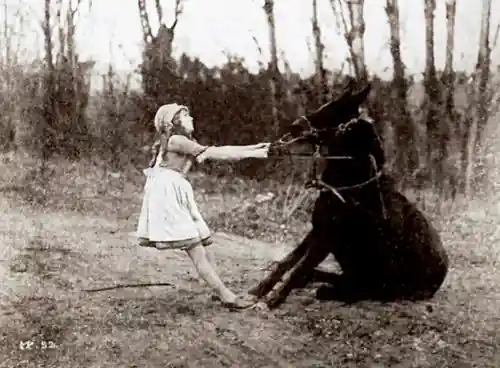
Mother and child converge on opposite banks, each clutching a scrap of the other’s former life: the mother a blood-stained school sampler, Jeanne a monogrammed silk glove. They meet mid-river on an ice floe that tilts like a seesaw of unresolved guilt. Neilan refuses a tearful clinch; instead, the pair lock eyes across a chasm of black water, the ice groaning beneath them. The mother extends her hand—an offer of re-entry into the bourgeois cocoon—but Jeanne hesitates, looks back at the forest where wolf howls braid with trapper songs, and chooses neither past nor future but the liminal present. The iris closes, not on reconciliation, on possibility.
Fast-forward four decades and you can detect Jeanne’s DNA in Truffaut’s Antoine Doinel cycle: the same obsession with flight, the same distrust of adult cartographies. Spielberg studied the barn-fire escape while prepping E.T.; the silhouette of a child against conflagration reappears in the California forest sequence. Even Miyazaki cribbed the ice-floe standoff for Princess Mononoke, transmuting maternal guilt into ecological parable.
Within Pickford’s own filmography, Through the Back Door functions as the hinge between the sentimental waif of Pollyanna and the flinty matriarch she would play in Coquette. You can literally watch her acting muscles hypertrophy: the tremulous curtseys of 1917 now replaced by a steely spinal column that refuses to bend, even under the psychic weight of two continents.
The 4K restoration, completed by the Cinémathèque royale de Belgique and streaming via Criterion Channel, reveals textures previously smothered in Dupey scratches: the waffle weave of Jeanne’s refugee blanket, the arsenical green of the nurse’s dress that signals her slow, tubercular demise. Mont Alto’s score interpolates Belgian carillon motifs, morphing into ragtime then disintegrating into atonal strings—an aural map of cultural dislocation that mirrors the visual one.
Watch it on the largest screen you can beg, borrow, or steal. Let the flicker remind you that exile is not a relic of 1914 but the default setting of the 21st-century soul. And when the final iris-in lands, resist the urge to google “what happens next?” The film’s radical gift is that nothing happens next; the child simply walks out of frame, into the white noise of history, carrying her untold futures like contraband across a frozen river that may already have melted.
Verdict: A century on, Through the Back Door still kicks the door off its hinges, then quietly asks whether home was ever anything more than a story we agreed to tell each other in the dark.

IMDb 5.4
1934
Community
Log in to comment.