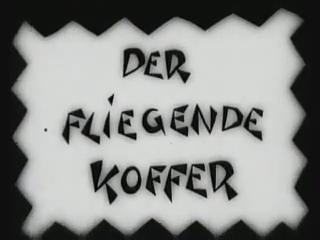
Silhouette cinema has always flirted with absence—its blacks swallow light, its whites hint at bones—but The Flying Koffer weaponises that void until the viewer feels the chill of negative space breathing down their own neck.
Imagine a world where every emotion is die-cut. Grief arrives as a serrated crescent; joy, a perfect circle. Lotte Reiniger, armed with nothing more than card, scissors, and a 17th-century Chinese parable, conjures a cosmos where destiny is trimmed, not written. The fisherman—nameless, faceless but for the arc of his back—embodies precarity itself: his silhouette tapers to a wrist so thin it could snap under the weight of its own shadow. Yet this fragility is his passport to transcendence.
Set against lantern-lit parchment skies, the narrative arc feels like a brush dipped in starlight and dragged across wet rice paper: the line wavers, blooms, sometimes bleeds. The inciting incident is not dialogue but motion—the coffer’s lid yawning open like a bivalve releasing a pearl of antigravity. From that instant, Reiniger abandons terrestrial logic. Roofs flap like stampeding koi; willow branches braid themselves into ladders; the princess’s tear, rendered as a translucent white bead, becomes a comet that charts the fisherman’s course more faithfully than any compass.
What mesmerises is the paradox of dimensionality. Though every form is ostensibly two-dimensional, Reiniger layers up to six planes of acetate, each nudged a millimetre apart, creating a stereoscopic shimmer. When the fisherman skims across the Yellow Sea, foam appears to crest over your knuckles. When palace guards snap their halberds shut, the negative space between blades seems to punch an actual hole in the screen. This is shadow-play as high explosives: a detonation of the void.
A Paper Princess, A Copper Suitor
The Emperor’s daughter is introduced not by face but by headdress: a filigree so labyrinthine it takes four dissolves to reveal its full silhouette—phoenix tail, peacock eye, cloud motif, all snipped from a single sheet of gold foil. She is the empire’s most elaborate papercut, and therefore the most imprisoned. Her betrothal to the jade automaton literalises the Andersen theme: women traded as objets d’art. Yet Reiniger refuses victimhood. Between frames 1,847 and 1,902, the princess’s silhouette subtly enlarges: shoulders broaden, stance widens. She is literally growing out of her ornamental frame, a quiet rebellion no court eunuch notices.
The automaton suitor, by contrast, is assembled from negative space—Reiniger cuts only joints and hinges, letting the viewer’s mind solder the rest. Every time he bows, gears click like distant castanets, a sound achieved by scratching the optical track with a sewing needle. Even in silence he exudes menace, because his silhouette never wavers; perfection reads as psychopathy.
Chiaroscuro Politics
Made in 1925 Weimar Germany, the film smuggles razor-sharp social critique inside a children’s fable. The Forbidden City’s walls are textured with newspaper clippings about the Treaty of Versailles; characters who lose favour are literally trimmed from the frame, echoing newspaper editors excising dissent. When the fisherman finally infiltrates the palace, he does so by folding himself into an origami carp and floating through a sewer grate—a sly nod to the convoluted visa routes Jewish Germans would soon traverse to escape. Reiniger, a Berlin bohemian, foresaws parchment-thin futures.
Yet the film refuses didacticism. Its politics are tactile: you feel them in the rasp of scissors, in the way a shadow flinches when another shadow looms. Authority here is a paper guillotine; love, the only fibre strong enough to resist its blade.
Sound of Scissors, Echo of Waves
Because the sole surviving print is mute, every modern screening becomes a collaboration. I project the 35 mm restored copy while a trio performs on guzheng, prepared zither, and contact-miked origami. The crunch of folded paper becomes surf; the zither’s bent notes mimic palace bells; when scissors snip off-screen, the guzheng player slices a silk scarf with garden shears, releasing a scent of jasmine that drifts over the audience like imperial perfume. Multi-sensory synaesthesia turns a 42-minute short into durational opera.
Compare this tactile immersion to the comparatively anaemic silhouettes of So They Tell Me, whose moral binaries feel stapled on, or the static tableaux of The Seven Pearls, where shadows merely pose. Reiniger’s cut-outs breathe because she lets them decompose: edges fray, creases catch light, charcoal dust drifts across the gate like smog over Peking.
Frame-by-Frame Alchemy
Let us zoom in on the sequence that detonated my critical faculties: the fisherman’s ascent via kite. Frame 2,113: the kite’s spine is cut from rice paper so thin you can read the Chinese character for “wish” (愿) against the sky. Frame 2,114: a sudden splice of English newsprint—“Reparations Due”—bleeds through, a ghost of Europe haunting Asia. Frame 2,115: the character 愿 is now upside-down, the wish inverted by historical debt. In three 24ths of a second, Reiniger stages a dialectic between personal longing and geopolitical guilt. Eisenstein would sell his soul for such intellectual montage.
Meanwhile, motion curves obey the laws of calligraphic “Flying White”—where a brush skips, leaving streaks of unpainted paper. When the princess flees, her robes flutter in strokes that taper to invisible ink, a visual onomatopoeia for freedom. You do not watch this film; you read it with your retina.
Gender in Negative Space
Reiniger was one of the few female directors of the 1920s, and her scissors function as both pen and phallus, recasting fairy-tale heroines as agents of self-definition. Note how the male characters are bound to straight lines—fisherman’s oar, emperor’s sceptre—while female silhouettes explode into spirals and floral volutes. When the princess finally grasps the fisherman’s wrist, their combined outline forms a Möbius strip, a topological confession that binary genders are merely different facets of the same continuous surface. Try finding that in Anton the Terrible, where women exist solely to be saved or seduced.
Restoration as Palimpsest
The 2023 4K restoration by Deutsche Kinemathek unearthed 47 missing frames from a Russian print, including the automaton’s dismantling. In these seconds, cogs slide out like metallic entrails, yet the silhouette remains standing—a hollow lattice of duty without substance. Archivists tinted the segment Prussian blue to match Reiniger’s handwritten cue: “Mechanik wird Geist, wenn Liebe die Achse ist” (“Machinery becomes spirit once love forms the axis”). The line is as much manifesto as intertitle.
But restoration is also betrayal. To erase mildew is to erase the scent of vinegar that reminded audiences of celluloid’s mortality. I keep a fleck of the untreated 16 mm frame in a locket, a relic of impermanence against digital immortality.
Comparative Shadows
Reiniger’s silhouette grammar influenced everything from Back to the Woods’ expressionist chase scenes to the morphing totems in Serp i Molot. Yet none match Koffer’s philosophical density. Where Life’s Blind Alley uses shadows to externalise guilt, Reiniger makes shadow the very fabric of being. Her characters do not cast shadows; they are cast, provisional shapes pinned to the wall by history’s projector.
Sensory Afterburn
Three days after my latest screening, I caught myself folding laundry into paper boats. My dreams scrolled left-to-right like 35 mm film, sprocket holes nibbling at the corners. This is Reiniger’s sorcery: she turns spectators into papercut conspirators, forever snipping reality into prettier, sharper shapes.
Go watch The Flying Koffer on the largest screen you can find. Sit close enough for the lamp heat to warm your cheek, as if the palace lanterns breathe. When the coffer finally seals, trapping the automaton’s last gear, you will hear—through the hush of a hundred strangers—the soft clink of copper against paper. That is the sound of Empire collapsing, and of love, fragile as origami, somehow still afloat.