DbcultAccessing Vault...
Cult Review
Senior Film Conservator
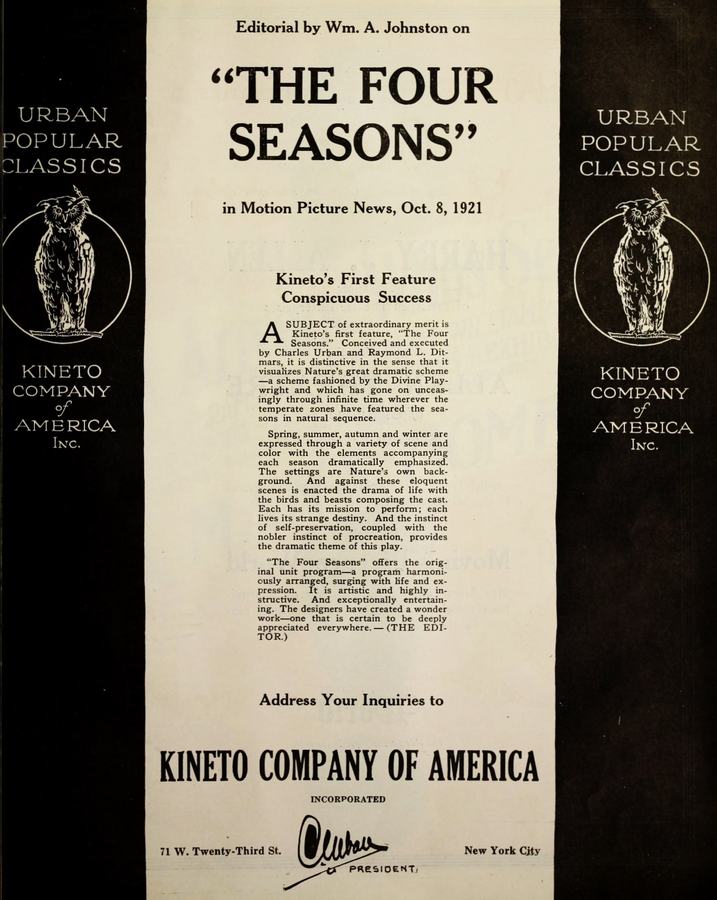
In the nascent years of the twentieth century, the cinematic medium was largely preoccupied with the theatricality of human melodrama or the slapstick antics of the vaudevillian tradition. However, Raymond L. Ditmars, a man whose sensibilities were as much rooted in the herpetological archives of the Bronx Zoo as they were in the burgeoning possibilities of the silver screen, offered a radical departure with The Four Seasons. This 1921 documentary is not merely a record of environmental shifts; it is a profound meditation on the persistence of life, a visual symphony that captures the silent, grinding gears of the planetary clockwork. While contemporary audiences were flocking to see the moral complexities of The White Dove, Ditmars was inviting them to witness a different kind of truth—one that predates civilization and will undoubtedly outlast it.
The structural integrity of 'The Four Seasons' rests upon its refusal to anthropomorphize its subjects. In an era where films like It's a Bear utilized animals for comedic relief, Ditmars treated his subjects with a reverent, almost clinical distance that somehow achieved a higher level of intimacy. The centerpiece of the film—the shedding and subsequent regrowth of a deer's antlers—is presented with a patience that borders on the transcendental. We see the stag not as a character in a fable, but as a vessel for the seasons themselves. The heavy, calcified crown of winter falls away, a divestment of the old self that feels almost elegiac. Yet, the rapid emergence of velvet-clad buds in the spring signals a biological optimism that no scripted drama could hope to replicate.
This cycle of loss and gain provides a rhythmic backbone to the film. Ditmars’ camera lingers on the subtlest transitions: the hardening of the ground, the skeletal architecture of deciduous trees against a grey sky, and the eventual, explosive return of chlorophyll. The lexical diversity of the natural world is here translated into a visual language of texture and light. Unlike the frantic pacing found in The Terror of the Range, the pacing here is dictated by the sun and the soil. It is a slow cinema before the term ever existed, demanding that the viewer synchronize their pulse with the slow throb of the earth.
One must acknowledge the technical audacity required to produce such a work in 1921. Nature cinematography was in its infancy, plagued by the limitations of bulky hand-cranked cameras and the unpredictable temperament of natural lighting. Ditmars, however, possessed a curator’s eye for detail. His compositions are frequently startling, capturing the macro-realities of flora with a clarity that rivals the psychological depth of The Birth of Character. There is a specific shot of a seedling breaking through the crust of the earth that feels like a monumental triumph, a silent explosion of vitality that resonates more powerfully than the choreographed stunts of the day’s action serials.
The film’s lack of a traditional protagonist is its greatest strength. While Lady Audley's Secret relied on the machinations of human deceit to drive its plot, 'The Four Seasons' relies on the inevitability of the equinox. This creates a sense of cosmic scale. The viewer is reminded of their own transience. We are mere observers of a process that has repeated for eons. The deer, the squirrels, the burgeoning wildflowers—they are not performing for us; they are simply being. This ontological honesty is what separates Ditmars from his peers who were more interested in the artifice of the studio.
When placed alongside the melodramatic intensity of The Clemenceau Case or the brooding atmosphere of Fantomas - On the Stroke of Nine, 'The Four Seasons' appears almost avant-garde. It ignores the conventions of the 'well-made play' and instead embraces the chaotic, beautiful spontaneity of the wild. There is no moralizing here, no didactic lesson on the virtues of man. Instead, Ditmars presents a world of absolute neutrality. The predator and the prey are both subject to the same seasonal whims. The harshness of winter is not a villain, and the warmth of summer is not a hero; they are merely states of existence.
Consider the way the film handles the concept of 'home.' In narrative films like Bond of Fear, the home is a site of domestic conflict or refuge. In Ditmars’ work, the 'home' is the entire landscape. It is a shifting, breathing entity that provides and withholds in equal measure. The animals' adaptations—their changing coats, their food storage, their migratory patterns—are the true 'dialogue' of the film. It is a conversation between the organism and its environment, conducted in the language of survival.
Visually, the film benefits from the high-contrast aesthetic of early black-and-white stock. The snow of winter possesses a crystalline brilliance that feels almost tactile, while the deep shadows of the summer forest provide a sense of cool relief. There is a painterly quality to Ditmars’ framing that recalls the Hudson River School, yet it is infused with a kinetic energy that only film can provide. The movement of a brook, the fluttering of a leaf, the twitch of a rabbit’s nose—these small gestures are elevated to the status of high art.
In comparison to the stylized performances in A Model's Confession, the 'performances' in 'The Four Seasons' are refreshingly unselfconscious. There is a purity to the movement of the stag that no actor could ever hope to emulate. This purity extends to the film’s editing, which follows a logic of proximity and transition rather than dramatic escalation. We move from the micro to the macro, from the individual bud to the sweeping vista, creating a holistic view of the world that was remarkably sophisticated for its time.
It is easy to look back at 'The Four Seasons' from our current vantage point of high-definition, drone-assisted nature documentaries and see it as primitive. But to do so would be to miss the revolutionary spirit that animates it. Ditmars was a pioneer, attempting to bridge the gap between scientific inquiry and public entertainment. He understood that by showing the public the intricate beauty of the natural world, he was making a case for its preservation. While films like A Man and His Mate explored the primal nature of human relationships, Ditmars explored our relationship with the planet itself.
The film also stands as a precursor to the environmentalist movement. By highlighting the interconnectedness of the seasons, Ditmars illustrated the fragility of the balance. If one season were to fail, the entire system would collapse. This message, though silent and subtle, is perhaps more relevant today than it was in 1921. The stag’s antlers will always grow back, provided the spring continues to arrive. But Ditmars subtly asks: what happens if the cycle is broken? It is a question that haunts the edges of the frame, even in its most beautiful moments.
Ditmars’ background as a curator of reptiles and a noted entomologist meant that he approached filmmaking with a different set of priorities than the typical Hollywood director. He wasn't interested in the 'star system' or box office receipts in the same way the producers of Daring Lions and Dizzy Lovers might have been. His goal was education through immersion. He wanted the audience to leave the theater with a deeper understanding of the world they inhabited, not just a temporary escape from it.
This educational bent doesn't make the film dry or academic. On the contrary, there is a sense of wonder that permeates every frame. Ditmars captures the 'marvelous' in the mundane. A simple frost-covered branch is treated with the same cinematic reverence that a director like Victor Sjöström might give to a dramatic revelation in Revelj. It is this elevation of the ordinary that gives the film its lasting power. It teaches us to look closer, to see the complexity in the simple, and to appreciate the profound drama of existence that unfolds in our own backyards every single day.
In the grand tapestry of early cinema, 'The Four Seasons' remains a singular thread. It lacks the explosive action of Noris or the social critique of Bill's Opportunity, but it possesses something far more enduring: a connection to the eternal. It is a film that breathes. It is a film that grows. It is a film that understands that the greatest story ever told is not one of human ambition or romance, but the story of life itself, endlessly renewing, stubbornly persisting, and infinitely varied.
Watching 'The Four Seasons' today is a meditative experience. It strips away the noise of the modern world and returns us to a state of primal observation. We become like the stag, waiting for the thaw, or like the trees, bracing for the wind. Raymond L. Ditmars didn't just make a movie; he captured a heartbeat. It is a heartbeat that continues to thrum beneath the surface of all things, a silent reminder that we are all part of a much larger, much older, and much more beautiful story than we often care to admit. For anyone interested in the roots of documentary film, or simply in the quiet majesty of the world around them, this film is an essential, luminous experience that transcends the boundaries of its era.
IMDb 5.6
1935
Community
Log in to comment.