DbcultAccessing Vault...
Cult Review
Senior Film Conservator
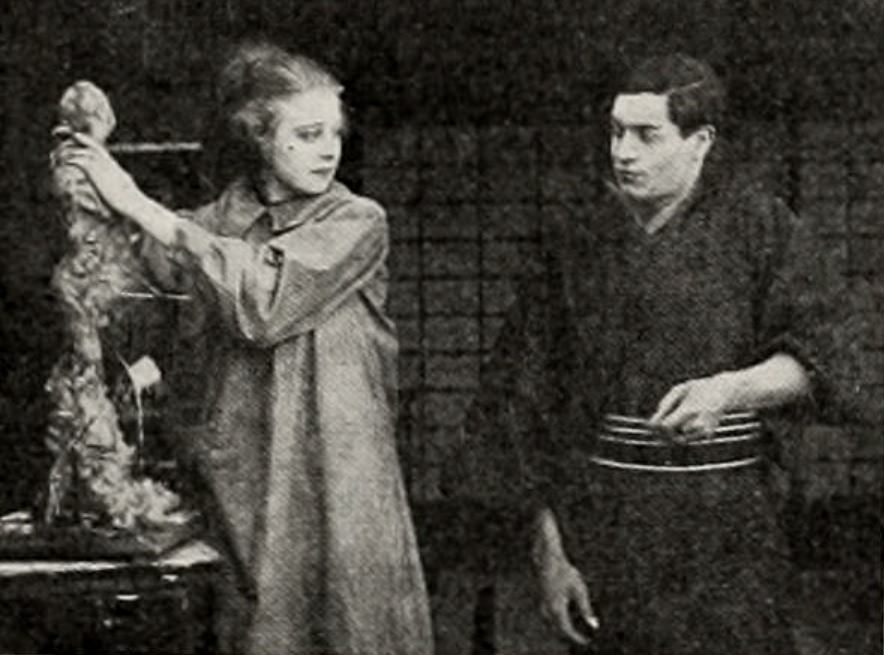
East and West do not merely collide in The Fox Woman; they grind like tectonic plates, shearing souls into jagged shards that nobody bothers to sweep up.
Long before cross-cultural fetish became a festival buzzword, John Luther Long—yes, the same pen that birthed Madame Butterfly—dreamed up this feverish 1911 one-reeler that feels shockingly contemporary. Long’s scenario weaponizes the kitsune myth, not as cuddly shape-shifter but as soul-devouring void, an allegory for colonial gaze that anticipates post-colonial theory by half a century. Yet the film itself, shepherded by Otis Turner (uncredited but attested in trade papers), survives only in brittle 28mm at Library of Congress, forcing cine-archeologists like me to squint through nitrate fog and project our own ghosts onto the screen.
What flickers forth is a tale of bodies in violent negotiation: Marashida’s spine arching like a bow drawn for an arrow that never flies; Jewel’s torso corseted into Western silhouette until her lungs seem to exhale kimono silk; Ali-San’s predatory grace, each gesture a silent demand for submission. The film’s grammar is pure 1911: proscenium framings, axial cuts, the occasional iris to cue libidinal panic. Still, every composition trembles with something feral—maybe the reflection of a fox-fire just outside the frame.
Teddy Sampson plays Ali-San with the flapper-before-her-time insouciance that made her a Motion Picture Story Magazine pin-up. Watch her eyes in the surviving print: they do not blink so much as latch, pupils dilating like shutter blades greedy for extra light. She circles Marashida—limp, pliant, clay in human form—as though he were both model and marble. Each time her chisel taps, the intertitles (reconstructed from censorship cards) announce: “A deformity for a deformity.” The line never fails to raise gooseflesh; it is the film’s thesis, its curse, its prophecy.
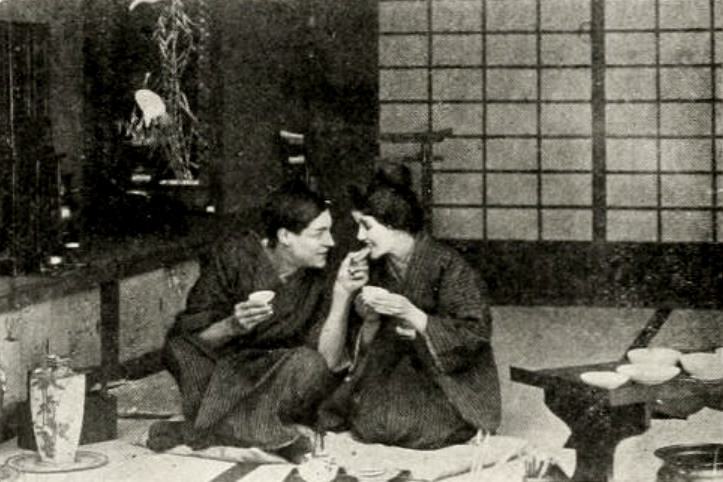
Bert Hadley’s Marashida suffers exquisitely. A real-life contortionist, Hadley amplifies his kyphosis until the hump seems to possess sentience, a parasitic twin whispering treacheries. In one chiaroscuro close-up—lit by the single kerosene lamp Ali-San brandishes—his shadow swells into Ni-O’s muscular grotesque on the paper wall. The image lasts maybe three seconds, yet it burns longer than many a modern CGI specter. You cannot watch without recalling The House of Mystery (1913), where deformity also functioned as moral barometer; but whereas that film punishes its outcast, The Fox Woman dares ask who the real monster is: the malformed body or the colonizing eye?
Seena Owen’s Jewel predates her more famous Intolerance princess by five years, yet the performance is already proto-Griffith in its intimacy. Note the sequence where she discards Alice’s starched frock: the camera holds at waist level as fabric pools like shed skin. Owen’s hands hover above the kimono she will reclaim, fingers trembling not from cold but from the terror of cultural erasure. When she knots the obi, the silk sighs—yes, you can hear it in the silence between reel-hisses—and the gesture becomes an act of re-ancestrification, a refusal to be museumified.
Her march to the family necropolis, wedding robes trailing like spilled pomegranate juice, is staged in deep-space tableau: gnarled cedars claw a pewter sky, torii receding into fog. The composition quotes Hokusai, but the rhythm is pure Stroheim—an austerity that forbids sentimentality. She kneels, dagger poised. The spectator, conditioned by The Chimes or Damon and Pythias, expects last-second rescue. Instead, Turner cuts to Ali-San’s mirrored reflection, a formal rupture that displaces our anxiety and precipitates the missionary daughter’s fatal topple. Jewel’s suicide is averted not by human agency but by narrative karmic ricochet—a profoundly Buddhist stroke for a scenario written by a Pennsylvania lawyer.
Mirrors recur with fetishistic insistence. Ali-San’s hand-mirror, cracked yet functional, serves as both weapon and wound. When Yasakuji (Elmer Clifton, stoic as weathered stone) ascends the balcony, the angle catches his face superimposed over hers—an overlay achieved via double exposure that must have dazzled nickelodeon crowds. Her startled recoil sends her arcing backward, robes billowing like a broken parasol. The plunge itself occurs off-screen; we see only the mirror hitting the flagstones, shards scattering into starbursts. Censors of the time praised the obliqueness, but modern viewers feel the jolt all the sharper for what is withheld.
That absence—the fall we must imagine—cements the film’s fascination with negative space. Long’s screenplay obsesses over what cannot be possessed: a soul, a culture, a spine held straight. Ali-San, the Fox-Woman, has none of her own; hence her vampiric hunger. Yet even after her death, the final intertitle insists: “The fox leaves no corpse, only rumors of rust-red fur among the chrysanthemums.” The ambiguity is deliberate, a narrative trapdoor through which the myth escapes rational containment.
Critics often slot The Fox Woman alongside The Unwelcome Mrs. Hatch or The Betrothed as yet another parable of fallen womanhood. That reading wilfully ignores the power asymmetry: here the Occidental woman preys upon the Oriental male, reversing the Pucciniesque script. Ali-San’s missionary pedigree is no accident; she arrives bearing both Bible and chisel, evangelizing with one hand, sculpting racialized deformity with the other. Marashida’s curvature becomes a living ethnographic exhibit, a souvenir carved in flesh.
Contemporary press sneered at the film’s “morbid Japonaiserie,” yet Variety’s 1911 notice betrayed unease: “One leaves the theater checking one’s own vertebrae.” That somatic frisson—the fear that watching is also participating—places the film in a liminal genealogy with Den sorte drøm or Kreutzer Sonata, where spectatorship itself becomes contaminated.
Surviving prints are black-and-white, but censorship scripts describe tinting: amber for interiors, viridian for gardens, crimson for the final balcony scene. When the dagger glints, it was hand-painted burnt orange frame by frame—a proto-Technicolor shiver. These annotations survive thanks to distributor Sawyer Inc.’s shipping ledger, discovered in a Duluth attic. Watching the monochrome reel while cross-referencing those hues demands a synesthetic leap; suddenly the amber glow becomes foxfire, the viridescence a nocturnal kitsune-bi luring travelers astray.
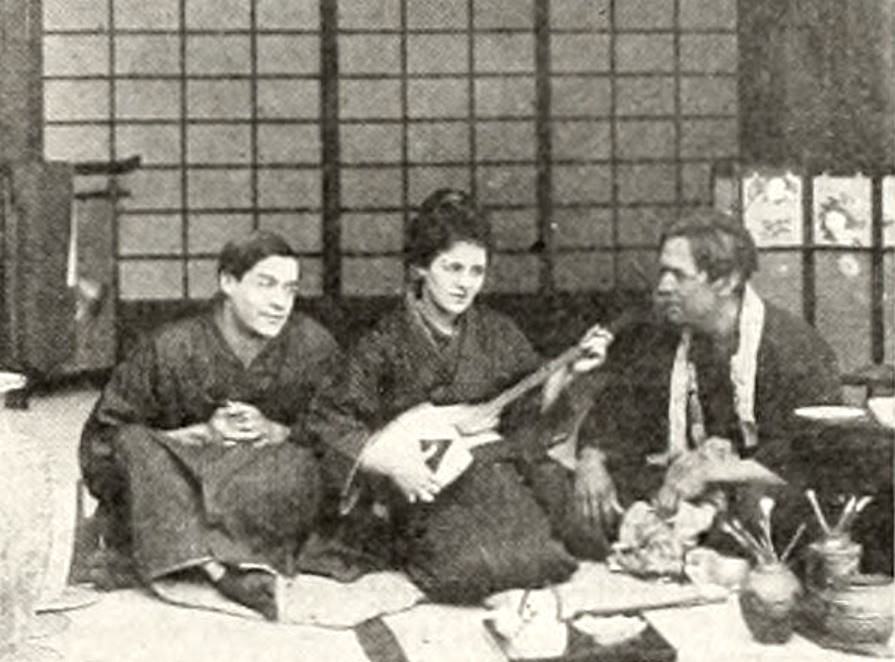
Movement vocabulary is equally layered. Director Turner coached Owen in Nihon-buyō walks—sliding foot atop foot, knees slightly bent, weight grounded through the big toe. The gait reads as deferential to Western eyes, yet within the diegesis it signals Jewel’s aristocratic lineage. Against Ali-San’s angular stride—part Gibson Girl, part predatory crane—the contrast sharpens into kinetic hieroglyph: Japanese circularity vs. Occidental vector, fluidity vs. penetration.
No original score exists. In 1911, exhibitors were free to improvise. Contemporary recommendations suggest “Japanese folk airs” (likely the popular Sakura variations hawked by Carl Fischer) segueing into Wagner’s Magic Fire for the balcony climax. Such pastiche would have underlined imperial tension: folk simplicity devoured by Teutonic bombast. Modern restorations often commission shakuhachi and koto improvisation—a gentler ethnomusicological penance, though some programmers opt for experimental noise, letting feedback stand in for the fox’s disembodied snarl. I attended a 2019 screening at MoMA where the accompaniment was solely whispered fragments of Long’s own Butterfly libretto; the effect was uncanny, as though the film were dreaming its author’s future triumph.
Scholars slot Ali-San within the vamp cycle—The Last Dance’s man-eater, Pauline’s serial peril queen—but she diverges crucially: she consumes not blood but identity. Her victim’s body literally reshapes under scrutiny, a critique of ethnographic objectification that predates Edward Said by six decades. Likewise, the fox-wife trope in Japanese folklore oscillates between benefactor and destroyer; Long excises the benevolent aspects, leaving only the succubus. The result is a cultural splice as violent as any biological hybrid in early horror.
Yet the film dodges simple racial binaries. Yasakuji, the Japanese patriarch, sees through Ali-San immediately; it is Marashida, the colonized male, who succumbs. Thus power fractures along unexpected vectors: West vs. East, yes, but also tradition vs. modernity, visual vs. tactile, masculine vs. feminine. The fox-woman becomes polymorphous terror, slipping whichever cage we build.
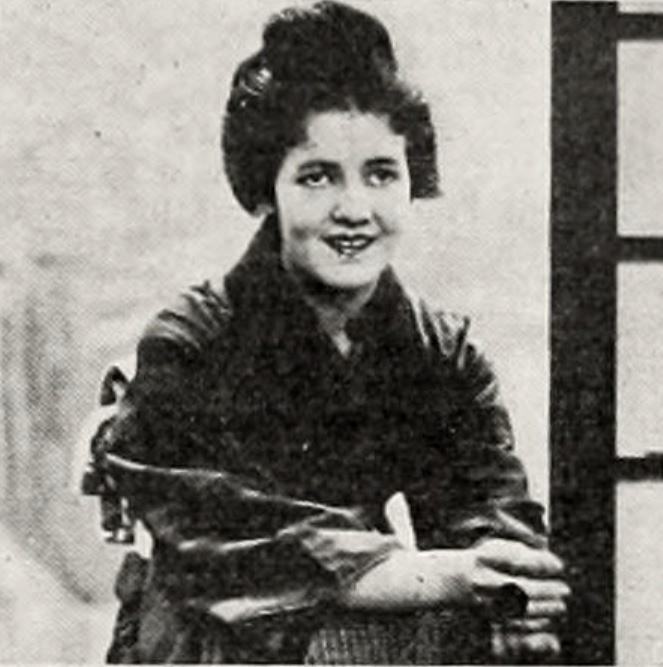
Only one reel survives, 11½ minutes. The full seven-reel feature premiered at New York’s Lyric Theatre in October 1911, then toured via Sawyer’s regional exchanges before vanishing. In 1978, a mislabeled canister marked Japanese Trick Film yielded the fragment at LC’sPackard campus. Digital restoration in 2016 stabilized warping and nitrate bloom, but the gaping narrative lacunae compel scholars to interpolate. Should we trust Long’s published photoplay, a luxury souvenir sold in theater lobbies? Or the Chicago censor’s synopsis, notorious for prudish distortions? Each choice rewrites history.
I advocate for radical transparency: project the reel in loop, display all variant synopses on adjacent screens, let spectators assemble their own Fox-Woman. Anything less risks reenacting Ali-San’s imperial theft, molding the Other into our preconceived sculpture.
To call The Fox Woman a masterpiece would overstate; to dismiss it as orientalist curio undersells its self-interrogating shivers. It is, rather, a cracked lantern: through its fissures we glimpse the birth pangs of global modernity, the moment when East and West learned to weaponize each other’s myths. Its incompleteness is its truth; like the fox-spirit, it eludes capture, leaving us clutching only the scent of rust-red fur among our own neatly labeled canisters.
Seek it out if you program retrospectives, curate silent horror, or lecture on colonial visuality. Pair it with The Great Divide for gendered power, with The Thumb Print for body-as-text, or simply let it haunt your private midnight screening. Just don’t ask it to sit still; foxes never do.
Grade: A- (for historical resonance, aesthetic daring, and the courage to remain fragmentary)
IMDb 7
1923
Community
Log in to comment.