DbcultAccessing Vault...
Cult Review
Senior Film Conservator
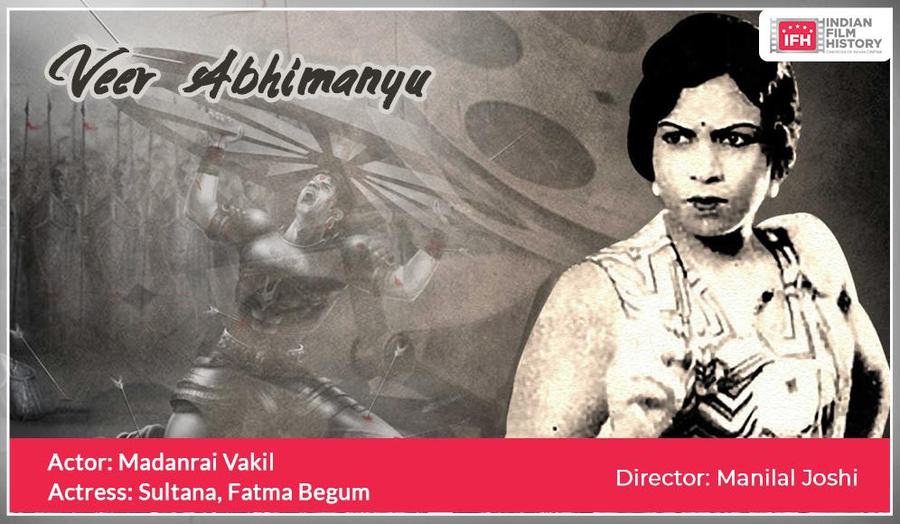
Glossy history books credit Ben-Hur (1925) for the chariot inferno that scorched MGM ledgers, yet a dusty 1922 reel—shot on Bombay’s open-air grounds with hand-cranked cameras—had already staged Kurukshetra’s cyclone of hooves and wheels. Veer Abhimanyu is not a mere curio; it is a prismatic wound that lets early Indian cinema bleed myth into modernity.
Cinematographer C. G. Gokhale tilts mirrors to bounce harsh noon into chiaroscuro corridors. Elephant howdahs become mobile turrets; their bronze bells, struck in sync with intertitles, create a percussive dialect. When Abhimanyu penetrates the first tier of the Chakravyuha, the camera pirouettes 360°—a feat achieved by seating the Bell & Howell on a spinning tea-stall platform—so the audience tastes vertigo. Compare this kinetic zeal to the static pageantry of Dandy Navigateur or the proscenium-bound tableaux of The Grandee’s Ring; here, space folds, breathes, devours.
Manilal Joshi’s Abhimanyu carries the brittle arrogance of youth—his smile arrives a fraction early, as though pre-empting applause. The performance ages mid-film; shoulders slacken, pupils dilate, the grin calcifies into a stoic hinge. Meanwhile Fatma Begum’s Subhadra achieves maternal sublimity without the crutch of dialogue: she cradles air, as if the unborn epic still kicks inside an invisible womb. Sultana’s Uttara, though allotted sparse footage, weaponizes the close-up; her kohled eyes become twin embers forecasting widowhood. The ensemble’s gestural vocabulary predates the histrionic grammar of The Birth of a Race and feels closer to the elemental minimalism of Within Our Gates.
Scriptwriter G. Mohanial Dave condenses a labyrinthine epic into a swift 74 minutes without eviscerating complexity. The Chakravyuha is not mere military geometry; it embodies cyclical patriarchy—every tier a generation that must murder its future to survive. Note the meta-gesture: the film itself is a strategic spiral, drawing viewers inward until the centre cannot hold. Compare this narrative vortex to the moral binaries of The Grip of Evil or the picaresque sprawl of Vingt ans après; here, ambiguity is the blade.
Original screenings relied on a harmonium, a tabla, and a ram’s horn to sync with reels. Contemporary festival restorations retain the percussive leitmotif: each time Abhimanyu advances, the tabla fires a 7-beat cycle that crashes against the audience’s ribcage. The absence of spoken word amplifies every creak of leather, every elephantine grunt. In an era when even American silents like Stop, Look and Listen chased sonic gimmicks, this Indian production weaponized silence as spiritual negative space.
The film opens and closes on female orifices—womb, widow’s veil, the void of death. Male heroism is framed as something that passes through these thresholds yet never owns them. Even Krishna’s celestial counsel is filtered via Subhadra’s body, suggesting that patriarchal lore needs a maternal conduit to survive. Such proto-feminist undercurrents are alien to contemporaneous swashbucklers like Crossed Clues or the damsel-in-distress mechanics of Hoodoo Ann.
Shot two years before Gandhi’s first non-cooperation clarion, the film’s obsession with encirclement and breakout stealthily mirrors anti-colonial sentiment. British censors excised two intertitles—one referencing "foreign shackles," another praising "youthful insurrection"—yet the visual allegory survived: a boy smashing through concentric rings of empire. The residue feels sharper than the overt racial polemic of Within Our Gates or the allegorical pallor of The Bells.
Dadasaheb Phalke’s mythologies painted combat like ballet; here, stunt coordinator Baburao Pendharkar introduces chaotic vectors—chariots skid in counter-directional diagonals, arrows enter the frame from obtuse angles. Blood (carmine dye splashed on black-and-white stock) appears as inkblots, a Rorschhaud test for dharma. The centrepiece, a 4-minute single-shot of Abhimanyu’s last stand, required 200 extras, 12 retakes, and a camera tethered to a bullock-cart pulley. Result: a kinetic frieze that rivals the maritime mayhem of Suds or the desert carnage promised yet never delivered by Lost in Darkness.
For decades the negative mouldered in a Nawanagar cellar, nibbled by silverfish drunk on celluloid ether. A 2018 4K scan by the Film Heritage Foundation reveals textures once thought apocryphal: the chequered armour of Kripa, the turquoise fingernails of Draupadi’s cameo. What survives is not just a film but a palimpsest—scratches, raindrop splotches, frame-line fungus—all conspiring to make mythology tactile. Purists decry the tinting (amber for day, cyan for night) as non-authentic, yet these chromatic fugues rescue the movie from museum mothballs, much like the tinted resurrection of Il ventriloquo.
Hindu orthodoxy objected to the humanisation of a demigod; pamphlets claimed showing Abhimanyu’s corpse "polluted" sacred geography. The controversy ricocheted into parliamentary questions, foreshadowing later censorship battles around Judge Rummy’s Miscue. Yet the uproar cemented the film’s box-office immortality: to ban something is to mint its legend.
Today, when CGI regiments can conjure thousand-headed hydras, the hand-forged illusion of Veer Abhimanyu feels almost monastic. Watch it for the hubris of a fifteen-year-old who charges into an algorithm of annihilation. Watch it for the lullabies that leak through armour. Watch it because every pixel of contemporary spectacle stands on the shoulders of such grainy ghosts. Watch it, above all, to remember that the first breath of Indian cinema was not talkie but battle-cry.
IMDb —
1934
Community
Log in to comment.