DbcultAccessing Vault...
Cult Review
Senior Film Conservator
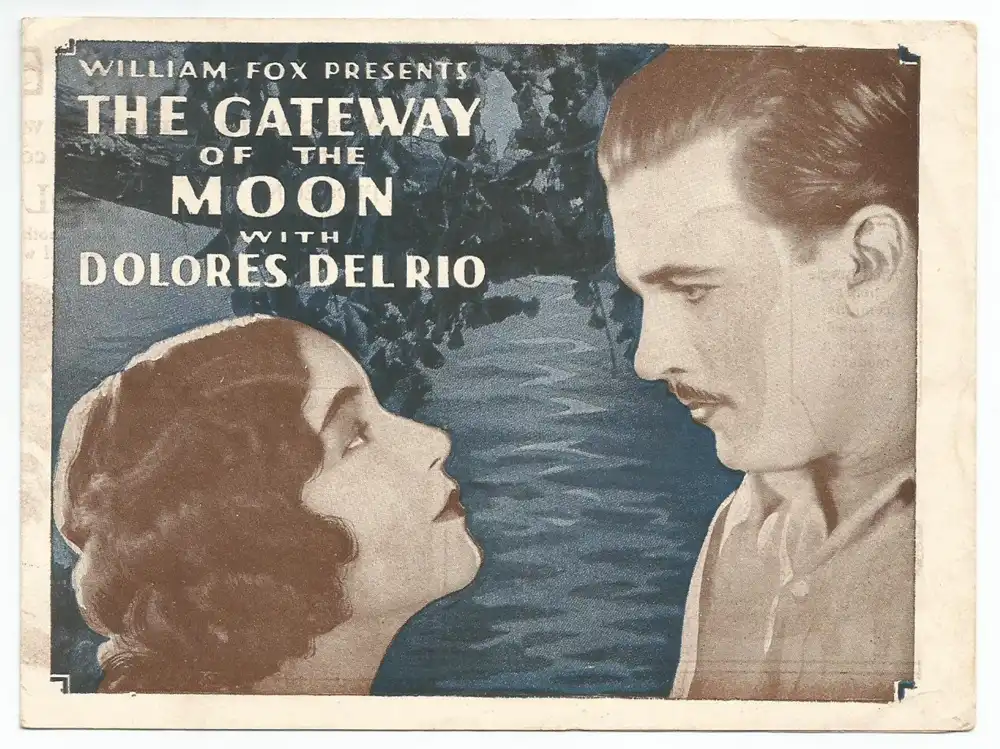
If you’re looking for a reason to watch The Gateway of the Moon today, it’s entirely because of Dolores Del Río. If you hate silent films that lean heavily into the 'exotic' tropes of the 1920s, or if you can’t stand watching a leading man who looks like he’s afraid to move his neck, you should probably skip this one. It’s a strange, uneven piece of work that feels like two different movies fighting for space in the Bolivian jungle.
The plot is standard melodrama. Walter Pidgeon plays Arthur Wyatt, an Englishman sent to inspect a railway. He looks incredibly out of place. There’s a scene early on where he’s walking through the construction site, and his suit is so perfectly pressed it feels like he’s just stepped out of a tailor shop in London rather than trekking through South America. He has this way of standing—chest out, chin up—that makes him look more like a mannequin than an inspector. It’s hard to buy him as someone who would survive five minutes in a jungle, let alone a murder attempt.
Then there’s Gillespie, the foreman. Anders Randolf plays him with a scowl that never quite leaves his face. He’s 'ruthless,' which in 1928 cinema language means he smokes aggressively and treats the workers like props. The way the movie handles the 'cruel methods' he’s using is a bit vague. We see some people looking tired and some dusty construction equipment, but the movie is much more interested in the tension between the white characters than the actual human cost of the railway. It’s a bit like Lure of Ambition in that sense—the setting is just a backdrop for a very specific kind of Western anxiety.
The movie gets significantly better whenever Dolores Del Río is on screen as Toni. She has to play the 'half-breed' trope, which is obviously dated and awkward, but she brings a physical energy to the role that the rest of the cast lacks. There’s a moment where she’s watching Wyatt from the brush, and the camera stays on her eyes for a few seconds too long. It’s one of those silent film close-ups that actually works because she isn’t over-acting with her eyebrows. She just looks curious.
The chemistry between her and Pidgeon is... non-existent? It’s more like she’s a force of nature and he’s a very confused tourist. When she saves him after he’s been shot, the way she drags him into hiding feels surprisingly gritty for a film that otherwise feels quite staged. The lighting in the 'night' scenes is that classic blue-tinted silent film darkness where you can still see everything perfectly, but it adds a weird, dreamlike quality to the rescue.
One thing that really stuck out to me was the editing during the climax. There’s a sequence where the plot against Wyatt is being uncovered, and the cuts between the uncle’s office and the jungle are jarring. It feels like some footage might have been lost or they just ran out of time to smooth it over. You’ll be watching a tense conversation, and then suddenly there’s a shot of a bird or a tree that lingers for way too long before jumping back to the action.
The sets are hit or miss. Some of the railway shots look massive and impressive, but the interior of the foreman’s quarters looks like it was built on a Friday afternoon. There’s a window in the background that clearly has a painted backdrop behind it that doesn't quite match the lighting of the room. It’s the kind of thing you only notice if you’re looking for it, but once you do, it’s hard to unsee.
It’s not as tightly paced as something like Pretty Smooth, and it lacks the weird charm of Dynamite Dan. It’s a movie about a railway where the railway feels like the least important thing happening. By the time we get to the resolution, the 'cruel methods' of the foreman are almost forgotten in favor of the romance. It’s a bit of a letdown if you were hoping for a more serious look at the corruption mentioned in the premise.
Still, there is one shot near the end—Toni standing against the skyline—that is genuinely beautiful. It’s one of those moments where the cinematography outshines the script by a mile. It makes you wish the rest of the movie was as focused as that one image. If you’re a fan of Del Río, you’ll find enough here to enjoy, but if you’re looking for a gripping thriller, you might find yourself checking the time halfway through.
IMDb 5.7
1926
Community
Log in to comment.