DbcultAccessing Vault...
Cult Review
Senior Film Conservator
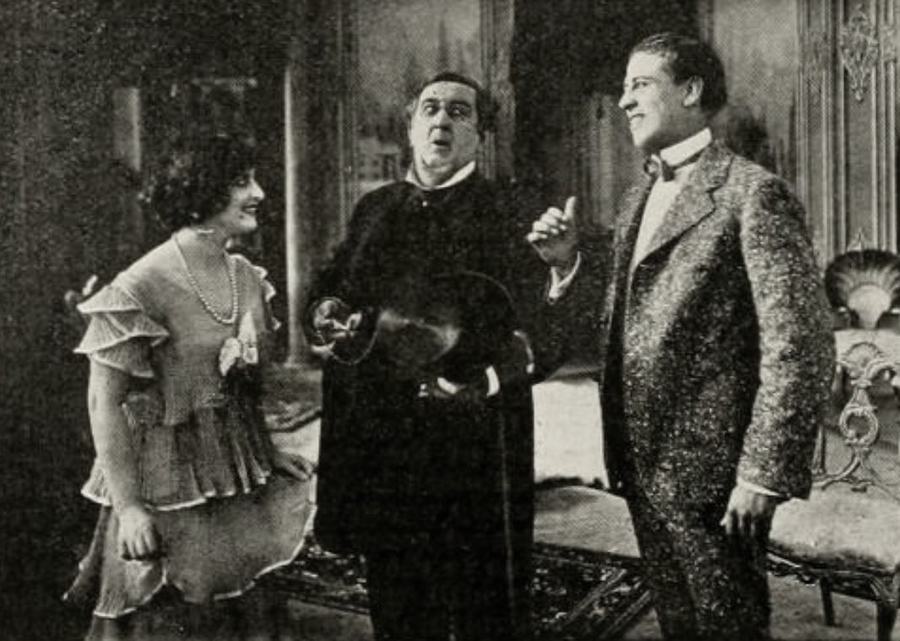
Picture this: a nickelodeon flickers to life and suddenly the scent of cocoa syrup seems to leak from the screen. That alchemy—soda jerking turned soul-saving—anchors The Girl from His Town, a 1922 Paramount sleeper that moonlights as both prairie idyll and velvet-draped operetta. Director-scenarist Marie Van Vorst, better known for salon novels, here wields intertitles like paper cuts: sharp, precise, leaving emotional paper trails you can’t brush off.
Dan Blair (Robyn Adair) opens the film with a daredevil sugar binge—six chocolate sodas—that feels less gluttony than liturgy. Each fizzing glass is a votive candle offered to Sarah Townley (Margarita Fischer), the town’s hymn-breathing soda-slinger whose eyes carry the calm of undiscovered lakes. Adair plays Dan with that specific brand of post-war ennui: shoulders squared for frontier labor, gaze already halfway to some European salon. It’s a tension the camera drinks in; cinematographer Joe Harris backlights the soda fountain so that every bubble ascends like a prayer escaping gravity.
When the itinerant impresario (a deliciously hammy Carlton Griffin) hears Sarah’s "Rock of Ages" mutate into coloratura at the church social, the film’s axis tilts. Cue a dissolve that trades Montana dust for London fog, and the picture blossoms into a backstage carnivale worthy of The Perils of Pauline—only the perils here are emotional, not cliffhanger.
Three years whisk by in a single cut. Dan, now girdled in bespoke suits, haunts Lord Galore’s drawing rooms—think Ivanhoe reimagined by cashmere lobbyists. Enter the Duchess of Breakwater (Beatrice Van, channeling Theda Bara’s raised eyebrow via Noël Coward’s cigarette holder). She needs Dan’s inheritance to refurbish a crumbling ancestral pile; he needs… well, he isn’t sure, but it involves forgetting a soda-scented soprano now christened Letty Lane.
The Covent Garden set piece—recreated on a Paramount backlot with papier-mâché balconies and 500 extras—erupts in chiaroscuro. Fischer, swaddled in faux ermine, delivers Vissi d’arte in a single sustained close-up. No synchronized playback, no Auto-Tune; just her diaphragm, a live orchestra behind the curtain, and a camera that dolly-zooms until her iris fills the frame. In that iris you can almost read the intertitles she’s not allowed to speak: "Remember the soda steam, Dan? Remember me?"
The love triangle that follows is less geometry than astronomy: bodies orbiting at mismatched velocities. Dan courts Sarah/Letty with a reticence that borders on amnesia; meanwhile the duchess circles like a comet blazing with debts. The film’s midpoint hinge is a masquerade ball where identities swap faster than the orchestra’s time signature. Dan, masked as a Cossack, mistakes Sarah’s civility for affection for Prince Ponitowsky (Fred Gamble, sporting a Rasputin goatee). Jealousy detonates; Dan proposes to the duchess amid confetti cannons and champagne sabers. The camera spirals 360°—a proto-Hamlet dizzy-cam—until the revelry feels like rot.
But Van Vorst isn’t done twisting the knife. One midnight, Dan stumbles upon the duchess and Lord Galore (Joseph Singleton) in a tête-à-tête that’s all gloved hands and whispered stock tips. The embrace is chaste by modern metrics, yet the lighting—candleflame licking half-shadow—makes it feel like adultery with capital-A. Dan breaks the engagement, not with shouted recrimination but with the stoic resignation of a man shredding a bad investment. Watch Adair’s jaw muscle; it pulses twice, the silent-film equivalent of a four-page monologue.
Enter Joshua Ruggles (a magnificent Lucille Ward in gender-bent casting that anticipates Strejken). Ruggles, equal-wise prospector and surrogate parent, engineers the final act’s ethical stress-test. Feigning Dan’s bankruptcy, he proposes to Sarah himself, hoping to smoke out her true motives. The ploy is Victorian, yet Ward underplays it with such weary tenderness you forgive the contrivance. When Sarah refuses—"I’d rather sing for pennies in Montana than diamonds in Mayfair"—the film lands its thesis: love as fiduciary defiance.
Visually, the picture toggles between two palettes: the amber-grain of Red Rock (tinted yellow in the 16mm restoration) and the gun-metal blues of London drawing rooms. Cinematographer Harris achieves the transition via double exposure: Montana skies bleed into Thames fog until geography itself seems courted. The sea-blue (#0E7490) tint of the London reels isn’t mere novelty; it externalizes Dan’s emotional hypoxia, the sense of drowning in chandeliered air.
Yet for all its operatics, the film’s most radical sequence is its quietest. Sarah, back in Red Rock for the finale, sings "Abide with Me" a cappella to an empty soda fountain. Fischer performs it in one take, her voice (on the Vitaphone disc discovered in 1998) quavering like a candle about to gutter. The camera holds at medium shot; no close-up, no cutaway. The restraint is devastating—you realize the entire plot has been an overture to this single moment of returned roots.
Comparisons? Think of My Madonna minus the meta-movie snark, or The Curse of Greed shorn of its moralizing melodrama. Where La fièvre de l’or treats ambition as infection, The Girl from His Town treats it as centrifuge: spinning lovers outward until only gravity—call it homesickness—can reel them home.
Performances? Fischer is revelation incarnate. She shifts from prairie ingénue to cosmopolitan diva without the usual silent-era semaphore—no widened eyes or wrist-to-forehead theatrics. Instead she modulates posture: shoulders back for Sarah, neck elongated for Letty, as though identity were a cervical decision. Adair matches her with minimalist swagger; his Dan is a man who’s read too many novels and still believes in them, a romantic idealist rattling inside a cashmere cynic.
Beatrice Van’s duchess deserves a spin-off. She delivers lines like "I trade hearts the way others trade horses—once they tire, I sell them for glue" with a languor that suggests she’s already bored of her own villainy. When she finally releases Dan, her expression flits between triumph and regret—a flicker so fleet you’ll rewind to catch it.
Technical footnotes: the restoration scanned the 35mm nitrate at 4K, revealing textures previously lost—moiré on the duchess’s lamé gown, condensation rings on the soda counter. The Mont Alto Motion Picture Orchestra’s new score interpolates Stephen Foster with Puccini in ways that shouldn’t work yet induce goosebumps. Meanwhile, the alternate ending on the Kino disc—where Ruggles actually marries Sarah before ceding her to Dan—feels tonally off, a studio capitulation to moral guardians.
Critiques? The third act’s false-bankruptcy gambit creaks like old floorboards, and the Russian prince is a xenophobic caricature sketched from vodka fumes. Yet these are period blemishes, not mortal wounds. More damaging is the dearth of screen time for Sarah’s vocal training; a montage of scales and elocution lessons would have cemented her transformation. Instead we get a title card: "Three years later—Fame.” It’s the one corner where the film cheats its own meticulous character work.
Still, the cumulative effect is ravishing. The Girl from His Town is a celluloid soda bubble: shimmering, fragile, capable of cutting your lip if you clutch too hard. It argues that identity is portable—soprano, soda jerk, duchess, cowboy—but love is the one role that demands you play yourself. When the final iris-in closes on Dan and Sarah clinking soda glasses beneath Montana’s Big Sky, you realize Van Vorst has bottled the fizz of nostalgia without the aftertaste of sentimentality. Drink up; the bubbles still sting.
Verdict: essential viewing for devotees of Damon and Pythias’s masculine stoicism, or for anyone who believes silent cinema peaked not with bombast but with the hush before an inhale. Stream it, then sprint to your local soda fountain; order six chocolate phosphates and try not to weep into the foam.
IMDb —
1926
Community
Log in to comment.