DbcultAccessing Vault...
Cult Review
Senior Film Conservator
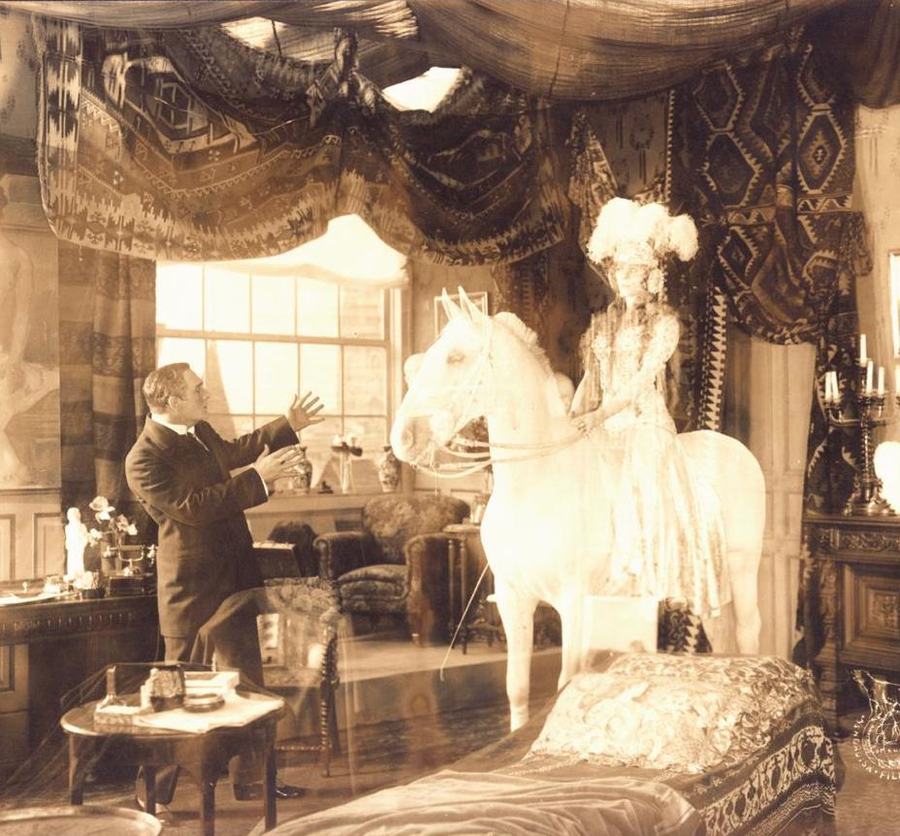
The first time we see Miss Evelyn she is already mid-air—thighs clamped around nothing but velocity, gloved fingers releasing the reins for the split second that turns gravity into gossip. Denmark 1916 had never photographed a woman like this: not bare-shouldered odalisque, not milk-fed peasant, but a projectile of will. Baptista Schreiber, who also co-wrote the script, understood that the camera does not worship flesh; it worships trajectory. Her body arcs across the silent screen and lands in the retinas of two men who will spend the rest of the reels trying to translate that arc into language—canvas, diagnosis, chequebook, marriage certificate—anything that can staple the sublime to earth.
Director Otto Detlefsen keeps the circus tableau static, almost clinical, as though the ring were a petri dish and we, the microbes, are invited to watch desire colonise. The monochrome is so crisp you can count the wood-shavings on the floor; the whites are mercury, the blacks are velvet, and between them the woman in albino leathers becomes a silver bullet. Notice how the film withholds close-ups until the restaurant scene. Up to then, Evelyn is motion, not face; myth, not labour. When the cut finally lands on her pupils, we realise the delay was merciful: those irises have the chill of a fjord that has never seen spring.
Willi Cornel—played by Olaf Fønss with the gaunt glamour of a man who has sold his last easel for a tube of titanium—enters the film like a sketch half-erased. His coat is smeared with ochre; his pockets jingle with charcoal. When he watches Evelyn he is not merely aroused; he is anatomising colour values in motion, calculating how to trap kinetic light inside linseed. Later, in the restaurant, he will lean too close, breathing in the salt on her wrist, and whisper, "I want to paint the sound of your canter." The line is corny, but Fønss delivers it like a confession of bankruptcy: he has nothing left to trade except cliché.
Henri Parker, by contrast, is the empiricist. Axel Boesen gives him the soft arrogance of someone who believes every heartbeat is a syllable the body misspells until a doctor corrects it. When Evelyn confesses her insomnia, Henri’s pupils dilate—not with concern, but with the pleasure of a collector who has found a new species. He offers a diagnosis without asking a single question: "Your blood races faster than your will; let me regulate the ratio." The sentence is absurd, yet delivered with such velvet certainty that Evelyn laughs—a soundless laugh, because the intertitle card only says (she laughs), leaving us to imagine the timbre of derision.
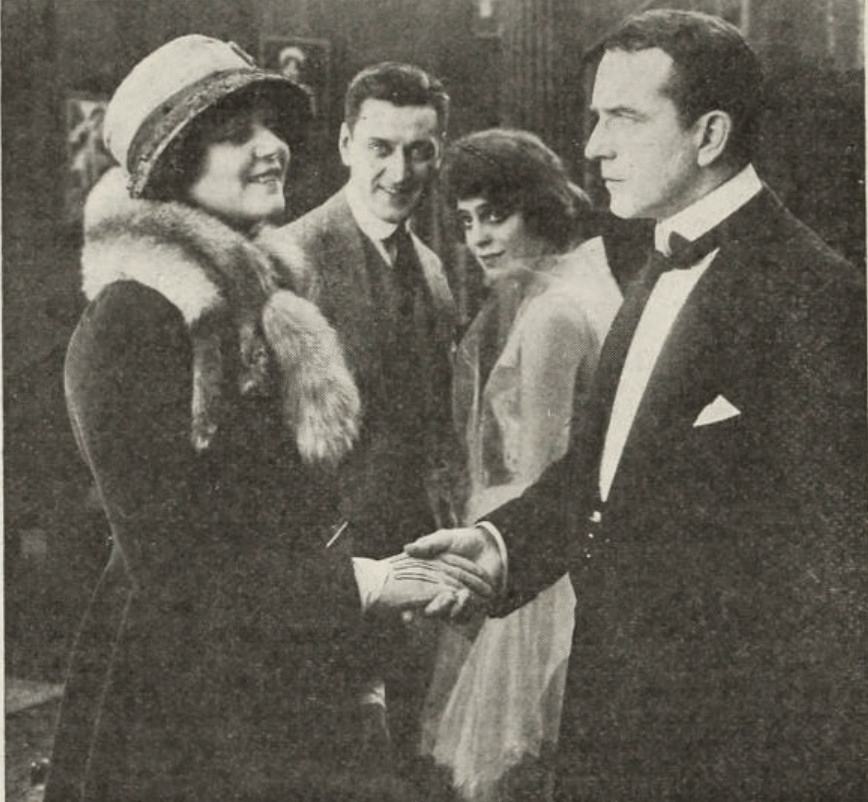
What makes the film perversely modern is that the woman never becomes prize. She is the event horizon; the men orbit, accelerate, and eventually red-shift into oblivion. There is no kiss, no duel, no scandalous elopement. Instead we get a sequence that feels like Tarkovsky in miniature: a long shot of the restaurant table, candles guttering, Henri’s glove resting on the white tablecloth like a surrender, Willi’s thumb rubbing the rim of a glass until it sings. Evelyn excuses herself; the camera stays with the men. Their silence swells until it drowns the soundtrack of clinking cutlery. In that hush you can hear masculinity cracking like thin ice.
Detlefsen cuts to the street. Copenhagen at night is a negative: black cobblestones glazed with reflected gaslight, the white rider now in a cloak the colour of bone. She walks between the two men but the blocking is asymmetrical: she is always one stride ahead, so the camera reads her as leader, them as escort. They arrive at her lodging house door. She steps inside, turns, and for the first time allows her gaze to linger—not in tenderness, but in measurement. Fade-out. The next morning the circus wagons are gone, leaving only rectangular scars on the grass. No note, no forwarding address. The men stand where the tent once billowed, looking at absence as though it were a canvas they forgot to prime.
Cinematographer Robert Schyberg shoots the white rider against a cyclorama of pure nothing—no crowd, no tent-poles—so she seems suspended in the limbo between apparition and athlete. The effect is not achieved through double exposure but through staging depth: a white canvas backdrop twenty metres behind the ring, lit from below so the edges vanish into over-exposure. When Evelyn gallops, the horse’s hooves throw up clouds of magnesium-white dust that catch the arc-lights and create a meteor-trail. You swear you can smell scorched air.
Compare this to La Belle Russe where the female performer is framed inside gilded proscenia, always contained by masculine architecture. In Den hvide rytterske the frame itself dissolves; containment is impossible because the woman is written in negative space. She is the hole in the photograph where the world leaks out.
The Danish intertitles are laconic to the brink of haiku. When Willi finally confesses his obsession, the card reads: "I would burn every canvas if it let me live inside your jump." No exclamation mark. The austerity makes the line vibrate like a piano-wire. Contemporary American silents would have plastered six adjectives and a moral; here, the reticence feels aristocratic.
Musical accompaniment in the 1916 premiere was reportedly a single gypsy violin, played live from the wings. The musician, unnamed in the archives, improvised a drone that rose a semitone every time Evelyn vaulted, creating a spiral of tension that resolved only when she landed. Modern restorations on streaming services substitute a sparse piano score—proper, but too polite. I recommend muting the track and playing something like Max Richter’s Infra at low volume; the chordal suspension marries the film’s marrow.
There is a moment—easy to miss—where Henri and Willi, left alone at the table, exchange a glance that lasts perhaps twelve frames. In it you can see the doctor silently asking the artist: Do we share the same disease? and the artist answering: No, we are merely symptoms of each other. That micro-recognition is the closest the film comes to male bonding. Immediately afterwards they part without farewell, walking in opposite directions through Copenhagen’s identical alleys, as though symmetry could erase the humiliation of wanting.
Contrast this with the camaraderie in Samson or the capitalist duels of The Toll of Mammon. Den hvide rytterske refuses redemption through bromance or money; it posits that heterosexual obsession is ultimately a monologue delivered to a mirror.
Baptista Schreiber never again played a role this feral. She aged into bourgeois matrons, dying at sixty-three with a cigar in one hand and a Pekinese in the other. Yet Evelyn persists as an after-image in Nordic cinema: the white rider resurfaces in the heroines of Sumerki zhenskoy dushi, in the defiant equestrienne of Wildfire, even in the manic pixie nightmare of The Kangaroo. Each owes a debt to the woman who refused to be the axle of anybody’s story.
Film historians sometimes lump Den hvide rytterske with Denmark’s golden-age melodramas, but its DNA feels closer to post-war modernism: the ellipses, the refusal of closure, the treatment of eros as epistemological rupture. You could program it beside L’hallali and create a double-bill about predation, but the prey here is the gaze itself.
The only surviving print, a 35 mm nitrate positive, languished in a Helsingør attic until 1987. The Danish Film Institute performed a 4K photochemical rescue in 2019, mining the silver halide to restore the magnesium flare of the riding scenes. The result is on DAFilms and MUBI Nordic, region-locked but VPN-friendly. Cinephile trackers circulate a 6.4 GB MKV with the original Danish intertitles and optional English subs; the gamma curve leans slightly teal, but the whites still scorch the screen.
Den hvide rytterske is not a love story; it is a treatise on the moment when admiration metastasises into ownership, and on the woman who outruns that moment by staying in perpetual motion. Ninety-seven years later, when every pixel of skin can be freeze-framed and possessed, this silent Danish shard still warns: what you try to cage will merely gallop through your dreams, hooves striking sparks on the inside of your skull.
Watch it at night, lights off, volume low. Let the white rider blur into your own reflection. When the screen goes black, do not rush to restore electric light; sit inside the afterglow until you hear the distant thud of hooves that never quite fade.
IMDb —
1917
Community
Log in to comment.