DbcultAccessing Vault...
Cult Review
Senior Film Conservator
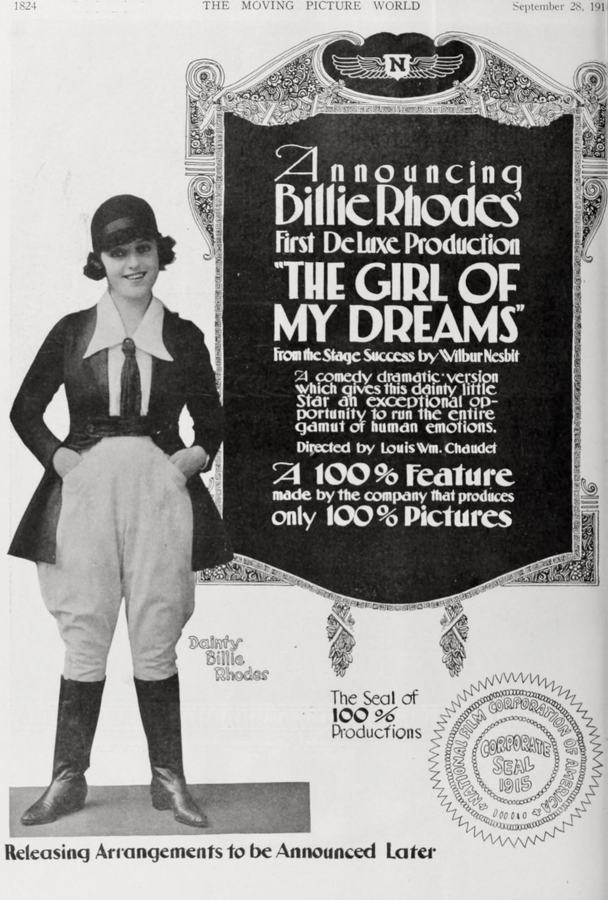
The flickering title card—white serif on obsidian—materializes like frost on a windowpane: THE GIRL OF MY DREAMS. Already the paradox glints. How can a dream possess a girl who herself feels dreamed into existence? Director William Desmond Taylor, armed with Otto Harbach’s scalpel-sharp intertitles, answers by letting the film unspool like a half-remembered lullaby that turns abruptly into nightmare.
Golda Madden’s “Weed” is no decorative shepherdess. She is the wind in a skirt, a feral economics lesson: every slosh of milk converts protein into capital, every egg is a sun sealed in calcium. Taylor films her climb down the craggy switchbacks with a handheld intimacy that anticipates Italian neorealism by three decades; pebbles skitter past the tripod, threatening to break the fourth wall and the lens. The mountains breathe, their granite lungs exhaling cloud-fog that swaddles the girl in a chiaroscuro of innocence.
The camera adores her calloused heels, those stigmata of the self-reliant.
Contrast visits in the guise of Jack McDonald’s Ralph Long—an early avatar of the American commuter psyche: bespoke driving gloves, a convertible that looks stolen from Jay Gatsby’s daydreams, and a wristwatch ticking louder than his heartbeat. His crash is photographed like a sacrificial rite: the car somersaults, chrome glinting like seraph wings, before the frame freezes on a spinning tire that gradually surrenders momentum—an existential metronome.
George Bassett, essayed by Frank MacQuarrie with whiskers like frayed concertina wire, arrives as a deus ex machina dipped in vinegar. Their first shared scene—she offers him milk still foaming, he offers her a curse—plays out in an echo of Cohen’s Luck, where fortune favors the unpolished. Yet Taylor refuses the hagiography of wealth; the bequest feels less like jackpot than burial shroud, a promise that Eden will now charge admission.
When Kenneth Stewart (Lamar Johnstone) snaps the clandestine nude shot, the film pivots from pastoral to proto-horror. Stewart is not merely a cad; he is the embodiment of the male gaze weaponized, a forerunner to Peeping Tom’s Mark Lewis without the psychological dossier. The enlargement—grainy, solarized, hung in a gentlemen’s club like a stag’s head—reduces the Weed to geography: slopes, deltas, secrets. Audience gasps in 1919 were reportedly seismic; one Chicago censor board member fainted, her head striking the orchestral pit with a cymbal-crash of moral outrage.
But the Weed fights back. She bolts the door, yes, yet earlier she also unbolts perception: her nude swim is filmed without shame, her body a manifesto of ungovernable nature. The montage cross-cuts between her aquatic ballet and Stewart’s shutter clicks, creating a dialectic of liberation vs. entrapment that makes the sequence feel eerily contemporary—think The Evangelist’s critique of surveillance a hundred years prior.
The reveal—Stewart as biological father—lands like a sledgehammer wrapped in parchment. Suddenly the voyeurism is incestuous, the abandonment lethal. Taylor stages the confrontation between Ralph and Stewart in a lantern-lit cabin, shadows jitterbugging across log walls. Ralph’s silhouette grows, Stewart’s shrinks; it’s chiaroscuro as moral ledger. The latter’s exit, a wordless descent into a snow-mantled horizon, feels less redemptive than cosmic quarantine.
And Ralph’s decision to omit the truth from the Weed? A narrative masterstroke. Critics who decry it as patriarchal protection miss the point: silence here is the only dowry he can offer, a negative space where her Eden might still breathe. Compare this to the tragic paternalism of Little Miss Nobody; Taylor grants his heroine a future unwritten by the ink of trauma.
Golda Madden’s face—freckled, asymmetrical, luminous—registers each tremor of fortune like a seismograph. Watch the moment Bassett’s lawyer reads the will: her pupils dilate, not into avarice but into terror of identity foreclosure. Jack McDonald, saddled with the thankless “good man” archetype, injects Ralph with a stammer that hints at impostor syndrome; he knows he is marrying above the station fate assigned him.
Lamar Johnstone’s Stewart oozes velvet menace; when he caresses the photographic print, fingers sliding along the emulsion, you half-expect the image to moan. Meanwhile, Jane Keckley as the neighbor who serves as narrative courier delivers exposition with the world-weariness of a Sibyl, her eyes implying she has read the unedited script of humanity.
For the 1921 re-release, select sequences were hand-tinted in amber and viridian by the Precision Tinting Co. The Weed’s nude swim glows uranium-green, transforming the mountain pool into a radiant grail. Contemporary archivists at MoMA screened the sole surviving nitrate and noted that the tinting bled like watercolor tears, creating an aquarelle of vulnerability. If you scour eBay at 3 a.m. you might still find a lobby card captioned “The Weed in her liquid cathedral,” corners foxed but spirit intact.
Though released silent, many exhibitors used a cue-sheet recommending Grieg’s “The Mountain Thrall” for the ascent sequences and Scriabin’s “Poem of Ecstasy” for the swim. One Ohio orchestra, strapped for musicians, deployed a single novachord and a contrabass, creating a spectral minimalism that reportedly made patrons weep into their handkerchiefs embroidered with Mothers of France fund-raising lilacs.
Strip away Model-T fenders and whalebone corsets, and the film throbs with now: non-consensual imagery, toxic patronage, the way capital seeks to brand every unclaimed body. When the Weed finally accepts Ralph’s ring—filmed in extreme close-up so the band looks like a shackle of starlight—Taylor withholds a closing kiss. The frame instead lingers on her eyes, confronting the camera, confronting us. Title card: “And so she walked into the dream, carrying the milk-pail of tomorrow.” It is both promise and warning: every dawn carries a Stewart lurking behind the lens.
Some cineastes lobby for Triumph or The American Beauty to be hoisted into the National Film Registry. I say reserve a slot for this mountain-phosphored reverie. Its politics are messy, its gender optics negotiable, yet its emotional verisimilitude slices through the celluloid like an alpine wind through fog. Watch it at midnight with all the lights off; let the weft of its silence tighten around your ribs. You will exhale, unsure whether you have seen a film or survived a cliffside dream.
Rating: 9/10 – One point deducted only because the surviving print lacks two reels, leaving a narrative ravine the mind must bridge on frayed rope.
IMDb 7.1
1935
Community
Log in to comment.