DbcultAccessing Vault...
Cult Review
Senior Film Conservator
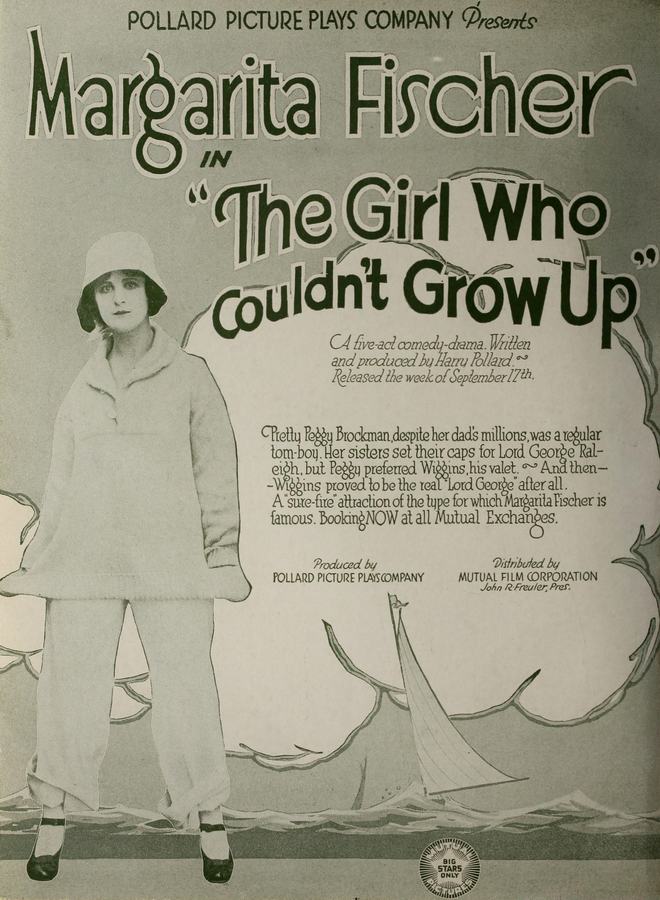
Harry A. Pollard’s 1917 one-reel daydream The Girl Who Couldn’t Grow Up lands like a champagne cork fired across a marble salon: frivolous, effervescent, yet capable of chipping Versailles-grade veneer if you lean too close. Shot on the cusp of America’s entry into the Great War, the picture exudes a last-summer-before-the-storm insouciance—white linen suits, ankle-length voile frocks, and a yacht that might as well be a floating Fitzgerald mansion years before Scott coined the Jazz Age.
The plot, a feather-light soufflé of mistaken identities and dormitory mix-ups, disguises razor-sharp commentary on class mobility and the commodification of daughters. Peggy’s father, an oil baron whose wealth smells of petroleum rather than pedigree, epitomizes nouveau-riche unease; his bride, a widow whose laughter tinkles like counterfeit coins, seeks to graft noble scions onto her nouveau family tree. Their transactional marriage is the silent era’s answer to a hostile takeover.
Cinematographer Alfred Gosden bathes the coastal scenes in a honeyed luminosity that makes every frame resemble a hand-tinted postcard left too long in the sun. Note the sequence where Peggy rows toward the yacht: waves catch the light like scattered doubloons while her silhouette—wide-brimmed hat, determined shoulders—etches itself against a horizon that seems to promise every adolescent fantasy. Inside the cabin, however, Gosden pivots to chiaroscuro; taffeta curtains filter moonbeams into silver prison bars, foreshadowing the literal jail cell awaiting the lovers.
As Peggy, Margarita Fischer oscillates between coltish impudence and bruised vulnerability without ever tilting into maudlin territory. Watch her eyes in the close-up after Raleigh confesses his title: a rapid succession of shock, calculation, and then delighted defiance flickers across her pupils like light through a spinning prism. It’s a masterclass in micro-gesture, the kind of performance that reminds us why silent acting is closer to dance than to speech.
Compare Fischer’s kineticism to Lucy Cotton’s repressed torment in Beatrice Cenci or Hedda Nova’s operatic suffering in The Lash; where those tragedies demand stoic masks, Fischer invites us to witness every blush and flinch.
Joe Harris, saddled with a role that could have slid into cardboard nobility, instead plays Raleigh as a man terminally fatigued by entitlement. His first appearance—bare feet on teak deck, cigarette holder dangling like an exclamation point—reads less like a peer of the realm than a disenchanted poet slumming in a coronet. Harris lets a sardonic half-smile do half the acting, while his languid posture suggests someone forever calculating escape routes from his own pedigree.
Pollard and scenarist Helen M. Cavanagh strip Cinderella to its marrow, then graft on contemporary anxieties: the fear that college is yet another finishing school for marital auction blocks, the suspicion that American wealth can purchase titles but not immunity from scandal. The script’s most delicious inversion? The prince-figure enrolls in the heroine’s institution, not vice versa, turning collegiate corridors into a battleground where lectures on Latin conjugations become proxy skirmishes for sexual politics.
No review can bypass the penultimate jail scene, staged with baroque theatricality: iron bars slash shadows across Peggy’s cheekbones like black lightning; a single kerosene lantern throws Raleigh’s profile onto damp stone, making him appear both savior and jailer. When he produces a signet ring from his waistcoat, the camera lingers on the metal’s dull gleam—a relic of dynastic power surrendered to a girl whose dowry is mischief. The moment is pure visual opera, worthy of the graveyard epiphanies in Great Expectations but compressed into a heartbeat.
Place The Girl Who Couldn’t Grow Up beside Medicine Bend’s frontier moralizing or The Turmoil’s industrial melodrama, and Pollard’s film feels like a rebellious cousin who sneaks champagne into the prayer meeting. Its DNA shares more chromosomes with This Is the Life’s carnival buoyancy, yet it anticipates the flapper comedies of the twenties by seasoning romance with proto-feminist spunk.
A 4K restoration by UCLA Film & Television Archive premiered at SILENTdrome LA last autumn, accompanied by Maud Nelissen’s klezmer-tinged score that swaps rococo strings for clarinet riffs, underscoring the film’s subversive heartbeat. Streaming rights are tangled in estate limbo, but boutique label ReelVault has hinted at a Blu-ray drop coinciding with Women’s History Month; keep your Morse code taps primed.
In an era when algorithms flatten nuance into swipeable squares, The Girl Who Couldn’t Grow Up reintroduces the radical pleasure of ambiguity. Peggy neither renounces wealth nor embraces it; she weaponizes it. Raleigh doesn’t rescue; he colludes. Their elopement is less escape than entrepreneurial merger, a merger the film declines to moralize. We are left at the jailhouse threshold, hearts thrumming with the delicious uncertainty of whether marriage will liberate or merely rebrand our heroine’s cage.
Verdict: A sun-bleached fable that moonlights as a socioeconomic Trojan horse, delivered with performances so incandescent they threaten to warp the nitrate. Seek it, binge it, then revisit your assumptions about what growing up actually costs.
IMDb —
1920
Community
Log in to comment.