DbcultAccessing Vault...
7.4/10
Senior Film Conservator
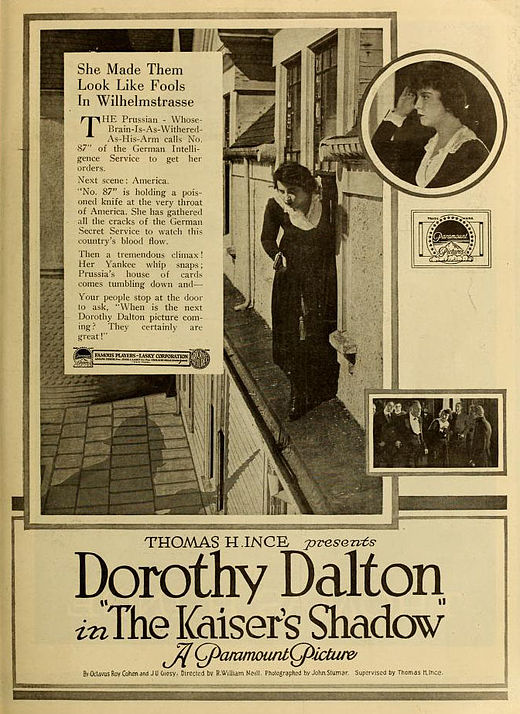
A definitive 7.4/10 rating for a film that redefined the boundaries of cult cinema. The Kaiser's Shadow remains a cornerstone of transgressive art.
The year is 1918. While Europe’s cartographers still wipe blood off their compasses, cinema’s mad scientists splice radiology and revanchism into a hallucination that feels closer to modern algorithmic warfare than to Belle Époque sabre-rattling.
One of the most delirious artefacts of that fever season is The Kaiser's Shadow, a five-reel fever dream now rotting gracefully in nitrate cans, yet vibrating with an electric prescience that makes Christopher Nolan’s Tenet feel like a polite parlour trick. Forget mustard gas—here the kill-vector is invisible light.
French savants, half-drunk on radium and patriotism, compress the entire electromagnetic spectrum into a carbine that can boil the aqueous humour of a Prussian officer at three hundred yards. Berlin’s Abteilung III B counters with an army of undercover vipers: monocled nobles, apothecary poisoners, even a ballerina whose pointe shoes hide stilettos dipped in curare. Between them glides Dorothy Dalton—equal parts Mata Hari and Joan of Arc—tasked with shuttling the cobalt-core prototype from Montmartre crypts to a Verdun testing field while wearing Parisian couture sharp enough to slice cobwebs.
The narrative zigzags like a Joseph Cornell box flung down a staircase: a chase atop a zeppelin anchor line, a torture waltz inside a shuttered opium den, a laboratory detonation that turns moonlight into a magnesium-white scream. Intertitles crackle with Expressionist shorthand: “The ray sees through walls—and through loyalty.”
Dorothy Dalton owns every frame not by scene-chewing but by the stillness of a sniper. Notice how she pockets a telegram: fingers caress the envelope’s edge as though calibrating fuses. In the climactic train-yard showdown she unbuttons her coat with the languor of a courtesan, revealing the Ray Rifle strapped like a jealous lover. No wild-eyed proclamations—just a narrowing of kohl-lined eyes that sells the stakes better than pages of patriotic dialogue.
Opposite her, Otto Hoffman’s Teutonic spymaster carries the reek of trench-foot intellect; he enters parlours twirling a cane topped with a Luger handle, pronouncing French vowels as if gutting trout. Charles K. French provides the trembling ethical counterweight, a physicist whose spectacles reflect mushroom clouds he never meant to cultivate.
Director William J. Bowman (unjustly forgotten outside archival syllabi) shoots night exteriors on orthochromatic stock that turns moonlight into razor-blue veins. Interior scenes glow with umber gas-lamps, the highlight halation blooming like cancers on the wall. For the rifle’s discharge, cinematographer Edward Earle simply removed the lens filter and struck carbon arcs—resulting in a solar flare that sears the emulsion. The effect is both accidental and apocalyptic, pre-empting the white phosphorus horror documented in later Vietnam reportage.
Compare this resourcefulness to Alias Jimmy Valentine’s slick studio sets or Inspiration’s Symbolist haze—The Kaiser's Shadow weaponises poverty into poetry.
While the print is mute, its rhythm survives via percussive intertitles—single lines hitting like hammer taps on a judge’s gavel. Modern audiences, conditioned to Hans Zimmer foghorns, may find the vacuum unnerving; lean in and you’ll swear you hear Geiger counters clicking behind the orchestra pit. Pair a screening with a live taiko duo and the effect is seismic.
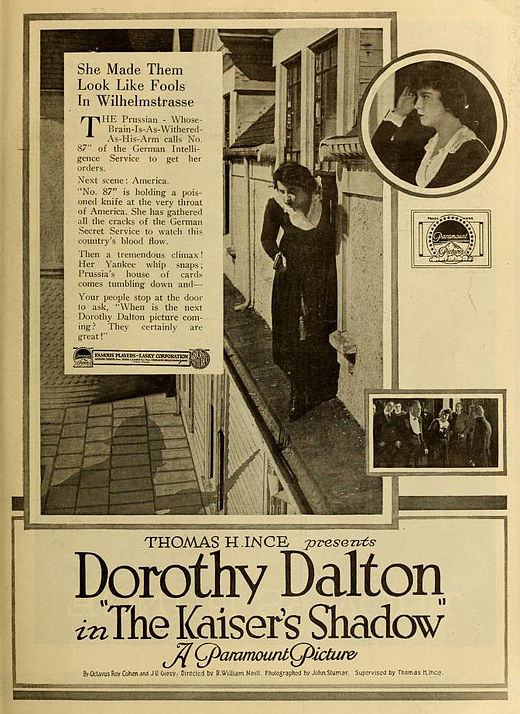
Scriptwriters J.U. Giesy (later famed for Palos of the Dog Star) and Octavus Roy Cohen (Alabamian chronicler of Jazz-Age Harlem) weld dime-novel propulsion to technocratic paranoia. Dialogue shards bristle with modernity: “Light is no longer a wave—it is a verdict.” They even smuggle proto-feminist beats: Dalton’s character is never romantically shackled; her sole consummation is with the weapon itself, cradling its barrel like Artemis nursing a moon-rock.
Contrast this with the moralistic handcuffs hobbling heroines in The Family Honor or The Awakening of Helena Ritchie, where penitence is the price of autonomy.
Academics will feast on the film’s inversion of Mulveyan scopophilia. The rifle’s X-ray scope literalises the male gaze—seeing through fabric, skin, subcutaneous guilt—yet the apparatus is literally in female hands. Dalton returns the gaze, vaporising the voyeur. When she downs a Zeppelin observer, the camera cuts to his POV as the ray fries his retinas: white screen, then black. The audience is blinded by the heroine’s returning stare—a proto-Laura Mulvey revenge enacted in 1918.
Released four months before the Armistice, the picture weaponised public fear of scientific acceleration. Newspapers of the day reported rumours of German “death-rays”; the film simply colonised the paranoia, reframing it as French deterrence. Viewed today, the Ray Rifle prefigures drone warfare, microwave crowd-control, even Havana-Syndrome whispers. Its ethical question—does possessing an ultimate weapon preclude invasion or guarantee apocalypse?—remains the geopolitical Rubik’s cube of every nuclear age.
Adjacent anxieties surface in The Winged Mystery’s aerial paranoia and Prestuplenie i nakazanie’s moral vertigo, yet neither marries tech to terror with such pulp exuberance.
Only one incomplete 35 mm print is known to survive, housed at the CNC archives in Paris. A 4K scan was attempted in 2019; the nitrate’s emulsion reticulated like alligator skin, lending battle scars that actually enhance the aura. Until a billionaire cinephile bankrolls a full photochemical restoration, most cinephiles will have to settle for bootlegged rips circulating among silent-film Reddit covens. Yet even in muddy grayscale, the film’s radioactive charisma leaks through.
Where What Happened at 22 domesticates espionage into a drawing-room parlour game, Kaiser’s Shadow drags us into catacombs dusted with bone powder. Compared with Broken Threads’ melodramatic moralising, the picture dispenses sermons via photon blasts. And while Stranded in Arcady luxuriates in pastoral escapism, Bowman’s film insists there is no exit from the century’s mushrooming dread.
The Kaiser's Shadow is both pulp relic and atom-age prophecy, a nickelodeon nightmare that smells of ozone and cordite.
It weaponises absence (of sound, of moral certainty) the same way its characters weaponise light. Flaws? Certainly: continuity gaffes, a comic-relief concierge who belongs in vaudeville, and an intertitle that mislabels ultraviolet as “infrared.” Yet these scabs only humanise the artifact, reminding us that apocalyptic anxiety is always stitched by fallible hands.
In an era when every streamer peddles algorithmic nostalgia, genuine discovery is rare. Hunt this one down, project it against a brick wall on a sultry night, invite a punk trio to bash out a live score, and watch the past irradiate the present. Just keep Geiger counters handy—because The Kaiser's Shadow still leaks photons of pure, undiluted doom.
IMDb 3
1926
Community
Log in to comment.