DbcultAccessing Vault...
Cult Review
Senior Film Conservator
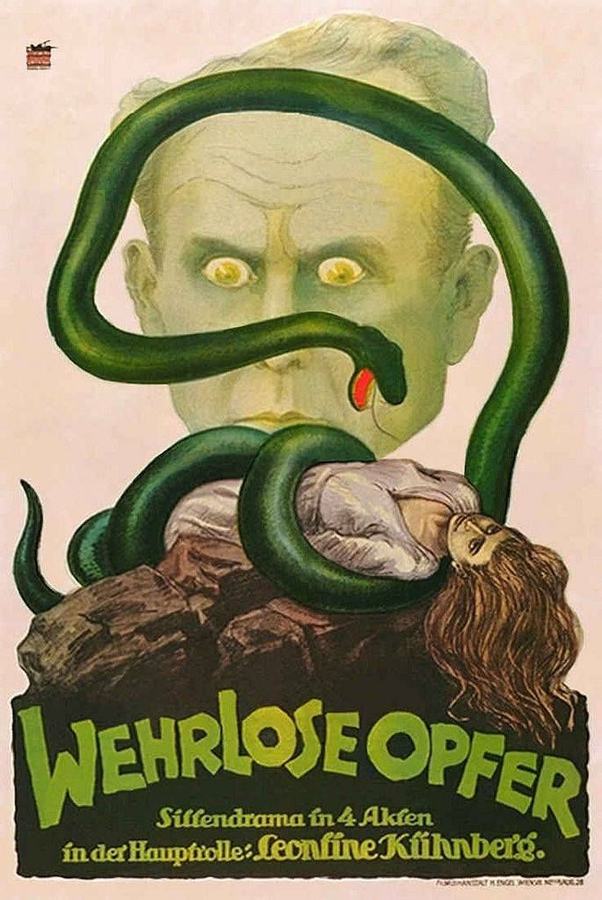
To approach Wolfgang Neff’s 1919 opus, Wehrlose Opfer, is to step into a time capsule of profound societal anxiety. Emerging from the smoldering ruins of the Great War, German cinema was undergoing a metamorphic shift, shedding the skin of imperial artifice for something far more jagged and visceral. This film stands as a quintessential artifact of the 'Aufklärungsfilm'—a genre ostensibly designed for public education but frequently operating as a conduit for the era’s deepest taboos. Unlike the more sanitized American productions of the same year, such as the lighthearted A Kiss for Susie, Neff’s work refuses to offer the audience the anesthetic of a happy resolution. Instead, it demands a confrontation with the predatory nature of the human condition.
The casting of Leontine Kühnberg was a masterstroke of empathetic resonance. Her performance transcends the typical histrionics of the silent era, offering a nuanced portrayal of a woman whose agency is systematically stripped away. In many ways, her journey mirrors the thematic weight found in The Victim, yet Neff imbues the narrative with a specific Teutonic gloom that feels uniquely oppressive. The cinematography, though restricted by the technical limitations of 1919, utilizes shadow and framing to create a sense of inevitable doom. We see the characters not as masters of their fate, but as figures in a landscape that is actively conspiring against their survival.
The screenplay by Arthur Teuber is a marvel of structural economy and thematic density. Teuber, a writer who understood the mechanics of the melodrama better than most of his contemporaries, crafts a narrative that functions like a trap. Every act of kindness is met with a double-edged sword of consequence. While American films like The Fires of Youth attempted to reconcile class differences through sentimentalism, Wehrlose Opfer posits that the divide is an unbridgeable chasm. The script meticulously charts the descent of its characters, ensuring that their 'defenselessness' is not a personal failing, but a structural inevitability.
Consider the role of Borré Chiro and Aenderly Lebius, whose presence on screen adds a layer of gravitas that grounds the film’s more sensational elements. Their interactions are characterized by a weary cynicism that feels startlingly modern. In comparison to the rugged individualism seen in Sandy Burke of the U-Bar-U, the characters in Wehrlose Opfer are denied the luxury of heroism. They are survivors in a world where survival itself is a form of slow-motion defeat. Teuber’s dialogue (rendered through title cards) avoids the flowery prose of the period, opting instead for a directness that punctuates the visual misery with surgical precision.
Visually, the film is a masterclass in the use of limited space. Wolfgang Neff, working with cinematographer Wolfgang Neff (who often wore multiple hats in these productions), creates a chiaroscuro effect that predates the height of German Expressionism. The streets of Berlin are depicted not as thoroughfares of commerce, but as hunting grounds. This aesthetic choice places the film in direct conversation with The Unknown, where the environment itself becomes a character—a silent witness to the atrocities committed in the name of desperation. The use of low-angle shots to empower the villains and high-angle shots to diminish the victims creates a subconscious hierarchy of power that the viewer feels in their marrow.
The supporting cast, including Auguste Prasch-Grevenberg and Marga Köhler, provide a rich texture to the social milieu. These are not merely background players; they represent the different strata of a society in freefall. When we compare this to the ensemble dynamics in Passers By, we see a stark difference in intent. While Passers By seeks to find the common thread of humanity, Wehrlose Opfer seeks to expose the fraying of those very threads. The film’s pacing is deliberate, almost agonizingly so, mirroring the slow suffocation of its protagonists as they are drawn deeper into the underworld.
To understand Wehrlose Opfer, one must understand the 'Sittenfilm'—the film of manners or morals. These were often controversial, frequently banned, and always provocative. Neff’s film pushed the boundaries of what was permissible, using the guise of social critique to explore the mechanics of sexual and economic exploitation. It shares a certain DNA with The Slave Auction, though it transposes the literal auction block into the metaphorical one of the modern city. The 'victims' of the title are those who have no currency in a world that has commodified everything, from labor to love.
The film also serves as a fascinating counterpoint to Public Opinion. Where the latter examines the external judgment of society, Wehrlose Opfer examines the internal rot that makes such judgment possible. It is a film about the complicity of the bystander. Rudolf Klein-Rhoden’s performance as one of the more sinister figures in the narrative is particularly chilling because he portrays evil not as a mustache-twirling caricature, but as a banal byproduct of greed. This realism is what makes the film so enduringly uncomfortable; it suggests that the monsters are not hiding in the shadows, but are sitting in the brightly lit offices of power.
When we look at contemporary films like Way Outback or Nan of Music Mountain, we see cinema grappling with the harshness of nature. Wehrlose Opfer, however, reminds us that the harshest environment is the one we built for ourselves. The urban jungle of Berlin is more lethal than any mountain pass or desert plain because it is designed to exploit the very qualities—trust, love, hope—that make us human. Even a film like The Quickening Flame, with its focus on internal passion, feels almost escapist when placed alongside Neff’s grim reality.
The film’s intersection with Jewish themes, though subtle, invites comparison with Árendás zsidó, highlighting the precarious position of marginalized groups in a shifting political landscape. In Wehrlose Opfer, marginalization is the default state for anyone without capital. The film’s depiction of the 'fallen woman' avoids the judgmental tone of A Woman of Impulse, instead framing her 'fall' as a logical consequence of a gravity-bound society. It is this lack of judgment that makes the film feel so ahead of its time.
The ensemble cast, including Emil Rameau and Wolfgang Neff himself in a minor role, works with a synchronicity that is rare for the period. Each actor seems to understand the specific weight of the 'victims' they are portraying. Hilde Benz and Preben J. Rist provide moments of fleeting warmth that only serve to highlight the coldness of the overall narrative. It is a film of contrasts: the warmth of a shared meal against the coldness of a landlord’s heart, the light of a streetlamp against the darkness of an alleyway. This interplay is what gives the film its rhythmic pulse.
In the broader context of 1919, a year that gave us He Got His and Stranded, Wehrlose Opfer remains a singular achievement. It does not seek to entertain in the traditional sense; it seeks to haunt. The final reels of the film, which I will not spoil here, contain a sequence of images that are as powerful today as they were over a century ago. The way Neff captures the resignation in Kühnberg’s eyes is a testament to the power of silent cinema to communicate the incommunicable. It is a reminder that while technology evolves, the fundamental struggles of the human spirit—the fight for dignity in the face of indifference—remain unchanged.
Final Critical Note: Wehrlose Opfer is more than a historical curiosity. It is a searing indictment of a world that views people as disposable. It is a difficult watch, but an essential one for anyone interested in the roots of social realism and the development of cinematic empathy. Wolfgang Neff and Arthur Teuber created a work that refuses to be forgotten, a ghost that continues to walk the halls of film history, whispering the stories of those who were never meant to be heard.
IMDb —
1917
Community
Log in to comment.