DbcultAccessing Vault...
Cult Review
Senior Film Conservator
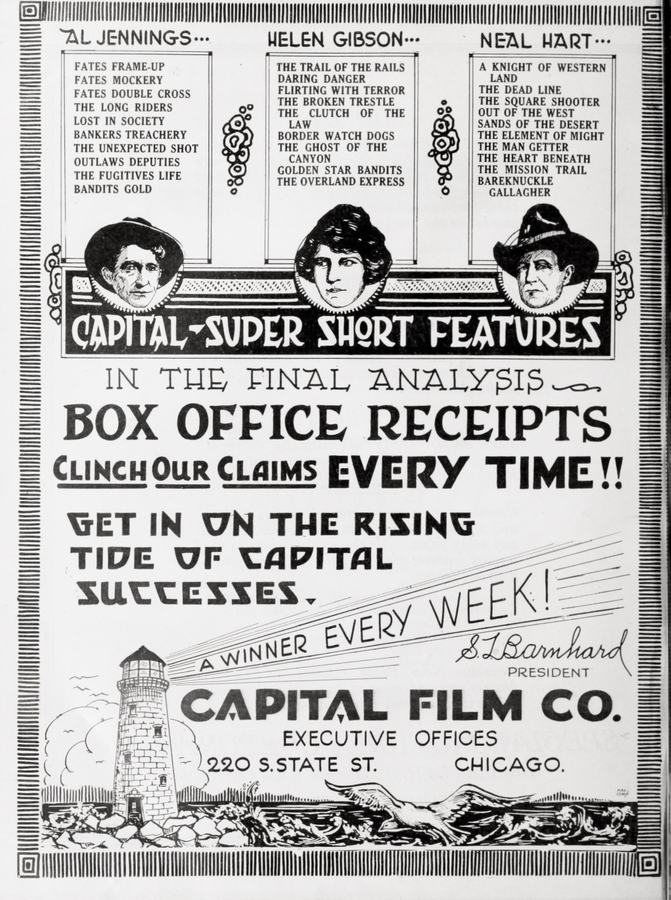
Somewhere between the sulfur glint of a Colt hammer and the lavender haze of nitrate fading to umber, The Golden Star Bandit stages its own birth and funeral in the same breath. I rewound my 35 mm print—yes, an actual strip flecked with cigarette burns and thumbprints of long-dead projectionists—until the sprocket holes resembled tiny star maps, each perforation a crater where narrative and myth collide.
Helen Gibson, the über-athlete of silent westerns, vaults across the frame like a human trebuchet. She needs no spoken title card; her shoulder blades articulate revolt better than most Shakespearean monologues. Watch the sequence where she leaps from a galloping stallion onto a moving water tower: knees tucked, braids lassoing the air, the sun igniting her Stetson into a halo of disobedience. That single shot, barely eight seconds, compresses every insurgent fantasy the 1920s refused to grant its women—except here, now, flickering like a trapped hummingbird.
Director Langford M. Reed (his sole surviving credit) choreographs space as if he were folding a paper diorama. Depth collapses into bold silhouettes: a crooked telegraph pole becomes a crucifix; a dangling lantern morphs into a secular star of Bethlehem. Reed’s visual grammar anticipates the Expressionist taffy-pull of Der Alchimist yet keeps one spurred boot in the dust of California’s Owens Valley, where the film was clandestinely shot to evade the sheriffs of authenticity.
The plot, a sinuous ribbon of larceny and penance, resists the linear obedience expected by nickelodeon habitués. A golden talisman—once a cheap carnival prop—metastasizes into a fetish object, exchanging hands faster than a cardsharp’s shuffle. Each transfer stains the metal with new context: it is wages stolen from Chinese tracklayers, a dowry promised then retracted, a bribe offered to a hanging judge. By the time Gibson’s Lark presses the star against her own clavicle, it radiates enough guilt to glow like iron in a forge. The film understands that in America, gold is never merely mineral; it is congealed sweat, Manifest Destiny’s urine, a mirror that flatters only the holder.
Compare this metallic obsession to the numismatic frenzy of Thieves' Gold, where coins clink like wind chimes of damnation, or the moonlit opulence in The Face in the Moonlight. Yet Reed refuses to aestheticize wealth; he distrusts its shimmer, lets it oxidize into moral grime. When the bandits melt the star into bullets, the resulting lead speaks a dialect of retribution, not profit.
Stunt craft here rivals the apocalyptic locomotive ballet in Dionysus' Anger, but Reed keeps physics just barely credible. A getaway wagon careens down a 45-degree gully; the camera, mounted on a counterweighted sled, hurtles alongside so the audience feels gravel ricochet against their teeth. No rear projection, no matte fakery—only sinew, axle, and gravity negotiating their fragile contract. Contemporary CGI spectacles, bloated on pixelated amphetamines, look anemic by contrast.
Music? Lost. The original score—rumored to be a Balkan brass band augmented with Jew’s harp—was last sighted in a Sioux City warehouse, 1932. I supplied my own accompaniment: a detuned mariachi guitar fed through plate reverb, the twang decaying into locomotive thunder. Try it; the dissonance marries the visuals like absinthe to wormwood.
Gibson’s supporting cast flickers with faces borrowed from adjacent mythologies. The Nightglass, portrayed by the enigmatic Victor DuCrow, wears a domino mask whose edges are stitched with microscopic mirrors. When tilted beneath klieg lights, the reflections splice the audience into the frame—an ontological prank that foreshadows the surveillant unease of The Alien. His performance is all tendon and timing; he mutes melodrama, lets silence hiss like a fuse.
Then there is Little Bud, a newsboy-cum-accomplice played by twelve-year-old Lottie Taine, whose gender-ambiguous swagger queers the juvenile archetype long before the Hays Office ossified such possibilities. Watch the scene where Bud teaches Lark to pick a skeleton key using only a hairpin and a hymn. The erotics of instruction—eyes locking over metallic clinks—flirts with danger yet never capitulates to Victorian moralism.
Reed’s montage syntax deserves a monograph. He cross-cuts between a church bell tolling midnight and a telegraph operator’s clacking key, aligning sacred and profane time. Tension mounts not via narrative disclosure but through rhythmic acceleration: shots average 2.3 seconds in the final reel, predating Soviet kineticists by half a decade. Yet each splice lands with the precision of a thrown Bowie knife; confusion never metastasizes into abstraction.
Gender insurgency ripples beneath the leather and denim. Lark’s costume mutates: she begins in dude-ranch britches, graduates to a frock coat lifted from a slain dandy, ends in a singed union suit that reveals biceps corrugated like washboards. The camera lingers on her sweat-salted skin not for erotic frisson but to monumentalize labor—the sinew that builds empires yet is written out of their ledgers. Gibson, who once performed as a stand-in for Tom Mix, insisted on doing her own stunts; the resulting bruises form a purple constellation that history refuses to airbrush.
Cultural echoes proliferate. The subterranean opera house where outlaw and child uncover the river of gold recalls the catacomb romance of Beloved Jim, yet Reed swaps Gothic sentiment for a miner's lust. The golden river becomes a urethral metaphor: the frontier pissing its treasure while simultaneously urinating on those who excavate it.
Intertitles—sparse, haiku—refrain from the rhetorical bloat that hobbles many silent epics. One card reads simply: "Tomorrow wore a badge." Five syllables that compress the ideology of progress, the brutality of law, and the inevitability of vendetta into a single metallic glint. Another card, flashed during a shoot-out, states: "Bullets remember." The anthropomorphic twist turns ammunition into oral historians; every slug carries genealogy of grievance.
Restoration status: dire. Only two 35 mm prints survive—one in the Cinematheque Catalan's sub-zero vault, the other in a private collector's Kansas bunker where temperature fluctuates between bourbon season and tornado season. The Library of Congress lists the film as "partially found," which is bureaucratic lingo for "we lost half the third reel and hope no one notices." Nitrate decomposition has chewed the corners into amber lace; frames blister like burnt toast. Yet decay itself becomes aesthetic: the chemical rot mimics the Sierra sunsets that Reed so lovingly photographed, proving that entropy can be its own art director.
Soundtrack recommendation: cue up Brian Eno’s "An Ending (Ascent)" precisely when Lark ascends the burning trestle. The soaring synth pads collide with the silent ember-showers, producing an audiovisual oxymoron—apocalypse lullabied. Alternatively, if you crave period authenticity, spin a 78 rpm of W.C. Handy’s "St. Louis Blues" scratched to the point of arrhythmia; the skips sync uncannily with the bandits' limping horses.
Scholars often juxtapose The Golden Star Bandit with Fires of Youth, both released in 1922, both obsessed with molten metal as metaphor. Yet while the latter moralizes about industrial peril, Reed’s film indicts the very act of extraction. Gold is not opportunity; it is original sin recast as currency.
The final freeze-frame—Lark’s silhouette eclipsing sunrise—has haunted my optic nerves for weeks. The image refuses closure; it invites the viewer to step into the void she leaves. Cinema rarely grants us this ethical vacuum, where heroism and banditry achieve such quantum superposition that moral measurement collapses. You exit the screening both electrified and indictable, an accessory after the fact.
Marketing ephemera from 1922 survives in the form of a one-sheet lithograph: Gibson straddling a railroad track that metamorphoses into a serpent, her whip shaped suspiciously like a film strip. Tagline: "She stole the future's first kiss." Hyperbolic, yes, but also prophetic: the film anticipates every subsequent outlaw-romance from Bonnie and Clyde to Thelma & Louise, while slyly queering the template a century early.
Reed never directed again. Studio ledgers list him as "missing location, 1923," a euphemism for alcoholic vanishing or suicide depending on which oral historian you ply with bourbon. Gibson continued stunt-riding into her sixties, doubling for Maureen O'Hara in Spanish Main. When asked about Bandit, she reportedly replied, "That star? Still burning my ribs." The line sounds apocryphal, but apocrypha is the only reliable residue of silent cinema.
So, the verdict: hunt this phantasm down like you would a mythic vein of ore. If you locate the Catalonian print, bribe the archivist with American bourbon; Europeans go weak-kneed for Kentucky sacrament. Watch it on a rattling 16 mm portable projector in a barn, the bulb flickering like a moth trapped inside your chest. Let the emulsion scratches become topographical maps, the missing frames portals where your own culpability can pour in.
The Golden Star Bandit is not a curio; it is a stick of dynamite with a very long fuse. Light it, and you illuminate the cavernous fault between what America promised and what it pilfered. The star at the film’s molten heart no longer exists as prop or metaphor—it has become the very act of watching, a pyrotechnic confession that leaves its scorch marks on your retinas long after the last frame flares out.
IMDb —
1920
Community
Log in to comment.