DbcultAccessing Vault...
Cult Review
Senior Film Conservator
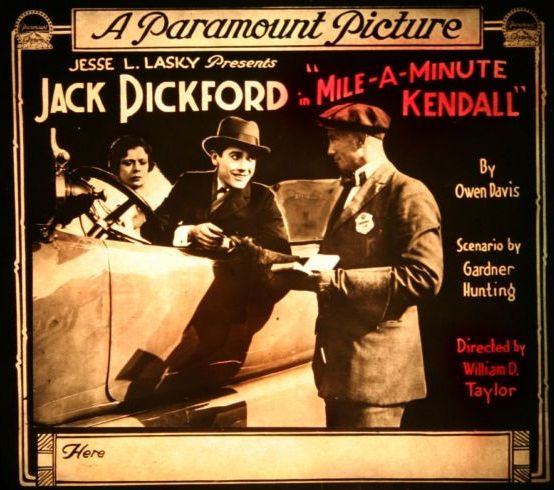
To witness Mile-a-Minute Kendall is to engage with a cinematic artifact that captures the very moment the American psyche shifted from the Victorian pastoral to the industrial frantic. Released in 1918, this production serves as a luminous showcase for Jack Pickford, an actor whose legacy is often unfairly eclipsed by his sister Mary, yet who possessed a unique, mercurial charisma. The film operates on a frequency of restless energy, a thematic 'velocity' that challenges the ossified structures of early 20th-century class expectations. Unlike the more somber explorations of duty found in The Secret Game, Kendall's journey is one of exuberant rebellion, a frantic sprint away from the shadow of a domineering patriarch.
The narrative scaffolding, constructed by Owen Davis and Gardner Hunting, relies on the primal conflict between a father’s rigid expectations and a son’s unchanneled potential. Jack McDonald portrays the elder Kendall not merely as a villain, but as a relic of a dying era—a man who equates worth solely with industrial output and stoic adherence to tradition. This creates a fascinating tension with Jack Pickford’s Kendall, who embodies the 'Jazz Age' spirit several years before it truly took hold of the American consciousness. The visual storytelling emphasizes this gap; while the father is often framed within the heavy, dark mahogany of his office, the younger Kendall is frequently associated with the open road and the blur of movement.
In terms of pacing, the film lives up to its title. There is a rhythmic quality to the editing that feels surprisingly modern. While The Dupe experimented with psychological interiority, Mile-a-Minute Kendall focuses on the externalization of the soul through action. Kendall’s struggle for acceptance is not fought in quiet contemplation but in the grease of the garage and the dust of the racetrack. This shift from the 'layabout' to the 'mechanic' is a classic American trope, yet here it feels fresh, largely due to the earnestness of the performances.
Louise Huff provides the necessary emotional ballast to Pickford’s high-octane performance. Her presence on screen offers a quietude that contrasts sharply with the protagonist's frantic energy. In the silent era, chemistry was dictated by the subtle interplay of glances and the spatial relationship between actors, and Huff and Pickford navigate this with a sophistication that rivals the dramatic weight seen in The Soul of a Magdalen. Their scenes together provide the necessary respite from the film’s titular speed, grounding the narrative in a relatable human intimacy.
The supporting cast, including Lottie Pickford and Casson Ferguson, adds layers of social texture. Each character serves as a different mirror for Kendall’s transformation. Ferguson, in particular, embodies the 'proper' alternative to Kendall—the son the father wished he had—which heightens the stakes of Kendall’s eventual redemption. This ensemble dynamic creates a world that feels lived-in and socially complex, far removed from the more theatrical staging of Madame d' Ora.
One cannot discuss this film without acknowledging its obsession with the automobile. In 1918, the car was more than a mode of transport; it was a symbol of liberation and the democratization of speed. The cinematography captures this with a sense of wonder. The tracking shots, though rudimentary by today’s standards, were visceral for contemporary audiences. There is a raw, unpolished beauty in the way the film captures the landscape of early 20th-century America, a visual honesty that is often missing from more stylized productions like Fantômas: The False Magistrate.
The use of light and shadow in the industrial scenes suggests a proto-noir aesthetic. The grime of the workshop is rendered with a tactile quality, making Kendall’s physical labor feel authentic rather than performative. This dedication to realism in the 'working' scenes provides a stark contrast to the ethereal, almost dreamlike quality of the high-society parties. It is in this collision of worlds that the film finds its heart. The 'mile-a-minute' pace is not just about physical speed; it is about the rate at which a man must reinvent himself to survive a changing world.
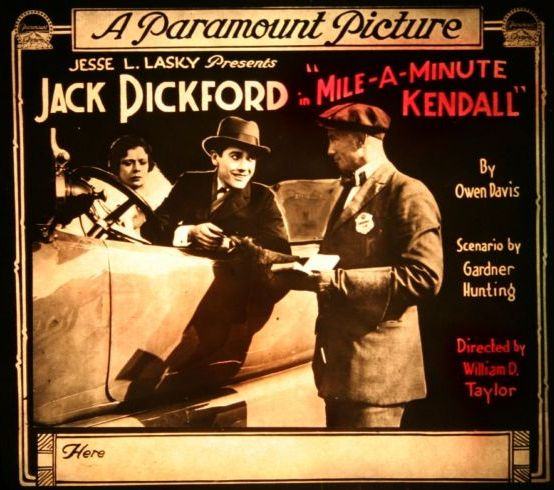
Jack Pickford’s performance here is a masterclass in the 'charming rogue' archetype. He possesses an innate vulnerability that prevents Kendall from ever becoming unlikable, even at his most reckless. This is a nuanced tightrope walk that many of his contemporaries failed to achieve. While films like Some Boy played the 'ne'er-do-well' for pure comedy, Mile-a-Minute Kendall treats the character's existential crisis with genuine gravity. There is a sense that Kendall’s speed is a flight from the crushing weight of the Pickford/Kendall name, a theme that likely resonated deeply with Jack himself.
Comparing this to One Wonderful Night, we see a similar fascination with the transformative power of a single evening or a single decision. However, Kendall’s transformation is more sustained and grounded in the dignity of labor. The film argues that salvation is found not in a lucky break, but in the mastery of a craft and the courage to defy one’s origins. It is a quintessentially American message, delivered with a cinematic flair that remains infectious over a century later.
In the broader context of 1910s cinema, Mile-a-Minute Kendall stands as a bridge between the moralistic fables of the early decade and the sophisticated character dramas of the 1920s. It lacks the heavy-handed didacticism found in The Great Problem, opting instead for a narrative driven by character psychology and physical momentum. The film’s exploration of the 'father-son' dynamic is surprisingly modern, eschewing simple resolutions for a more complex understanding of mutual respect.
Furthermore, the film’s technical proficiency is noteworthy. The editing by the uncredited cutters of the era demonstrates a sophisticated understanding of cross-cutting and temporal compression. The way the film interweaves the father’s escalating anxiety with Kendall’s escalating speed creates a genuine sense of suspense. It is this technical brio that elevates the film above standard melodrama, placing it in the company of works like Smerch lyubovnyy in its attempt to capture the 'tempest' of human emotion through visual metaphor.
As the final reels of Mile-a-Minute Kendall unfold, the viewer is left with a profound sense of the era’s optimism. Despite the domestic strife and the societal pressures, there is an underlying belief in the individual’s ability to outrun their past. The film doesn't just depict a race; it depicts the birth of the modern protagonist—one who is defined by his actions and his resilience rather than his pedigree. This is a theme that echoes through the decades, seen in various iterations in films like The Doctor and the Woman, where professional identity becomes the battleground for personal worth.
The film also serves as a poignant reminder of the fragility of silent film history. Seeing the Pickford family together—Jack, Lottie, and the influence of Mary’s production standards—is a rare treat for the cinephile. It is a snapshot of a dynasty at its zenith, channeling their collective energy into a story that feels both intimate and universal. The 'mile-a-minute' pace is a metaphor for the film industry itself in 1918: moving too fast to look back, fueled by innovation, and desperate to prove its own legitimacy as an art form.
Ultimately, Mile-a-Minute Kendall is more than a mere curiosity for historians. It is a vibrant, breathing piece of cinema that speaks to the perennial struggle for autonomy. Whether compared to the spiritual trials of Saint, Devil and Woman or the earthly dangers of The Opium Runners, Kendall’s story remains uniquely grounded in the human heart. It is a testament to the power of the 'idle' son to find his own path, provided he has a fast enough car and enough grit to see the race through to the end.
For those seeking to understand the evolution of the American hero, this film is essential viewing. It marks the transition from the hero of circumstance to the hero of agency. Jack Pickford’s Kendall is not saved by a miracle; he is saved by his own hands, his own sweat, and his refusal to be defined by his father’s narrow vision. In the dark of the theater, even a century later, the engine of Kendall’s ambition still roars with a defiant, beautiful clarity. It invites us to consider our own 'velocities' and the legacies we are so desperate to outpace or fulfill. In the end, we are all Kendall, looking for a stretch of open road and the chance to prove that we are worth more than the sum of our mistakes.
IMDb —
1915
Community
Log in to comment.