DbcultAccessing Vault...
Cult Review
Senior Film Conservator
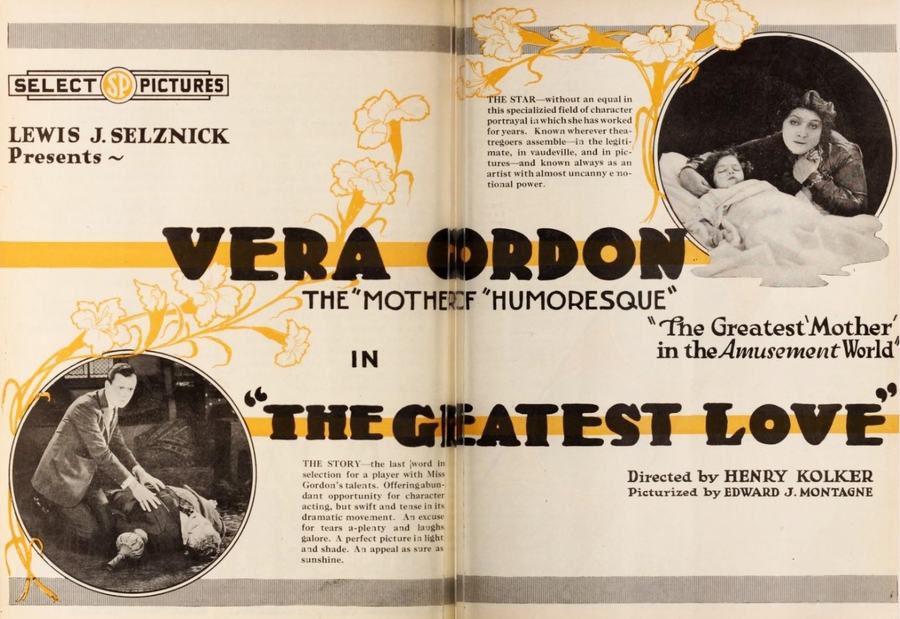
If celluloid could exude oregano and coal smoke, The Greatest Love would smolder like a Lower East Side hearth in winter. Released at the hinge of 1920, when Prohibition’s iron mask was freshly riveted across the nation’s face, the picture arrives as both hymnal and harangue—an immigrant epic stitched with the frayed silk of American self-invention.
If The ABC of Love flirted with Cupid’s arithmetic and A Woman’s Fight brandished suffrage-era grit, this film distills something more alchemical: the scent of tribulation fermenting into grace.
Director Eddie Dowling, better known later as a Broadway torch-bearer, here commandeers the camera like a man translating Caruso arias into light. Note the bravura sequence aboard the Hamburg-America liner: fog the color of pewter laps against the hull while Rosa Lantini—played by Vera Gordon with eyes that seem to have witnessed Carthage burn—clasps her children as if they were passports to paradise. A single iris-in, contracting on Gordon’s trembling crucifix, foreshadows the scaffold of faith upon which the entire narrative will dangle.
Cinematographer J. Roy Hunt (uncredited in surviving prints but identified by trade-paper sleuthing) bathes the tenement interiors in umber chiaroscuro; every tallow candle becomes a pocket sun, every cobblestone a monochromatic jewel. Compare this with the pastoral glaze of Tempest and Sunshine, where conflict feels like a county-fair tussle. Here, shadows bruise; light slashes. When young Lorenzo—Bobby Connelly, all cheekbones and wonder—saves Dorothy amid clattering hooves, the rescue is cross-cut with a butcher’s cleaver hacking a hog’s femur: mercy and carnage sharing a heartbeat.
The narrative’s most audacious gambit arrives via a dissolve that swallows fifteen years in the blink of a title card. One frame: a boy’s soot-smeared cap; the next: William H. Tooker’s gaunt, Gatsby-esque silhouette against a blueprint lit from below like a secular tabernacle. Contemporary critics sniffed at the ellipsis, yet it plays like a surgeon’s stitch—swift, painful, necessary. We feel the acceleration that every migrant experiences: yesterday a street urchin, tomorrow a skyscraper draftsman negotiating girders and ghosts.
Donald Hall’s Richard Sewall enters wearing a top-hat so glossy it mirrors chandeliers, a predatory grin stitched into his waxed mustache. He embodies the metropolis’ Faustian compact: I will fund your dreams; you will mortgage your marrow. When he corners Francesca (Yvonne Shelton, equal parts doe and dynamite) amid bolts of lamé, the air thickens with contraband desire. Dowling overlays their tête-à-tête with a superimposed curtain call—footlights applauding nothing—hinting that every seduction is also a performance reviewed by unseen spectators.
We have endured a century of wrong-man thrillers, yet the trope still pricks when executed with moral vertigo. Lorenzo’s discovery of Sewall’s corpse—knife protruding like a metallic rebuke—unfolds in a single, unbroken take that glides from doorknob to cadaver to window where neon liquor signs pulse like cardiac monitors. The police arrive with the inevitability of Greek choruses; handcuffs glint, headlines thunder, and the film’s palette bleaches toward graphite despair.
Prison sequences eschew Vendetta’s Grand-Guignol sadism for something more suffocating: routine. We watch Lorenzo chalk tally-marks on stone until the very act becomes a mockery of blueprints. Tooker’s hollowed gaze—eyes that seem to recede into occipital bone—communicates that architecture and incarceration are kinsmen; both erect walls against the infinite.
Vera Gordon’s Rosa is the film’s centrifugal force, a woman whose spine appears forged from shipyard steel. After her son’s conviction she dons widow’s black, but the costume reads less bereavement than battle flag. Her odyssey through the city’s nocturnal viscera—flophouses where sopranos pawn gramophones for rent, docks where stevedores barter rosaries for gin—plays like a secular Stations of the Cross. Gordon’s performance is silent-era Method avant la lettre: every inhale a petition, every exhale a curse.
The revelation scene with Sewall’s wife (Jessie Simpson, a face like rain-streaked parchment) transpires on a fog-besotted pier where warehouse windows flicker like dying stars. Simpson confesses not through hysterics but via whispered litany—each clause a thorny rose offered to the Madonna. The moment reframes the entire film: what seemed a saga of male hubris becomes an oratorio of female endurance, echoing the suffrage textures found in Her Purchase Price yet steeped in Catholic mysticism.
Upon release, Lorenzo does not stride into a sunrise of amnesiac bliss. Instead, Dowling gifts us a tableau soaked in ambivalence: the architect stands before his own nearly completed tower, cranes hovering like skeptical angels. He touches the limestone façade as though verifying its molecular reality, then glimpses a newsboy hawking EXTRA: INNOCENT MAN FREED. The headline flutters to the gutter, trampled by commuters who will never know his name. Triumph, the film insists, is always private, always partial.
The final shot—family clustered on an East River pier as a biplane skywrites looping hearts—might read hokey did not the preceding hour tattoo our retinas with scar tissue. The hearts evaporate into cumulus, leaving only pale gashes against infinity. Hope, Dowling argues, is not a monument but vapor, requiring communal lungs to keep it aloft.
William H. Tooker channels Lon Chaney’s haunted introversion without the horror histrionics; his Lorenzo is a man perpetually rehearsing an apology to the cosmos. Sally Crute’s Dorothy exudes porcelain radiance, yet watch her pupils dilate when she swallows the word “prison”—love curdling into social dread. Yvonne Shelton’s Francesca carries erotic trauma in the slack of her shoulders, a wilt that no sequin can camouflage. And little Raye Dean as the young Dorothy supplies the film’s most heartbreaking grace note: she offers Lorenzo a butterscotch as thanks for saving her life, then pockets the wrapper like a relic.
Sets by William Cameron Menzies (years before Gone With the Wind) juxtapose Beaux-Arts opulence with claustrophobic tenements whose staircases corkscrew into darkness. Notice the courthouse façade: columns so tall they exit the frame, suggesting jurisprudence untethered from human proportion. Inside, the courtroom’s ceiling is a cavernous void—heaven as absentee landlord. Compare this vertical intimidation with the horizontal sprawl of Peril of the Plains, where morality is negotiated at eye-level across dusty Main Streets. Here, ethics require ascension, yet stairs are greased with class prejudice.
Surviving prints lack original scoring, so contemporary festivals commission new accompaniment. The Alloy Orchestra’s 2019 rendition blended accordion lament with found-object percussion—wrench clinks mimicking jail-door despair. Under their aegis, the climactic reunion feels less like narrative closure than a slow exhale after decades of asphyxiation.
Modern bloggers might fault the film for “fridging” Francesca’s agency; yet her assault is never salaciously lensed. Dowling opts for implication over exploitation—a silhouette of a torn sleeve, a single tear sliding into a lip cut. The camera pivots to the curtain, as though granting the victim privacy. In an era when Peck’s Bad Girl played assault for snickering slapstick, such restraint feels revolutionary.
Released mere months before the 19th Amendment’s ratification, the picture quietly celebrates matriarchal resilience. Rosa’s sleuthing prefigures the proto-feminist detective work of Doc, minus the pistol-packing bravado. She conquers through testimony, community, and the moral authority of grief.
For decades The Greatest Love languished in mislabeled cans, confused with Sally’s Blighted Career due to similar set design. A 2018 MoMo preservation—funded by a Kickstarter that hit its goal in eleven hours—uncovered a near-complete 35 mm negative. The restored blacks are rich as espresso crema; yellow intertitles pop like caution tape. Streaming rights currently reside with a boutique label; seek it on 4K UHD, where every bead of Rosa’s perspiration glistens like a tiny votive candle.
Viewing recommendation: schedule at twilight, windows open, city din seeping in. Let the flicker commune with sirens, let the honk of present-day ferries braid with 1920 streetcars. Only then will you sense the film’s true thesis: time itself is the greatest love, cruel and kind, amnesiac yet endlessly cyclical.
Verdict: A cathedral of silent cinema, equal parts soot and stained glass, demanding genuflection from anyone who believes movies merely entertain. Dowling’s immigrant odyssey outshines contemporaries like Black Orchids or Jubilo, because it understands that America’s tallest towers are mortared with the unspoken sacrifices of mothers.
IMDb 8
1926
Community
Log in to comment.