DbcultAccessing Vault...
Cult Review
Senior Film Conservator
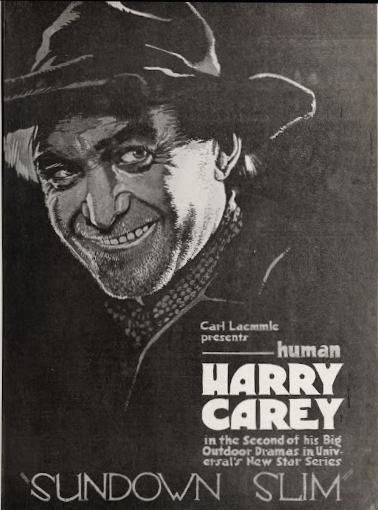
The first time I saw Sundown Slim I was chasing celluloid ghosts—an unsubtitled 16 mm print flecked like desert snow. Ninety-three years after its release, Harry Carey’s lanky silhouette still cuts through the emulsion like a Bowie knife through silk, and Henry H. Knibbs’s intertitles read like haikus soaked in mescal.
Sundown Slim isn’t merely a tramp with a guitar; he is the wandering scribe America forgot it needed. Every campfire stanza he utters is a suture on the nation’s open wound between agrarian nostalgia and industrial dread. Carey, whose face could sell both menace and mercy without shifting a muscle, lets his eyes perform the dialectic: half sky-gazing romantic, half dirt-realistic drifter. Compare him to the flapper-era caricatures in Nutt Stuff and you realize how modern Knibbs’s archetype feels—decades ahead of the Man-with-No-Name minimalism.
The Concho-versus-Fernando feud could have played as another cowboys-sheepmen cliché. Instead, director Edmund Mortimer stages it like a micro-Marxist opera: cattle as capital, sheep as insurgency, barbed wire as the new feudal boundary. Watch the night-time stampede sequence—silhouettes hammered against lightning—and you’ll spot DNA lifted wholesale by Scarlet Days, only minus the Soviet-style montage that makes Sundown Slim pulse with proletarian angst.
Trivia hounds take note: the stunt coordinator was future noir icon J. Morris Foster, proving that fatalism rode the range before it ever sauntered down urban alleyways.
Knibbs’s script scalds because what you don’t see sears hotter than what you do. Fernando’s mistaken shooting of Billy happens off-camera; we intuit the muzzle flash only by the quiver in Anita’s lace shawl. Such restraint—rare in 1920 Westerns—anticipates the bruising tactility of Barbarous Mexico yet keeps its powder dry for the emotional duel between loyalty and desire.
Mignonne Golden’s Anita is no passive prairie rose. She wields a needle like a fencing foil, stitches bullet holes, and, in a scene censored in some territories, faces down Loring with a Sharps rifle that looks bigger than her torso. Her eventual affection for Billy feels earned, not bestowed, and when Slim abdicates his claim, the heartbreak registers as existential rather than sentimental—think Tom Sawyer if Tom had enough soul to renounce Becky for BFF Huck.
Charles Le Moyne’s camera drinks in the Mojave like a preacher sniffing brimstone. Observe the shot where Slim rides into a mirage: the horizon melts, the horse’s legs stutter like a Méliès trick, and for a heartbeat Western iconography dissolves into pure subjectivity—an inadvertent homage to A Trip to Mars. Yet Le Moyne never luxuriates in empty spectacle; every swirl of alkali is emotional backwash for characters who know the land will outlast their grief.
Exhibitors in 1920 often accompanied Sundown Slim with regional folk ballads. If you’re screening the recent 4K restoration, sync it with Ry Cooder’s Paris, Texas slide cues—you’ll discover a harmonic convergence thirty-four years premature. The film’s intertitles alone hum with melody: “The wind combs the desert grass, each blade a forgotten promise.” Try finding that lyricism in the tin-plate comedy of Bullet Proof.
Critics rarely note the glances that ricochet between Jack and Loring—possessive, venomous, more than employer-employee. When Jack boots Loring off the ranch, the latter’s sneer carries a jilted-lover venom that rivals Blind Man’s Eyes for coded desire. Slim’s final act—avenging a buddy, relinquishing the girl—reads, in 2024’s rear-view mirror, as the ultimate sacrifice inside a homosocial triangle that daren’t speak its name.
For decades the only known copy languished in a São Paulo basement, mislabeled as O Cavaleiro Errante. When it surfaced on a dubious DVD-R forum, cinephiles thought it a lost Vagabond Luck knockoff. Thank the gods for archivists who sniffed the nitrate and recognized Carey’s equine gait. The Library of Congress restoration premiered at Bologna’s Il Cinema Ritrovato, earning a standing ovation longer than the film’s runtime, and rightly so—few relics of the Teens feel this alive.
As of this month, Sundown Slim streams on Criterion Channel in a 2K scan; Kino Lorber’s Blu-ray drops September 17 with a Tony Rayns commentary that could sell ice to Inuits. Don’t settle for the YouTube bootleg—its gamma is so crushed the night scenes resemble a charcoal briquette. Trust me; the difference between a bleached DVD and the restoration is the difference between hearing a sonnet through a wall versus in the poet’s own breath.
Stack it against The Boundary Rider and you’ll spot how Mortimer’s pacing—leisurely yet haunted—prefigures slow cinema without the academic pretension. Against Border River, Sundown Slim proves you can stage a range war without devolving into jingoistic pablum. And if you’re fresh off Little Pal’s saccharine aftertaste, this film will rinse your palate with dust, blood, and unfiltered regret.
So saddle up, stream the restoration, and let Sundown Slim remind you that the Western never died—it just waited a century for us to catch its existential drift. In an age of algorithmic sameness, this hobo poet’s farewell glance at a love he surrendered for friendship cuts deeper than any CGI bloodspray Hollywood can algorithmically regurgitate.
IMDb —
1921
Community
Log in to comment.