DbcultAccessing Vault...
Cult Review
Senior Film Conservator
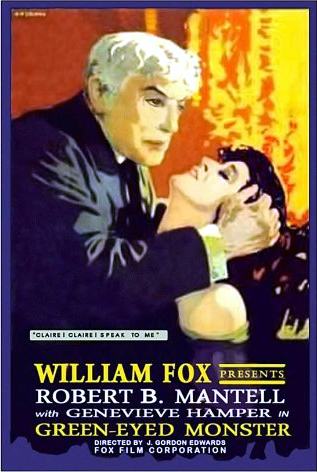
In the annals of early cinema, certain films emerge not merely as historical artifacts but as profound psychological explorations, daring to plumb the darkest recesses of the human psyche with a boldness that belies their silent nature. Mary Murillo's The Green-Eyed Monster, a cinematic endeavor that unfurls a tapestry of unrequited love, simmering resentment, and ultimately, a spiraling descent into madness, stands as a testament to the potent narrative capabilities of the era. It's a film that, despite its vintage, resonates with a primal intensity, dissecting the corrosive effects of jealousy with an almost clinical precision, yet imbued with a theatricality characteristic of its time.
The narrative commences amidst the gilded cages of French aristocracy, where the de Mornay chateau serves as the crucible for a family drama steeped in unspoken desire. Here, we are introduced to Raimond, portrayed with a brooding intensity by Robert B. Mantell, a figure whose internal landscape is already scarred by an undeclared passion for his cousin, Claire. This silent suffering, a common trope in romantic tragedies, is quickly amplified when his brother, Louis, effortlessly claims Claire's affection and hand. The film masterfully establishes Raimond's internal turmoil without the aid of dialogue, relying heavily on Mantell's expressive physiognomy and the dramatic staging inherent to silent film. The initial pangs of jealousy are not merely a plot device; they are the very bedrock upon which Raimond's sanity will eventually crumble, a creeping vine that chokes the life out of his moral compass.
Unable to endure the sight of his brother's marital bliss, Raimond embarks on a self-imposed exile, first seeking solace, or perhaps oblivion, in the vibrant, perhaps morally ambiguous, milieu of Vienna. This period of riotous living, though briefly depicted, is crucial. It hints at a character already predisposed to excess, a soul searching for an escape from an internal torment that conventional morality cannot assuage. The death of his father summons him back, but the brief return only serves to rekindle the inferno of his jealousy. The intimacy shared between Louis and Claire becomes an unbearable spectacle, driving Raimond to a more profound, more exotic escape: India. This sojourn is not merely a change of scenery; it is a transformative period, where he becomes 'versed in the ways of the Hindu.' This phrase, laden with the orientalist mystique prevalent in early 20th-century Western narratives, implies an acquisition of arcane knowledge, perhaps even dark arts, that will prove instrumental in his tragic downfall. It is here that he procures the sinister mechanisms that will later become instruments of his vengeance, a subtle nod to the dangers of exoticism when intertwined with a deranged mind, a theme also touched upon, albeit differently, in films like A Prince of India, which often capitalized on the allure of distant lands.
The return of Raimond, prompted by a letter from his nephew Paul, is fraught with a false sense of redemption. He believes he has conquered the 'green-eyed monster,' a delusion swiftly shattered by the renewed proximity to Claire and Louis. The film’s title, The Green-Eyed Monster, is not merely a poetic flourish; it becomes a literal, tangible force that consumes Raimond, driving him to an act of unspeakable cruelty. The acquisition of the cobra poison box in India is no mere coincidence; it is the physical manifestation of his festering malice, a symbol of the venom that has corrupted his soul. The scene where he presents this 'curious box' to Louis, preying on his brother's inquisitiveness, is a chilling masterclass in insidious manipulation. The release of the hidden spring, the injection of the virus – it's a meticulously planned, cold-blooded murder, executed with a detached cruelty that solidifies Raimond's transformation from a jealous lover to a calculating killer. The choice of poison, a silent, insidious killer, mirrors the silent, insidious nature of his jealousy.
The immediate aftermath of Louis’s death sees Raimond secreting the body in another of his Indian acquisitions – a casket. This macabre choice of a burial vessel, a relic from a distant land, further emphasizes the exotic, almost ritualistic nature of his crime, setting it apart from a mere act of passion. The casket becomes a silent accomplice, guarding his dark secret. However, secrets, especially those steeped in such profound malevolence, rarely remain buried. Claire's intuition, sharpened by grief and love, begins to prick at the veil of deception. Her suspicion, culminating in a direct accusation, marks a turning point in Raimond's psychological unraveling. His mind, already a fertile ground for torment, begins to succumb to derangement. The internal struggle, so subtly portrayed in the film's earlier acts, now breaks through the surface with visceral force.
The scene where Raimond, pleading innocence, leads Claire to the casket and flings open its lid, is a moment of pure, unadulterated horror. The shock of unexpectedly confronting her dead husband’s remains is too much for Claire, her life extinguished by the sheer terror of the revelation. This double tragedy, born from the same jealous seed, further isolates Raimond in his self-made hell. The film, in its stark portrayal of these events, delves into the destructive ripple effect of one man's unchecked obsession. The narrative here bears a thematic kinship with other dark thrillers of the period, such as Der Fund im Neubau - 2. Teil: Bekenntnisse eines Mörders, which also explored the psychological toll of murder and confession.
Remarkably, Raimond once again escapes immediate suspicion. But the reprieve is temporary, merely delaying the inevitable confrontation with his own fractured psyche. As time progresses, his derangement deepens, manifesting as an irrational dislike for his nephew, Paul, the innocent offspring of the couple he destroyed. This shift in focus from the object of his jealousy to its innocent byproduct is a chilling illustration of how madness metastasizes, distorting perception and corroding familial bonds. The obsession with showing Paul 'what is inside of the chest' is the final, grotesque act of his unraveling mind. Dragging the frightened child to the heavy box, forcing him to witness the skeletal remains of his father, is a moment of profound psychological cruelty, a twisted re-enactment of the trauma he inflicted upon Claire. It's a scene designed to shock, to underscore the utter depravity that jealousy can breed.
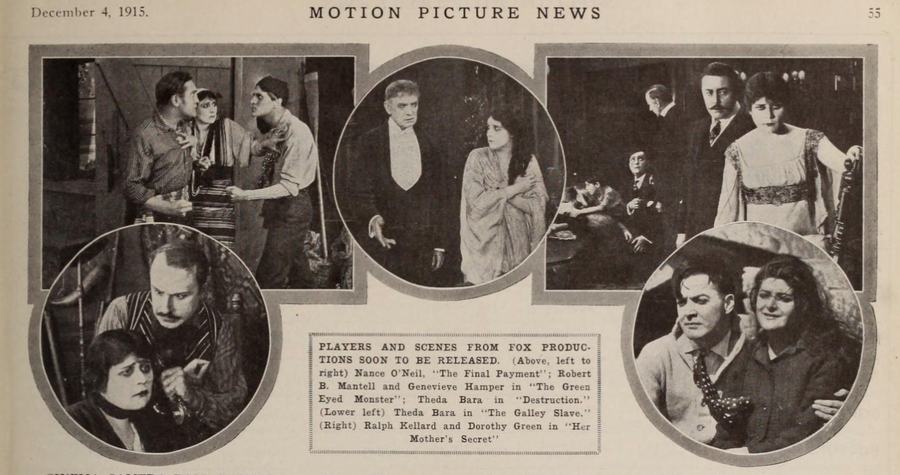
The film culminates in Raimond’s ultimate demise, a fittingly dramatic end for a character so consumed by his inner demons. As a 'raving maniac,' he falls dead, his last sight the very skeleton of his brother – the physical embodiment of his crime and the catalyst for his ruin. This final image is a powerful, poetic justice, a visual representation of how his obsession has literally consumed him, leaving him hollowed out and destroyed. The narrative arc, from silent yearning to murderous rage and ultimately to self-destruction, is remarkably cohesive, a testament to Mary Murillo’s intricate scriptwriting, which manages to maintain a psychological thread throughout the escalating horrors.
Robert B. Mantell's portrayal of Raimond de Mornay is, without question, the centrifugal force of The Green-Eyed Monster. His performance transcends the often-exaggerated gestures of silent cinema, delivering a nuanced depiction of a man's slow descent into depravity. Mantell conveys the initial pangs of unrequited love with a subtle melancholy, transitioning seamlessly into the seething resentment of a jealous brother, and finally, embodying the terrifying emptiness of a maniac. His eyes, in particular, convey a depth of emotion that speaks volumes where words are absent, a common strength in the era's leading men, much like the compelling presence seen in performances from films such as Ultus, the Man from the Dead.
Genevieve Hamper, as Claire, brings a delicate grace to her role, her innocence providing a stark contrast to Raimond's burgeoning darkness. Her eventual terror and tragic demise are rendered with a poignant vulnerability that elicits genuine empathy. Charles Crompton, as Louis, embodies the unsuspecting victim, his happiness serving as the unwitting spark for his brother's destructive rage. While the supporting cast, including Stuart Holmes, Charles Davidson, Henry Leone, and Pauline Barry, contribute effectively to the period's dramatic conventions, it is Mantell's singular performance that truly elevates the film from a mere melodrama to a compelling psychological study.
Mary Murillo's screenplay is a remarkable piece of dramatic construction. She meticulously crafts a narrative that, despite its sensational elements, maintains a tight focus on the psychological motivations of its central character. The pacing, a crucial element in silent film, is expertly handled, allowing the tension to build inexorably towards its grim conclusion. The film's reliance on visual storytelling – the ornate chateau, the exotic artifacts from India, the chilling reveal of the casket's contents – demonstrates a sophisticated understanding of cinematic language, proving that complex narratives did not require spoken dialogue to convey profound themes. The moral decay depicted here is a powerful cautionary tale, echoing the dramatic weight found in family sagas like The Family Honor, though with a distinctly darker hue.
The cinematography, while adhering to the technical constraints of its era, effectively utilizes lighting and composition to enhance the film's somber mood. Close-ups, though perhaps not as prevalent as in later periods, are employed judiciously to highlight Mantell's expressions, allowing the audience to witness the subtle shifts in his mental state. The use of intertitles, far from being a mere convenience, acts as a crucial narrative voice, guiding the audience through the psychological labyrinth of Raimond's mind, sometimes providing direct insight into his thoughts, sometimes advancing the plot with dramatic declarations.
The film's exploration of themes like jealousy, madness, and the corrupting influence of unchecked desire remains remarkably potent. It posits that the true monster lies not in external forces, but within the human heart, capable of festering into something truly horrific. The exoticism surrounding Raimond's Indian sojourn, while perhaps problematic by contemporary standards, serves a clear narrative purpose: to provide him with the means to actualize his destructive impulses, transforming him from a mere jealous man into an insidious force of nature. This interplay of internal decay and external influences gives the film a depth that transcends its melodramatic surface. We see a similar exploration of internal struggle and external consequence, albeit in different contexts, in films like Shadows from the Past, which also delved into the long-term impact of past deeds.
In a broader context, The Green-Eyed Monster can be viewed as a significant precursor to later psychological thrillers, demonstrating that cinema, even in its nascent stages, was capable of exploring complex human emotions and their devastating consequences. Its bold narrative choices, particularly the explicit depiction of murder and its subsequent mental unraveling, pushed boundaries for its time. It’s a film that demands engagement, challenging its audience to confront the darker side of human nature without the comfort of dialogue to soften the blows.
The enduring power of The Green-Eyed Monster lies in its unflinching portrayal of a man consumed by his own demons. It's a tragic opera of the mind, played out in stark black and white, where every gesture, every expression, every intertitle contributes to a relentless march towards an inevitable, horrifying conclusion. For enthusiasts of silent cinema and those fascinated by the psychological depths of early film, this picture offers a rich, if unsettling, viewing experience. It reminds us that the fundamental narratives of human passion and destruction are timeless, capable of being conveyed with profound impact across different eras and technological limitations. It's a stark reminder that some monsters are not lurking in the shadows, but festering within the very core of our being, waiting for the opportune moment to manifest. The film's ambition in tackling such dark themes with such a visceral visual language solidifies its place as a compelling, albeit chilling, piece of cinematic history.

IMDb 6.3
1928
Community
Log in to comment.