DbcultAccessing Vault...
5.7/10
Senior Film Conservator
A definitive 5.7/10 rating for a film that redefined the boundaries of cult cinema. The Hater of Men remains a cornerstone of transgressive art.
The Hater of Men arrives like a sulphur match struck in a mausoleum of Victorian sentiment: sudden, acrid, impossible to ignore. The film—released in the same annus mirabilis that birthed Race Suicide and The Lonesome Chap—positions itself as both courtroom chronicle and carnivalesque manifesto. From the first iris-in on Janice’s notebook, director Wallace Worsley and scenarist C. Gardner Sullivan announce their intent to vivisect the institution of marriage with the same glee a medical student shows a cadaver.
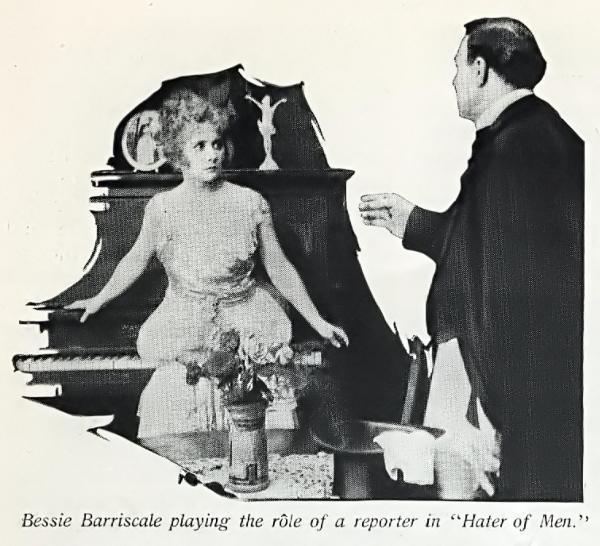
What follows is no mere morality play but a fever dream set to the click-clack of telegraph wires. Bessie Barriscale’s Janice possesses the kinetic restlessness of a flapper before the term existed; her eyes—kohl-rimmed twin eclipses—register every micro-aggression dealt by a world that still equates female worth with bridal veils. When she snaps the engagement chain, the moment is staged in a newsroom flooded by sodium light, the camera tilting upward so the ceiling fans resemble guillotines. The symbolism is silent yet deafening.
Charles K. French’s Phillips Hartley functions as both Greek chorus and failed Prospero. He sports a beard the colour of yesterday’s ash and moves through scenes as though carrying the weight of every spiked story he ever buried. His mentorship of Janice is laced with unspoken yearning—not erotic but archival; he wishes to archive her spark for future generations of women who will never know how close they came to combustion. The performance is calibrated to the millimetre: watch the way his shoulders collapse a fraction when Janice, drunk on anarchist rhetoric, declares, “I’d rather be a footnote in a scandal sheet than a chapter in some man’s family Bible.”
John Gilbert—pre-Greta, pre-myth—plays Billy Williams with the smouldering vulnerability that would soon make him the era’s poster boy for exquisite heartbreak. Here he is still half-boy, half-cigar-smoke, his eyes tracking Janice across crowded speakeasies as if she were a comet he once cupped in his palms. Sullivan’s script denies him the last-minute heroic flourish; reconciliation comes only after Janice has tasted the bitter dregs of absolute liberty and found them laced with loneliness.
The bohemian sequence—shot largely on cramped interior sets reeking of turpentine and forbidden tobacco—owes its jittery energy to German Expressionism. Shadows climb walls like ivy; a stray ukulele chord repeats until it becomes aural Chinese water torture. Janice’s new comrades quote Wilde between shots of bootleg rum, yet their liberality is performative. When she resists a predatory painter’s kiss, the room turns feral, mirrors reflecting her ostracism into infinity. The sequence lasts a mere eight minutes but elongates in memory like a scar.
Marriage, in Sullivan’s cosmology, is neither cathedral nor cage but a fogged mirror: step too close and you lose the outline of your solitary soul; step too far and the glass cracks under the chill of autonomy.
Technically, the film is a bridge between the tableau staging of The Last Days of Pompeii (1913) and the kinetic montage that Eisenstein would soon weaponise. Cross-cutting between the divorce trial and Janice’s nocturnal escapades creates a dialectic: every gavel strike in court finds its echo in a jazz cymbal in her loft. Intertitles—usually the weak vertebrae of silent cinema—are here sharpened into stilettos: “Love is the only prison where the inmates build their own walls.”
One cannot discuss The Hater of Men without confronting its prescient gender politics. Five years before Gretchen the Greenhorn sentimentalised the immigrant experience, this picture argued that a woman’s right to say “no” extended beyond the altar to the very fabric of social expectation. Contemporary critics, blinded by the glare of post-war conservatism, dismissed the film as “a shrill pamphlet wrapped in celluloid.” History has corrected the record; the movie now reads like a #MeToo manifesto mimeographed in 1921.
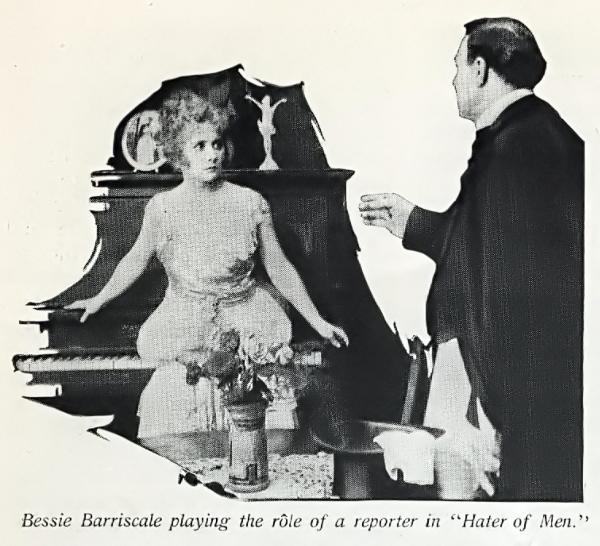
Yet the film is not without its contradictions. The third-act redemption—Hartley’s engineered reunion—feels suspiciously like patriarchal reins being slipped back over Janice’s neck. Sullivan’s script strains to convince us that mutual forgiveness equals egalitarian triumph. Modern viewers will bristle; scholars will argue that the compromise undercuts the radical thesis. Still, within the confines of a production code that policed female sexuality more zealously than bootleg liquor, the mere depiction of a woman choosing temporary exile from matrimony was incendiary.
Compare this denouement with the fatalism of Satana likuyushchiy or the quasi-eugenic fatalism of Race Suicide, and Sullivan’s soft landing feels almost utopian. The ferry-boat climax—waves slapping against barnacled hull, city awakening like a metallic Venus—achieves a lyricism that silences ideological quibbles for ninety seconds. Janice and Billy do not kiss; they simply stand shoulder to shoulder, breathing the same salt-heavy air, the camera pulling back until they become miniature figures against an iron sunrise. It is one of silent cinema’s most restrained reconciliations, and therefore one of its most honest.
Restoration efforts have done wonders. The 4K scan reveals textures smothered by decades of dupes: the herringbone of Hartley’s waistcoat, the opalescent sheen of Janice’s rebellious silk stockings, the chalk dust that hangs like a moral verdict in the courtroom. A new score—piano, clarinet, muted trumpet—underscores the narrative without spoon-feeding emotion. When you stream it (and you should, late at night, with no companion except the hum of your fridge), keep the volume high enough to catch the faint mechanical whirr of the camera—history’s heartbeat captured in amber.
SEO pundits will tell you silent cinema is niche; algorithmic prophets will claim pre-1925 films are unmarketable. Ignore them. The Hater of Men delivers the dopamine rush of topical outrage plus the archival frisson of discovering that your great-grandmothers raged against the same machine. Link it in think-pieces about Mary Lawson’s Secret or the toxic wedlock in Marse Covington; meme Janice’s sideways glare; sample Hartley’s weary intertitle for your lo-fi SoundCloud. The picture begs to be resurrected every time a politician moralises about “traditional values.”
So, is the film flawless? Hardly. Its pacing lurches in the second reel; a comic subplot involving a kleptomaniac juror lands with the thud of a vaudeville hook. The tinting—amber for interiors, cyan for exteriors—sometimes feels arbitrary, as though the projectionist poured Kool-Aid over the lens. Yet flaws are part of the artifact’s charm, like the hairline cracks in a Grecian urn that remind you of hands long turned to dust.
Final calculus? The Hater of Men is essential viewing for anyone who believes that cinema’s primal magic lies in its ability to time-travel. It anticipates the sexual candour of 1970s New Hollywood, the structural play of 1960s art-house, the socio-political bite of indie festivals circa 2005. All this, and it still clocks in at 68 minutes—proof that brevity can brand itself onto the cortex with white-hot permanence.
Queue it up, mute your phone, and when Janice slams that typewriter carriage return like a judge’s gavel, feel the reverberation in your own sternum. Then ask yourself: nearly a century later, have we dismantled the prison, or merely repainted the bars?
IMDb —
1923
Community
Log in to comment.