DbcultAccessing Vault...
4.7/10
Senior Film Conservator
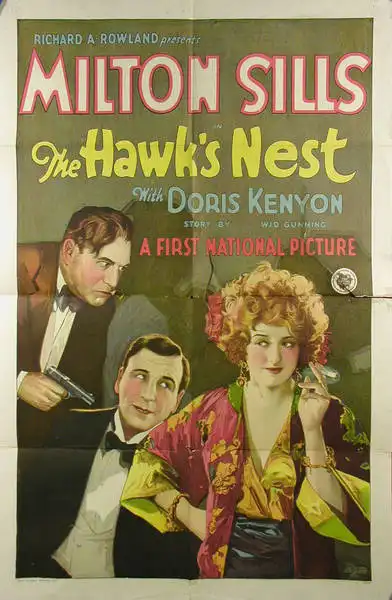
A definitive 4.7/10 rating for a film that redefined the boundaries of cult cinema. The Hawk's Nest remains a cornerstone of transgressive art.
Look, if you're not already deep into early gangster pictures, The Hawk's Nest isn't going to be your entry point. This one's for the hardcore silent film buffs, the kind who appreciate the clunky charm of a B-picture from the era, even its rough edges. Everyone else? You'll probably find it a bit of a slog, honestly, unless you have a real soft spot for melodramatic framing devices and villains who chew scenery with gusto.
The plot itself is pretty standard fare: two rival speakeasy owners, a framed partner, a dancer caught in the middle. John Finchley, played by Montagu Love, is our stoic hero trying to clear James Kent's name after Dan Daugherty (Mitchell Lewis, all sneer and bulk) pins a murder on him. It’s a solid enough setup, but the execution, well, that's where things get interesting.
There are moments where the film genuinely sparks. The initial confrontation between Finchley and Daugherty, for instance, has a decent tension to it. You can almost feel the air crackle, even without dialogue. Montagu Love has this way of looking at Lewis that implies a whole history of bad blood, without needing a title card to spell it out. But then, almost immediately, the pacing just... deflates.
The scene where Finchley is trying to piece together Daugherty's involvement in the murder, it goes on about 20 seconds too long. He just sits there, staring off into the middle distance, and the silence starts to feel awkward rather than emotional. You can almost feel the movie trying to convince you this moment matters, but it’s just a guy thinking, and it’s not particularly cinematic.
Doris Kenyon, as Madelon Arden, the dancer, is a bit of a mixed bag. She has a striking presence in some shots, particularly when she’s performing on stage. There's a close-up of her during one of her numbers where her expression is just captivating, a real star quality. But off-stage, her reactions often feel a beat too slow, or sometimes, a beat too exaggerated. There’s a scene where Daugherty corners her, and her wide-eyed terror felt less like genuine fear and more like a stage performance of terror, if that makes sense.
And the costumes! Madelon has this one dress, a sort of sequined flapper number, that looks fantastic under the stage lights. But then she appears in a daytime scene wearing something that resembles a hastily draped bedsheet, and it completely pulls you out of it. It's a small detail, but it makes you wonder about the budget or the wardrobe department's attention to consistency.
The whole Chinatown subplot, involving Sojin Kamiyama as the Tong leader, Sojin, is probably the most fascinating, if also the most culturally dated, aspect of the film. Kamiyama brings a real intensity to his role. He doesn't have a lot of screen time, but every time he appears, the film gets a noticeable jolt of energy. His movements are so precise, so deliberate. The scene where Finchley first approaches him in that dimly lit backroom, surrounded by incense and shadows, it's genuinely atmospheric. It's a shame the film doesn't lean into that more, instead of rushing through it to get back to the more pedestrian gangster stuff.
There's a weird edit right after one of the major revelations about Daugherty. It cuts from a tense, dramatic close-up of Finchley's face to a wide shot of a bustling street, completely unrelated, for what feels like a full five seconds before cutting back to the plot. It's jarring. Like a reel got mixed up or something. Did anyone else catch that?
The crowd scenes in the speakeasies have this oddly empty feeling sometimes, like half the extras wandered off for a smoke break. You see a few people dancing, a few at tables, but it never quite conveys the illicit, bustling energy you'd expect from a Prohibition-era joint. It's more like a dress rehearsal than a live performance.
And the dialogue, or rather, the title cards. Some of them are surprisingly sharp, cutting right to the chase. Others feel a bit clunky, over-explaining things that are already clear from the actors' expressions. There's a moment where a character says, 'He will pay for this treachery!' and it just lands with a thud. It's a reminder of how difficult it must have been to get that balance right in silent films.
The movie gets noticeably better once it stops taking itself so seriously in the final act, when Finchley and Sojin team up. There's a chase sequence that, while not exactly groundbreaking, has a decent energy to it. And the ultimate comeuppance for Daugherty is satisfyingly theatrical, even if it feels a little rushed after the slow burn of the middle section.
Overall, The Hawk's Nest is a curious artifact. It's not a lost masterpiece, and it’s certainly not going to convert anyone new to the silent film genre. But for those of us who enjoy sifting through the less-polished gems of the past, picking out the strange choices, the unexpected sparks, and the occasional outright blunders, there’s something here to chew on. Just don't expect it to be a smooth ride.
IMDb —
1920
Community
Log in to comment.