DbcultAccessing Vault...
Cult Review
Senior Film Conservator
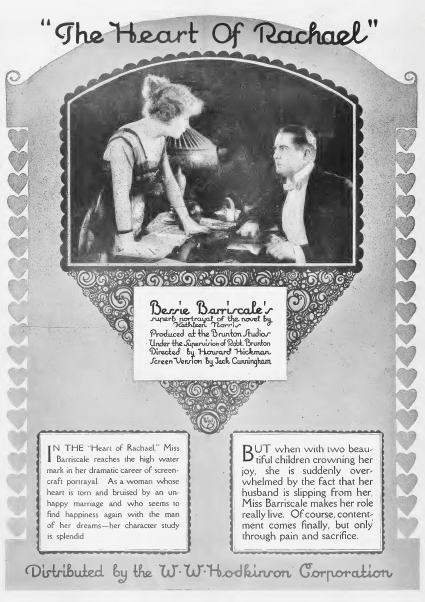
Stepping back into the hallowed halls of silent cinema often feels like unearthing a forgotten language, a lexicon of gestures, expressions, and intertitles that speak volumes without uttering a single sound. 'The Heart of Rachael' (1918), a profound domestic drama penned by Jack Cunningham and Kathleen Norris, emerges from this era as a particularly resonant piece, a cinematic lament on the complexities of marital disillusionment and the arduous path to redemption. It’s a film that, despite its century-plus vintage, grapples with themes that remain startlingly contemporary: the search for genuine connection, the corrosive nature of neglect, and the enduring power of familial love. It’s a narrative tapestry woven with threads of hope, despair, and the quiet resilience of the human spirit, anchored by a performance from Bessie Barriscale that is nothing short of captivating.
At its core, 'The Heart of Rachael' is the story of a woman adrift, navigating the treacherous waters of societal expectations and personal desires. Rachael, brought to life with exquisite nuance by Bessie Barriscale, begins her journey in a marriage that is, from the outset, doomed to emotional sterility. Her husband, Clarence Breckenridge (Herschel Mayall), is depicted not as a villain in the conventional sense, but as a man consumed by his own demons – primarily alcoholism – and an almost suffocating devotion to his daughter, Billy (Ella Hall). The tragedy here is not malice, but indifference. Rachael exists on the periphery of their lives, an unacknowledged presence, a ghost in her own home. This profound emotional vacuum is palpable, a silent scream resonating through the frames. It’s a testament to Barriscale’s acting that we feel Rachael’s isolation so keenly, her expressive eyes conveying a world of unspoken longing and quiet despair.
The film’s initial chapters meticulously build this sense of suffocation, laying the groundwork for Rachael’s eventual, and entirely understandable, flight. Her decision to divorce Clarence and marry her old friend, Dr. Warren Gregory (Herbert Heyes), is presented not as an act of capriciousness, but as a desperate bid for emotional salvation. One might consider the plight of other silent film heroines trapped in unhappy unions, perhaps those navigating similar societal pressures as seen in Susan Rocks the Boat, though Rachael's journey feels uniquely burdened by the very specific nature of her husband's singular devotion to his daughter, creating an impenetrable emotional barrier.
However, the narrative, with a keen eye for life's bitter ironies, reveals that Rachael's second marriage offers no immediate solace. Warren, once the embodiment of home-loving reliability, has, in Rachael’s absence, transformed into a social 'high-stepper,' mirroring the very superficiality and emotional distance that plagued her first union. This cruel twist of fate underscores a central theme of the film: that the external circumstances of a relationship can change, but the internal struggles of the heart, if left unaddressed, can resurface in new and equally painful guises. Rachael's disillusionment is amplified by this realization, leaving her once again in a state of profound loneliness, even within the confines of matrimony.
As the years unfold, the film meticulously charts a course through further tribulations, demonstrating how interconnected lives can unravel in a cascade of unfortunate events. Billy, Clarence’s cherished, if somewhat spoiled, daughter, makes a disastrous choice, eloping with Joe Pickering (Edward Coxen), a character painted with broad strokes as a 'worthless pleasure-seeker.' This rash decision serves as a catalyst for profound tragedy. Clarence, whose entire emotional life was seemingly invested in Billy, is utterly shattered by her foolishness. His already fragile constitution, undoubtedly exacerbated by his alcoholism, buckles under the weight of this fresh disappointment, leading him to take his own life. This particular plot point resonates with a stark realism, highlighting the devastating consequences of unchecked self-indulgence and the profound despair that can consume a parent when their child veers off course. It’s a moment that adds a layer of somber gravitas to the film, reminding us that even secondary characters carry significant emotional weight, their fates intertwined with Rachael's own complex journey.
Meanwhile, Warren’s own moral compass begins to waver. He develops an attachment to Magsie Clay (Gloria Hope), an actress whose allure proves too strong to resist. The film doesn't shy away from depicting the messy realities of human frailty and temptation. Magsie, surprisingly, is not portrayed as a stereotypical femme fatale; instead, she exhibits a degree of honesty and vulnerability when she admits her feelings for Warren to Rachael. This confession is a pivotal moment, showcasing Rachael's capacity for empathy even amidst her own pain. Her agreement to a divorce, born not of bitterness but a weary understanding, speaks volumes about her character's evolution. Yet, Warren, caught in a moral quandary, proves unable to fully commit to Magsie or completely abandon Rachael and their children. His departure for Europe is an act of evasion, a temporary reprieve from an impossible choice, leaving Rachael once again in a state of suspended animation, her future uncertain.
The narrative arc of 'The Heart of Rachael' reaches its emotional crescendo with a crisis that strips away all pretense and forces its central couple to confront their deepest feelings. Their young son, Jim (Mary Jane Irving), suffers a severe injury, a devastating blow that shatters the fragile peace Rachael had established. In her desperation, Rachael turns to the only person she believes can save him: Warren. This plea is not merely for medical intervention; it is an unspoken appeal for his presence, his strength, his shared parenthood. The film masterfully uses this moment of profound vulnerability to strip away the layers of resentment, disillusionment, and infidelity that had accumulated between them. The shared agony over their child’s suffering becomes a powerful crucible, burning away the dross of their past mistakes and revealing the foundational love that, despite everything, still flickered beneath the surface. It is a classic narrative device, to be sure, but executed here with such genuine pathos that it feels earned, rather than contrived. The shared ordeal of Jim's recovery becomes the catalyst for their reconciliation, a renewal of vows unspoken, forged in the fires of fear and hope.
This final act of the film is a powerful testament to the idea that love, especially within the context of family, can endure and even be strengthened by adversity. It suggests that while passions may wane and temptations may arise, the bonds forged through shared history, children, and mutual respect can ultimately prevail. The ending is not saccharine; rather, it feels like a hard-won peace, a mature understanding that love is not merely a feeling but a conscious choice, a commitment to weathering life’s storms together.
Bessie Barriscale, as Rachael, delivers a performance that transcends the limitations of silent film acting. Her portrayal is a masterclass in emotional transparency. She conveys Rachael's initial youthful optimism, her subsequent crushing disappointment, her quiet strength, and her ultimate resilience with incredible authenticity. Her eyes, often wide with sorrow or narrowed with determination, are the true windows to Rachael's soul, communicating complex inner turmoil without the need for dialogue. It's a performance that holds its own against the dramatic intensity found in other silent era works, perhaps even rivaling the emotional depth of characters in films like The Green Cloak where nuanced female roles were paramount.
Herbert Heyes, as Dr. Warren Gregory, successfully navigates the transformation from a seemingly dependable friend to a man swayed by social ambition and temptation. His portrayal captures the internal conflict of a man torn between duty and desire, making his eventual return to Rachael feel more like a conscious choice born of deeper love than mere obligation. Ella Hall, as Billy, effectively conveys the youthful impulsiveness that sets off a chain of tragic events, while Herschel Mayall's Clarence is a poignant study in self-destruction. Even young Mary Jane Irving, as Jim, manages to evoke genuine sympathy, her plight serving as the ultimate catalyst for the family's healing.
Directed with a steady hand, 'The Heart of Rachael' utilizes the visual language of silent cinema effectively. The cinematography, while perhaps not groundbreaking for its time, is competent and serves the story well, often using close-ups to emphasize the emotional weight of Barriscale's expressions. The pacing is deliberate, allowing the audience to fully absorb the emotional beats of Rachael's journey. The intertitles, crucial to silent storytelling, are well-crafted, providing necessary exposition without detracting from the visual narrative. The film, like many of its contemporaries such as The Gates of Doom, relies heavily on establishing clear moral stakes and emotional consequences, but 'Rachael' does so with a particular focus on the internal world of its protagonist.
What makes 'The Heart of Rachael' particularly enduring is its exploration of themes that remain universally resonant. The complexities of marriage, the pain of infidelity, the devastating impact of addiction, and the redemptive power of forgiveness are not confined to the silent era. The film serves as a powerful reminder that human emotions, in all their intricate glory and crushing despair, are timeless. It speaks to the idea that true love is not always idyllic, but often forged in the fires of adversity, requiring profound understanding and a willingness to forgive. In an age where relationships are often depicted with fleeting superficiality, 'The Heart of Rachael' offers a stark, yet ultimately hopeful, counter-narrative – a testament to the enduring human capacity for resilience and the arduous, but ultimately rewarding, journey back to connection.
Watching this film today is more than just an exercise in historical appreciation; it's an opportunity to connect with a powerful narrative about the human heart's capacity for both suffering and profound renewal. It encourages us to look beyond the surface of relationships, to understand the deeper currents of indifference, longing, and the ultimate, often painful, path to reconciliation. It’s a film that quietly asserts that the greatest victories are often won not in grand gestures, but in the quiet, persistent effort to mend what has been broken. For those who appreciate the rich tapestry of silent cinema and narratives that delve deep into the human condition, 'The Heart of Rachael' is an essential viewing, a poignant reminder of the enduring power of dramatic storytelling.
IMDb 5.1
1936
Community
Log in to comment.