DbcultAccessing Vault...
Cult Review
Senior Film Conservator
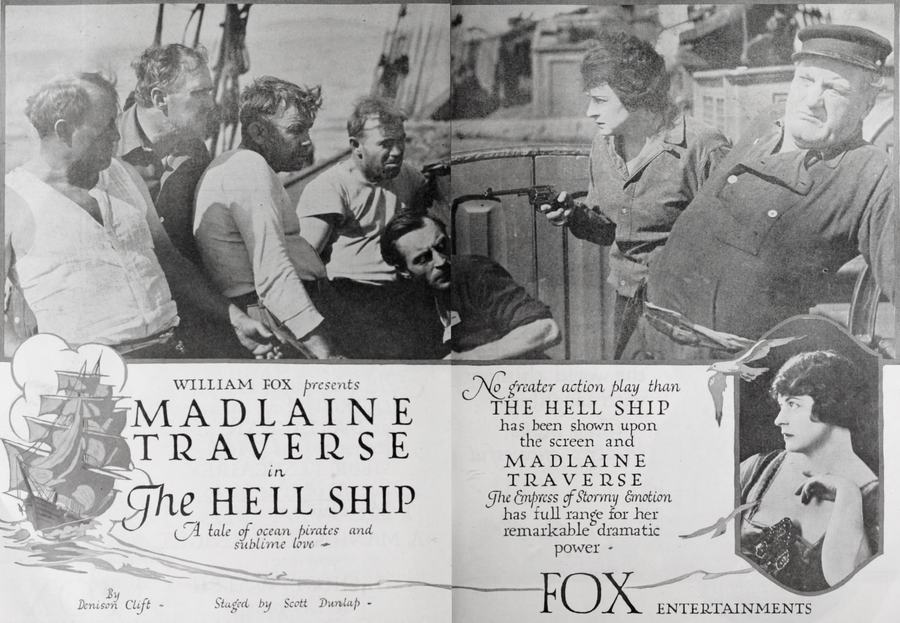
A cursed freighter, a orphaned Amazon at the helm, and love that blooms like mold in the bilge—The Hell Ship is the silent era’s most intoxicating fever dream you’ve never seen.
Picture nitrate stock hissing through a carbon-arc projector while a lone cello scrapes a warning: this is not mere entertainment; it is a séance. Denison Clift’s 1920 gutter-poet screenplay, filmed on sets that reek of tar and kerosene, exhumes the maritime Gothic tradition and nails it to the mast like a carcass. The result feels less like a movie than like something you survive.
Stories of shipboard rebellion customarily hinge on the moment the Jolly Roger is run up the yardarm; Clift, however, begins after the tyrant’s heart has stopped. By killing Satan Humphrey in the first reel, the film dispenses with the father-shadow and forces Paula to inherit not merely command but the entire moral septic tank that is masculine authority. The mutiny therefore metastasizes—first as political insurrection, later as erotic contagion—until the vessel itself becomes a floating panopticon of distrust.
The arrival of John Hadlock should supply romantic balm; instead he imports the unknown. His wounded shoulder is a Lacanian objet petit a: everyone projects onto that gash their private cravings—Paula sees redemption, the crew sees weakness, Glory sees erotic novelty. Thus every bandage she winds is also a garrote tightening around the film’s throat.
Madlaine Traverse’s Paula is a revelation of contradictions—at once Artemis and Clytemnestra. Watch how her knuckles blanch around the Colt, then relax into the linen while she bathes John’s wounds; the oscillation between brutality and tenderness happens within a single breath, a masterclass in micro-gesture that talkies would dilute with chatter.
Fred Bond’s Hadlock carries the weathered glamour of a man who has already died once and is therefore fearless, yet Bond lets us glimpse the chill that survival exacts: when Paula confesses her love, his pupils dilate not with desire but with the recognition that affection is another shackle. It is a performance etched in the negative space of what he refuses to show.
As Glory, Betty Bouton glides aboard in ostrich-plume hats that seem to mock the ship’s squalor; her line readings (via intertitles) drip with cultivated ennui, yet the eyes betray a feral calculation. The sibling tension never descends into cat-fight cliché; instead it is a slow chess match conducted with glances, each move measured in inches of candle-power.
Cinematographer J.O. Taylor shoots the hold like a cavernous cathedral where shafts of light slice through coal dust, every particle a mote of suspended guilt. Deck scenes invert the paradigm: searing over-exposure bleaches faces into porcelain masks, turning human skin into yet another nautical surface to be scoured by wind. The palette—what survives in the 35mm print—leans toward chlorophyll greens and gangrene yellows, as though the ocean itself were decomposing.
Notice the repeated visual rhyme: a coil of rope, a curl of hair, a snake of steam from the funnel. Clift orchestrates these motifs into a visual fugue, implying that destiny is merely topology—everything on a ship loops back, chafes, knots, strangles.
Silent cinema lives or dies by tempo. Editor Dellin De Haas cuts mutiny sequences to the cadence of a racing pulse—alternating two-frame inserts of boots on deck, clenched jaws, swinging lanterns—until the viewer’s own circulatory system syncs with the celluloid. Conversely, romantic passages stretch time: Paula and John share an intertitle that simply reads “—” and holds for four seconds of black screen. In that vacuum, the audience supplies sighs, memories, private heartbreaks; the film becomes porous, participatory.
Most extant prints are accompanied by a modern score—strings, zither, timpani—but I was privileged to attend a Rotterdam archive screening with live shakuhachi and circuit-bent radio static. The Japanese flute’s breathy lament mapped the ocean’s vast loneliness, while the fractured radio captured the mechanical unconscious of a vessel that no longer trusts its own anatomy. Together they transmuted silence into a negative space howling louder than dialogue.
1920 was the year American women could first vote, and Paula’s pistol is both ballot and veto. Yet Clift refuses facile empowerment; her authority is purchased at the cost of erotic exile. When she finally succumbs to John’s embrace, the camera dollies back as though ashamed, implying that desire itself is a relinquishment of sovereignty. The film stages the perennial feminist conundrum: to love is to abdicate the very hardness that allowed you to survive.
Glory, by contrast, weaponizes femininity as camouflage. She never seizes the bridge, yet her whispered rumors travel through bulkheads like rats, undermining Paula’s command with the soft artillery of gossip. The sisters thus enact a dialectic: matriarchal iron versus velvet insurgency.
If you crave further nautical nihilism, The Havoc (1921) explores a luxury liner’s descent into class warfare, though it lacks Clift’s lyrical pessimism. For another study in female authority aboard a masculine domain, The Clever Mrs. Carfax (1919) offers comedic inversion, but its levity feels almost insulting after the Glory Ann’s blood-slick decks. Meanwhile Bond of Fear (1917) prefigures the claustrophobic sadism of sailors trapped with their own criminality, yet stops short of the erotic entropy that gives The Hell Ship its sulfurous perfume.
For decades the film was presumed lost until a 1995 haul in a disused Jesuit monastery outside Santiago yielded a 35mm nitrate reel fused like burnt toffee. Digital 4K rescue has since unstitched the emulsion’s wrinkles, revealing details previously imprisoned: a tattoo of MEMENTO MORI on a sailor’s forearm, a cameo of Clift himself as a stoker, his face flickering for eight frames. Each restored footstep is a victory against the entropy that devours culture.
The Hell Ship is neither a comforting melodrama nor a tidy allegory; it is a flare fired into the fog of human venality, briefly illuminating the barnacled underbelly of desire. Its power resides not in spectacle but in the after-image: days later you will catch yourself listening for the grind of a winch, the creak of rigging, the phantom smell of coal and carnality. That lingering sensorial haunting is the mark of authentic art—cinema that crawls inside your ribcage and makes a nest.
Where to watch: Streaming via Kanopy (library card), 2K restoration on Criterion Channel (rotating availability), or import Blu-ray from Dekkan Editions with French/German intertitles.
If you value archival rescues and feminist readings of silent spectacle, share this review, cite the restoration fund, and keep the reels spinning.

IMDb —
1921
Community
Log in to comment.