DbcultAccessing Vault...
Cult Review
Senior Film Conservator
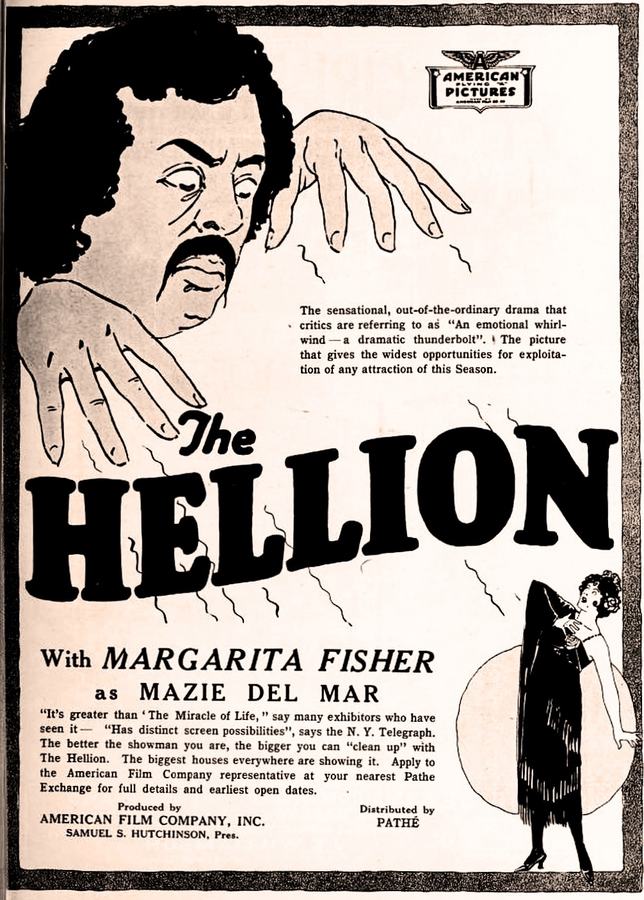
Stepping back into the nascent days of cinema, when flickering images and orchestral swells wove narratives without uttered words, we encounter 'The Hellion' (1919). This silent-era gem, a product of a burgeoning industry still experimenting with its expressive capabilities, delivers a melodrama steeped in deception, psychological manipulation, and the unexpected blossoming of love amidst a garden of lies. Directed with a keen eye for human frailty and moral quandaries, the film, penned by Daniel F. Whitcomb, stands as a testament to the era's capacity for intricate storytelling and profound emotional resonance, even in the absence of dialogue. It's a journey into the moral labyrinth constructed by desperate individuals, a narrative that explores the high stakes of identity and affection when all seems lost.
At the heart of 'The Hellion' lies the plight of Joseph and Helen Harper, a couple whose profligacy has led them to pilfer their niece Blanche's substantial inheritance. This act of familial betrayal forms the initial tremor in a landscape destined for seismic upheaval. Their meticulously guarded secret faces imminent exposure with the astonishing return of George Graham, Blanche's fiancé, believed to have perished in the Great War. George's reappearance is not merely an inconvenience; it threatens to unravel their entire existence, especially given Blanche's tragic state. Her mind, fractured by the devastating, albeit false, news of George's death, has retreated into an impenetrable veil of insanity. The Harpers, faced with the twin specters of financial ruin and the potential abandonment of their niece by her wealthy suitor, concoct a scheme born of pure desperation: find a doppelgänger for Blanche.
Enter Mazie Del Mar, a captivating cabaret dancer whose striking resemblance to Blanche becomes the Harpers' golden ticket out of their predicament. Mazie, however, is no free agent. She is ensnared in the insidious clutches of Signor Enrico, a nefarious cabaret owner whose moniker, "The Hellion," perfectly encapsulates his malevolent nature. Enrico maintains a chilling control over Mazie through the dark art of hypnosis, a sinister detail that imbues the narrative with an unsettling psychological dimension. For Mazie, the Harpers' proposition isn't just a job; it's a desperate bid for liberation from Enrico's tyrannical sway. She agrees to impersonate Blanche, to marry George, and thus, to step into a life of assumed identity, a path fraught with moral compromise and emotional peril.
What begins as a cold, calculated charade soon takes an unforeseen turn. As Mazie, in her assumed role, spends time with George, a genuine connection begins to forge between them. The initial pretense slowly gives way to authentic affection, trapping Mazie in a poignant dilemma. Her heart, once motivated by escape, now yearns for a love that feels both real and utterly forbidden, built as it is upon a foundation of deceit. This emotional complexity is where 'The Hellion' truly shines, exploring the nuanced boundaries between constructed reality and emergent truth. Margarita Fischer, embodying Mazie, delivers a performance that transcends the theatrical conventions of the era, conveying Mazie's internal turmoil with remarkable subtlety and depth, making her plight palpable to the audience.
The narrative masterfully intertwines the love story with the escalating tension of Enrico's villainy. Emory Johnson's portrayal of Signor Enrico is a study in menace, his silent presence radiating a palpable threat. His character, "The Hellion," is not merely a stock antagonist but a force of hypnotic control and possessive obsession, a stark contrast to George Graham's (Charles Spere) earnest sincerity. Enrico's continued attempts to reclaim Mazie ultimately lead to a tragic miscalculation. In a shocking twist, he kidnaps the real Blanche, mistaking her for Mazie. His subsequent, chilling attempts to hypnotize Blanche, already fragile and disturbed, prove futile, culminating in a violent struggle that tragically claims Blanche's life. This pivotal moment shatters the last vestiges of the Harpers' scheme and plunges the narrative into a darker, more irreversible realm.
With Blanche's death, the intricate web of lies can no longer hold. Mazie, burdened by guilt and love, prepares to confess her true identity and the elaborate deception. However, George, ever the astute and compassionate figure, preempts her. His detectives, it turns out, have been diligently working in the background, uncovering the entire scheme. What could have been a moment of devastating betrayal transforms into one of profound understanding and unexpected grace. George reveals his knowledge, not with anger, but with a reaffirmation of his love for Mazie, a love that has transcended the initial pretense. This revelation is a powerful statement on the nature of love itself – capable of seeing beyond facades and embracing genuine connection.
In a remarkable act of forgiveness, George absolves the Harpers, acknowledging the perverse irony that their desperate, morally dubious plan ultimately led him to the woman he loves. This denouement, while perhaps stretching the bounds of realism, offers a satisfying, albeit bittersweet, resolution to the complex moral tapestry woven throughout the film. It suggests that even from the darkest corners of human desperation, unforeseen beauty and genuine connection can emerge. The performances, particularly by Margarita Fischer, Charles Spere, and Emory Johnson, are crucial in selling this intricate emotional journey, using subtle gestures, facial expressions, and body language to convey a spectrum of human emotion, from despair to burgeoning love, from menacing control to ultimate forgiveness.
'The Hellion' stands as a compelling example of early cinema's ability to craft intricate psychological dramas. Daniel F. Whitcomb's screenplay is a marvel of construction, balancing suspense, romance, and tragedy with a deft hand. The film's visual narrative relies heavily on the evocative power of mise-en-scène and the expressive capabilities of its actors. Scenes of Enrico's hypnotic control, for instance, are rendered with a chilling efficacy, making the audience feel Mazie's helplessness without a single spoken word. The use of close-ups to capture the nuanced emotions on Margarita Fischer's face is particularly effective, drawing the viewer into her internal conflict. The sets, though perhaps modest by today's standards, effectively convey the disparate worlds of the Harpers' genteel but decaying respectability, the vibrant yet sinister cabaret, and George's world of quiet affluence.
The themes explored within 'The Hellion' – identity, manipulation, the true nature of love, and the consequences of desperation – remain timeless. The film probes the question of whether love can truly flourish when born from a lie, ultimately offering a surprisingly optimistic answer. This narrative complexity is a hallmark of the era, pushing beyond simple morality tales to explore the ambiguities of human experience. The film, in its quiet intensity, invites comparison to other silent dramas that delved into the intricacies of human psychology. One might consider Das Spiel ist aus for its potential exploration of games and manipulation, or perhaps Der Teufelswalzer if it too delves into themes of control and seduction, albeit in a different cultural context. These films, like 'The Hellion', demonstrate the silent screen's potent ability to convey profound psychological states.
The success of any silent film hinges entirely on the eloquence of its performers, and 'The Hellion' is no exception. Margarita Fischer, as Mazie Del Mar, delivers a tour de force. Her ability to convey both the vivaciousness of the cabaret dancer and the profound moral conflict of the imposter is exceptional. She navigates the emotional landscape with a grace that makes her character’s journey utterly believable, eliciting genuine empathy from the audience. Her transformation from a woman seeking escape to one grappling with burgeoning love and overwhelming guilt is the narrative's emotional anchor. Charles Spere, as George Graham, projects an earnest nobility that makes his character's eventual forgiveness all the more impactful. He is not a gullible fool, but a man of integrity who, through his own investigative efforts, chooses love over indignation. His performance provides a steady, moral counterpoint to the chaos around him.
Emory Johnson, as the titular "The Hellion" Signor Enrico, is chillingly effective. His command of physical presence and menacing gaze conveys the sinister power of hypnosis and obsessive control without resorting to theatrical excess. The supporting cast, including George Periolat, Henry A. Barrows, Frank Clark, Bull Montana, and Lillian Langdon, each contribute to the rich tapestry of the film, providing believable reactions and motivations that propel the narrative forward. The Harpers, in particular, embody a kind of desperate, almost pitiable villainy that avoids caricature, making their eventual absolution resonate more deeply. This ensemble's collective ability to communicate complex emotions and plot points through purely visual means is a masterclass in silent film acting.
When we consider 'The Hellion' within the broader landscape of early 20th-century cinema, its strengths become even clearer. Films of this era often grappled with themes of identity and moral choice, albeit sometimes with simpler narratives. For instance, the premise of mistaken identity or impersonation, central to 'The Hellion', finds echoes in other films of the period like Miss Nobody or Judy Forgot, though 'The Hellion' elevates this trope with its added layers of hypnotic control and tragic consequences. The dramatic intensity and focus on psychological manipulation might also draw parallels to thrillers of the time, even if 'The Brass Bullet' or Beatrice Fairfax Episode 1: The Missing Watchman operated in the more direct, episodic realm of serials. 'The Hellion', however, crafts a more cohesive, feature-length exploration of these darker human impulses.
The exploration of love born from adversity or unusual circumstances is also a recurring motif. While El amor que huye might explore the complexities of fleeting love, 'The Hellion' delves into the profound, transformative power of love that transcends initial deception. Even films like The Enchanted Barn, which could feature romantic entanglements, likely approach them with a lighter touch than the intense drama found here. The moral dilemmas presented to Mazie, caught between her past and her burgeoning future, resonate with the timeless questions of integrity and self-preservation. This nuanced approach to character motivation, particularly for a silent film, truly sets 'The Hellion' apart, demonstrating a sophisticated understanding of narrative tension and emotional depth. It stands as a vibrant example of how early filmmakers, with limited technical means, managed to craft narratives that continue to captivate and provoke thought.
'The Hellion' (1919) is far more than a historical curiosity; it is a compelling cinematic experience that showcases the artistic prowess of the silent film era. Its intricate plot, driven by desperate human choices and unexpected emotional truths, keeps the viewer engrossed from start to finish. The performances, particularly Margarita Fischer's nuanced portrayal of Mazie, elevate the material beyond mere melodrama, imbuing it with genuine pathos and dramatic weight. Daniel F. Whitcomb's screenplay proves remarkably sophisticated for its time, weaving together elements of psychological thriller, romance, and moral drama into a cohesive and impactful whole. The film’s exploration of themes like identity, manipulation, and the redemptive power of love ensures its continued relevance, inviting contemporary audiences to appreciate the enduring craft of early cinema.
For those interested in the evolution of cinematic storytelling, or simply in a captivating human drama, 'The Hellion' offers a rich and rewarding viewing experience. It reminds us that long before dialogue, sound, or color, filmmakers were already mastering the art of engaging audiences, crafting tales that resonate with the universal complexities of the human heart. Its blend of suspense, tragedy, and ultimately, a hard-won love, makes it a powerful testament to the timeless appeal of well-told stories, proving that even a century later, its silent echoes can still speak volumes. This film, with its unforgettable characters and intricate narrative, firmly establishes itself as a significant, albeit often overlooked, entry in the annals of silent film history.
IMDb —
1918
Community
Log in to comment.