DbcultAccessing Vault...
Cult Review
Senior Film Conservator
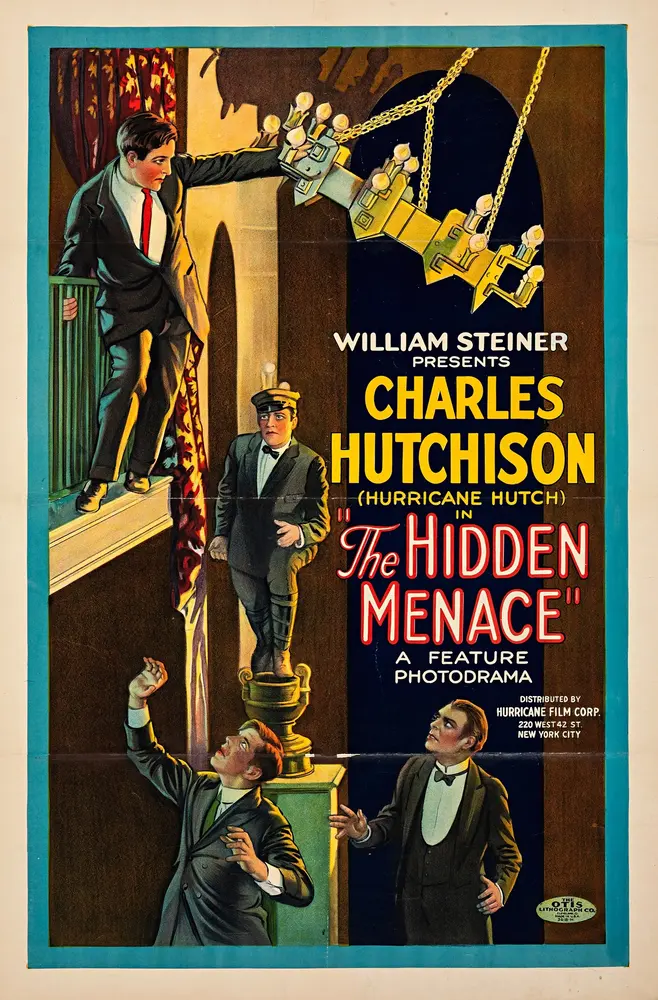
The silent era was not merely a precursor to modern cinema; it was a distinct, highly evolved language of movement and shadow that reached its zenith in the mid-1920s. Within this ephemeral landscape, The Hidden Menace stands as a testament to the sheer physical audacity that defined the career of Charles Hutchison. Often overshadowed by the comedic brilliance of Keaton or the swashbuckling grace of Fairbanks, Hutchison—famously known as 'Hutch'—brought a gritty, blue-collar athleticism to the screen that feels remarkably modern in its intensity. This film, penned by the prolific Jack Natteford, represents a fascinating convergence of high-octane action and the burgeoning tropes of the psychological thriller.
To watch The Hidden Menace is to witness a masterclass in spatial storytelling. Unlike the slapstick chaos found in The Duck Hunter, where the environment serves as a comedic foil, Natteford and Hutchison treat the world as a lethal obstacle course. The film’s pacing is relentless, a rhythmic pulse that mirrors the industrial heartbeat of the era. We see a world in transition, where the pastoral simplicity of films like Hoodoo Ann has been replaced by the jagged steel and unforgiving concrete of the modern city.
Hutchison’s performance is less about 'acting' in the theatrical sense and more about 'being' in the visceral sense. His movements are precise, devoid of the exaggerated pantomime that plagued many of his peers. In this regard, the film shares a certain DNA with the gritty realism of Os Lobos, though it swaps that film's brooding atmosphere for a more direct, confrontational energy. The 'hidden' aspect of the menace is not merely a plot point; it is a stylistic choice, with cinematography that utilizes deep shadows to obscure the protagonist's path, forcing the audience to share in his disorientation.
Jack Natteford, a writer whose utility in the industry was legendary, crafts a script that is deceptively complex. While on the surface it follows the trajectory of a standard mystery, the subtext is rife with anxieties regarding the loss of individual agency in a rapidly mechanizing world. This is a far cry from the lighthearted social maneuvering seen in Suzanne, professeur de flirt. Here, the stakes are existential. The protagonist is caught in a web of deceit that feels almost Kafkaesque, a precursor to the noir sensibilities that would dominate cinema two decades later.
The film’s structure demands comparison to the intricate plotting of Fantomas: The Mysterious Finger Print. Both films utilize the 'thriller' framework to explore the vulnerability of the modern citizen. However, where Fantomas relies on the macabre and the Gothic, The Hidden Menace relies on the tangible. When Hutchison leaps from a moving vehicle or scales a building, the danger is palpable. There are no safety nets, no CGI buffers. It is cinema at its most honest—a record of a man risking his life for the sake of an image.
In the broader context of 1925, a year that saw the release of Eisenstein’s revolutionary Strike, The Hidden Menace might seem like a populist diversion. Yet, there is a shared interest in the power of the edit. The way Natteford’s script builds tension through cross-cutting and rhythmic pacing shows a sophisticated understanding of the medium’s unique properties. It lacks the overt political messaging of the Soviet school, but it possesses a raw, democratic appeal. It is a film for the masses that refuses to talk down to them.
Consider the contrast with West Meets East. While that film explores cultural friction through a more traditional narrative lens, The Hidden Menace internalizes conflict. The protagonist is at war with an invisible force, a shadow organization that represents the faceless corporations of the roaring twenties. This thematic weight elevates the film above the level of simple 'stunt-work' and places it in conversation with more serious dramatic efforts like The Gift Supreme or the moral quandaries of The Devil's Riddle.
The cinematography in The Hidden Menace is surprisingly evocative for a film often categorized as a standard 'actioner.' There is a deliberate use of high-contrast lighting that anticipates the German Expressionist influence on Hollywood. The way shadows stretch across the set during the climactic warehouse sequence creates a sense of dread that is almost tactile. It is far more visually ambitious than the straightforward presentation of Young Ideas or the historical rigidity of Jamestown.
Furthermore, the film’s use of location shooting gives it a documentary-like authenticity. Much like Deck Sports in the Celebes Sea captures a specific moment in time and place, The Hidden Menace captures the gritty, unpolished reality of the 1920s American landscape. The grime on the buildings and the smoke from the trains aren't just background details; they are essential characters in the drama. This commitment to realism provides a grounding force for Hutchison’s more fantastic physical feats.
Charles Hutchison’s legacy is one of pure, unadulterated cinema. He understood that the camera is a witness to the impossible. In The Hidden Menace, he isn't just playing a hero; he is embodying the very concept of resilience. This film serves as a bridge between the early, primitive action shorts like Cleaning Up!!? and the sophisticated, high-stakes features that would follow. It lacks the whimsical absurdity of Snooky's Twin Troubles, opting instead for a somber, almost grim determination.
The final act of the film is a masterstroke of tension, utilizing a 'two-edged sword' of narrative stakes—a concept explored literally in The Two Edged Sword. The protagonist must not only defeat the villain but also clear his own name, a dual burden that Natteford exploits to maximum effect. As the credits roll, one is left with the indelible image of Hutchison in motion—a blur of kinetic energy against a world that seeks to keep him still.
The Hidden Menace is a vital piece of film history, a reminder that before there were superheroes, there were men like Charles Hutchison, who used nothing but their own bodies to tell stories of courage and peril. It is a film that demands to be seen, not just as a relic, but as a living, breathing piece of cinematic art.

IMDb 7.7
1933
Community
Log in to comment.