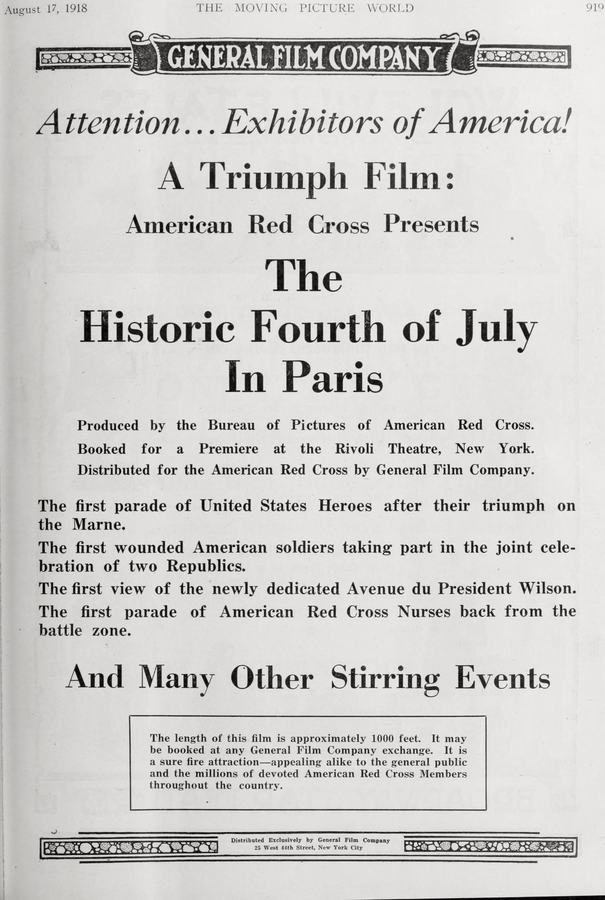
Dust motes dance in projector beams illuminating this century-old time capsule, where every scratched frame whispers urgent truths about nationalism, trauma, and collective catharsis. The Historic Fourth of July in Paris transcends its propagandistic origins through sheer anthropological potency. As the Doughboys advance down boulevards once trembling under Kaiser Wilhelm's shadow, the film reveals itself as psychic cartography—mapping intersections between personal deliverance and geopolitical turning points.
Consider the tactile desperation in spectators' gestures: shopkeepers in aprons scaling lampposts like schoolboys, grandmothers wiping eyes with frayed shawls, children thrusting wilting flowers toward passing rifles. These aren't generic crowds but individuals whose four years of dread melt into momentary rapture. Directorless yet profoundly authored, the montage juxtaposes stiff-backed officers on horseback against a laundress collapsing to her knees—her raw, wordless exhalation more eloquent than any statesman's address.
Cinematographically primitive yet emotionally sophisticated, the footage leverages axis-altering perspectives that predate Soviet montage theory. Low-angle shots magnify the 16th Infantry's approach past Vendôme Column, transforming soldiers into mythic giants, while overhead balcony views dissolve the parade into crawling currents of humanity. The recurring cutaways to Washington's statue—an Enlightenment-era ghost presiding over mechanized war—create ironic visual rhymes with the rigid, almost funereal marching columns.
When juxtaposed against fictionalized 1917 narratives like The Price of Pride or The Awakening of Ruth, this documentary's power resides precisely in its unvarnished veracity. Where studio productions relied on melodramatic tropes, here we witness authentic historical rupture: a baker dropping loaves to clutch at a soldier's sleeve, a veteran in horizon blue uniform saluting with a phantom limb. The film's climax arrives not through scripted crescendo but via spontaneous breach of protocol—civilians flooding the avenue to embrace marchers, dissolving military formation into human mosaic.
Modern viewers must navigate complex layers of mediation. As Red Cross propaganda, the film deliberately obscures war's horrors—no gas victims or trench mud here. Yet it inadvertently captures micro-tensions beneath Allied unity: Parisian side-eyes at ill-fitting Yankee uniforms, the forced grins of soldiers unnerved by hysterical gratitude. Unlike the celebratory artifice in musical hybrids like The Song and the Sergeant, this footage preserves the awkward intimacy of liberation—hands reaching but not quite clasping, laughter bordering on sobs.
The Avenue du Président Wilson sequences unfold with Haussmann-esque grandeur, transforming urban architecture into theatrical proscenium. Sunlight glints off bayonets as regiments dissolve into vanishing points, creating hypnotic patterns that anticipate abstract expressionism. This geometric precision starkly contrasts the Into the Primitive's chaotic wilderness or Sangre y arena's kinetic bullrings—here, civilization reasserts itself through symmetrical formations marching toward modernity's bloodiest crossroads.
What elevates this compilation beyond archival curiosity is its unconscious poetry. Note how wind billows a tricolor flag to momentarily eclipse the camera—a flutter of national veiling. Watch the play of shadows on General Pershing's face as he passes Washington's statue: enlightenment ideals literally darkening under wartime pragmatism. The most haunting frame lingers on a child perched on shoulders, waving not a flag but a crust of wartime bread—a silent testament to sacrifices preceding liberation.
Compared to escapist entertainments like Where D'Ye Get That Stuff? or Das Tal des Traumes, this film offers no such respite. Its historical weight echoes in subsequent war documentaries, from Sowers and Reapers' agrarian melancholy to Hearts and Flowers' domestic battlegrounds. Even the celebratory tone carries eerie premonition—these smiling troops will soon bleed in Belleau Wood's ravines, their optimism preserved like insects in amber.
Technically, the restoration reveals fascinating subtexts in degradation. Chemical deterioration around crowd scenes creates aureoles of decay around cheering faces—time literally consuming the moment. Vertical scratches during marching sequences evoke prison bars, subtly commenting on conscripted fates. These unintentional effects generate dialogue between 1918's intentions and 21st-century hindsight, making the film a palimpsest of interpretations.
Unlike narrative-driven features such as Ann's Finish or The Spindle of Life, this documentary's brilliance lies in elliptical storytelling. We infer entire biographies from a half-second close-up of a woman pressing a locket to her lips—presumably containing a conscript's portrait. The absence of intertitles becomes a virtue, forcing audiences to read history through facial hieroglyphics: the tight smiles of officials versus the disheveled rapture of ordinary Parisians.
Contemporary viewers might critique the film's romanticized interventionism, yet its historical value is incontestable. It predates Walter Benjamin's aura theory by capturing the hereness of history-making—the sweaty, discordant, unedited truth before mythologization. When compared to the vampiric fantasy of The Vampires: Satanas or the moralizing of The Supreme Temptation, this footage achieves something radical: bearing witness without interpretation.
Modern parallels emerge unexpectedly. The shots of public euphoria prefigure V-J Day in Times Square, while the blending of military pageantry and civic joy anticipates liberation-of-Paris footage from 1944. Yet what remains uniquely poignant is the fragility of the hope displayed—these crowds don't know the armistice remains 16 months away, nor the influenza tsunami approaching. Their catharsis is tragically provisional, making their unfiltered joy almost unbearable to witness.
Ultimately, the film operates as kinetic sculpture, freezing a pendulum swing between despair and renewal. The composition of the final crowd panorama—with the Eiffel Tower's latticework visually stitching together French and American flags—transcends propaganda to become pure visual philosophy. One leaves not with patriotic fervor, but with profound humility before the ephemeral grace of collective relief. In an era saturated with reenactments, this remains indispensable cinema: unscripted humanity writing history with its body.