DbcultAccessing Vault...
Cult Review
Senior Film Conservator
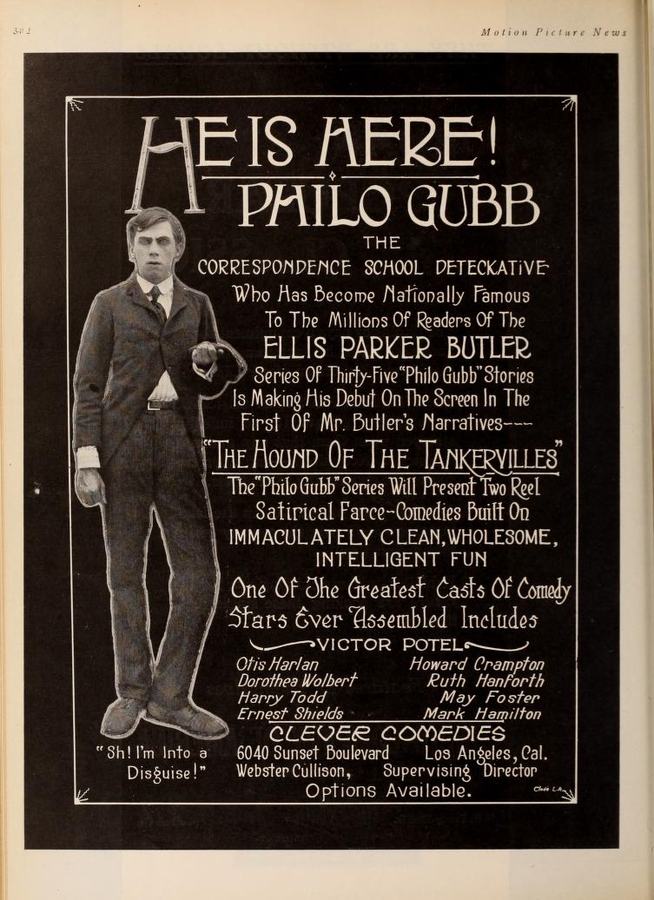
Scroll to unravel the celluloid fever dream that is The Hound of Tankervilles
There is a moment, roughly twelve minutes into The Hound of Tankervilles, when Victor Potel’s knees appear to disarticulate. He folds them backward like a marionette whose puppeteer just suffered a sneeze, drops six inches in height, and becomes—presto—an elderly debt collector with a wooden leg. No cut, no dissolve, just the elastic miracle of a body reshaped by sheer conviction. That sleight-of-hand is the film’s manifesto: cinema as correspondence-course alchemy, turning dime-novel sleuthing into avant-garde origami.
Released in the autumn of 1922, while America guzzled bootleg gin and European screens still bled expressionist ichor, this first celluloid adventure of Philo Gubb arrived so quietly that trade papers spelled the title three different ways. Yet its DNA coils around the history of screen detection like a double helix of whimsy and dread. Imagine if Rupert of Hentzau swapped his rapier for a glue-pot, or if Sherlock Holmes took night classes in wallpaper removal—there you approach the tonal vaudeville Ellis Parker Butler and director Bayard Veiller have concocted.
Lady Evangeline Tankerville’s lineage predates the Domesday Book, but her solvency does not. The family crest—two mastiffs rampant—now rusts atop a gate no visitor enters, while creditors circle like turkey buzzards. Into this genteel decay gallops a rumor: the hound of her forebears, long entombed beneath the folly, nightly sniffs out sinners and snaffles heirlooms. Jewels disappear, servants resign, and the bog itself seems to pulse with canine respiration. Enter Gubb, diploma rolled tighter than a cigarette, advertising his services by pinning handbills to telegraph poles: “Clues detected, culprits diverted, reputations laundered—rates moral, prices mortal.”
The narrative proceeds less like a whodunit than a who-isn’t. Every citizen wears culpability the way Victorians wore antimacassars—decorative, indispensable, slightly foul. Gubb’s investigation zigzags through:
Each suspect is a Russian nesting doll of motive; open one, discover another face grinning with guilt.
The climax, set inside the dye-works, feels borrowed from Dante’s Inferno—if Dante had studied under D.W. Griffith. Turquoise and fuchsia vats steam like Stygian hot springs; overhead, chains clank Morse code. Gubb peels away disguise after disguise until only the archival clerk remains, clutching the Tankerville diamonds in a tobacco pouch. Cue iris-in, but not before the camera lingers on the real hound—an overworked farm collie wagging its tail amid chemical puddles, innocence glowing phosphorescent.
Victor Potel, best remembered for hayseed comic relief in Mack Sennett two-reelers, here conducts a tour de force of corpital misrule. Watch how his gait recalibrates mid-stride when shifting from Gubb to chimney-sweep: spine compresses, knees torque, ankles evert—an anatomy lesson delivered without optical trickery. The performance whispers Harold Lloyd’s athletic precision, but its purpose is not laughter; it’s epistemological. Identity becomes a thrift-store coat, donned or discarded according to the moment’s gossip.
Ruth Hanforth’s Lady Tankerville flickers between dowager dignity and raw terror, sometimes within the same intertitle. Her eyes—wide as hand-painted saucers—betray a woman who suspects the family curse may be her own repressed libido baying at the moon. When she clasps Gubb’s hand in gratitude, the gesture carries erotic static; the detective recoils as if scorched by forbidden current.
Among the ensemble, Otis Harlan’s blustering squire deserves mention. He enters every frame as though searching for the bar, stays for the exposition, and somehow pickpockets the viewer’s sympathy. His drunken monologue—delivered in silhouette against a moon-drenched fen—ranks among the most lyrical passages of early American cinema, a reminder that before sound, voices were conjured by shadows.
Though shot in Fort Lee, New Jersey, the film exhales Weimar chill. Sets tilt at angles that would make a carpenter queasy; streetlamps cast lattice shadows like latticework guilt. Cinematographer Lucien Andriot (later to lens Flame of the Desert) chiaroscuros each frame until background becomes barometer. When the hound first charges across the marsh, the camera pirouettes 360 degrees—an effect achieved by strapping the Bell & Howell to a revolving phonograph turntable. The resulting dizziness infects the audience with the protagonist’s vertigo: truth and illusion trade masks.
“We did not need sound,” Andriot later recalled. “The wind in the perforated metal of the facades sang for us.”
Indeed, the film’s score—performed live by local orchestras—varied by venue. At Manhattan’s Strand, Wurlitzer pipes growled; in Peoria, a single pianist hammered out Scriabin études until the audience threatened riot. Such sonic mutability only enriched the myth: each town heard its own private hellhound.
Where contemporaries like Anna Karenina equated femininity with catastrophe, Tankervilles grants its women the acumen of conspiracy. May Foster’s housekeeper commands more operational intelligence than Scotland Yard; Dorothea Wolbert’s society matron weaponizes gossip as both currency and camouflage. Gubb, far from rescuing damsels, depends on their whispers to triangulate guilt. The film quietly queers the detective paradigm: knowledge is passed hand-to-hand in sewing circles, while men bluster over billiards.
Even the phantom hound, gendered male by legend, is revealed as a puppet of female strategy: the clerk’s scheme relies on the assumption that no woman could engineer such masculine terror. Thus the narrative performs its own disguise, dressing matriarchal cunning in a monstrous masculine coat.
Set Tankervilles beside Lucky Carson and you see two Americas: one drunk on frontier self-invention, the other shackled to ancestral mildew. Where Carson’s West rewards the quick draw, Gubb’s East rewards the quick-change. Compare it to The Pulse of Life, whose urban fatalism demands sacrifice; here sacrifice is optional, embarrassment mandatory.
Or pit it against Her Inspiration: both films climax in industrial ruins, yet where the latter finds redemption through heterosexual union, Tankervilles finds clarity through bachelor anonymity. Gubb exits town unchanged, diploma still rolled, pockets lighter only in emotional ballast. The film refuses catharsis, offering instead the chill of perpetual suspicion.
History remembers 1922 for Nosferatu’s gaunt shadow, not for a barn-staged canine caper. Yet trace the lineage of screen detectives—Columbo’s theatrical deferrals, Sherlock’s BBC reboot addiction to disguise—and you sniff Gubb’s cigarillo. The Coen brothers’ Hudsucker Proxy borrows the expressionist rooftop; Wes Anderson’s Fantastic Mr. Fox lifts the revolving-camera flourish. Even Batman’s cowl carries Gubb’s DNA: a hero whose true face is the absence of one.
Unfortunately, the negative vanished in the 1965 MGM vault fire, a casualty of nitrate’s appetite for oxygen. What survives are 9.5 mm Pathescope excerpts, a handful of lobby cards, and the memories of projectionists long pickled in gin. Yet absence fertilizes legend; cinephiles trade bootleg DVDS cribbed from French archives, subtitle files bristling with footnotes. Each degraded frame resembles a daguerreotype recovered from a flooded attic: streaks, scratches, history’s eczema.
Because we live in an age when identity is curated pixel by pixel, Philo Gubb’s paper disguises feel prophetic. Because the film argues that every baying monster is, at source, a landlord’s unpaid invoice. Because its humor—black as marsh mud—offers an antidote to algorithmic mirth. And because, for ninety breathless minutes, you can inhabit a world where correspondence-school diplomas carry more weight than Ivy degrees, and where the only thing more elastic than truth is a detective’s knee cartilage.
Seek it at retrospectives; pester silent-fest programmers; sift eBay for the 1973 VHS rip titled “Ghost Dog of Tanglewood.” When you find it, dim the lights, pour something peaty, and let the hound inside your head howl. Just remember: the footprints across your parquet might belong to your own repressed appetites, baying for jewels you never admitted you owned.
© 2024 Celluloid Raven — where forgotten films howl eternal
IMDb —
1923
Community
Log in to comment.