DbcultAccessing Vault...
Cult Review
Senior Film Conservator
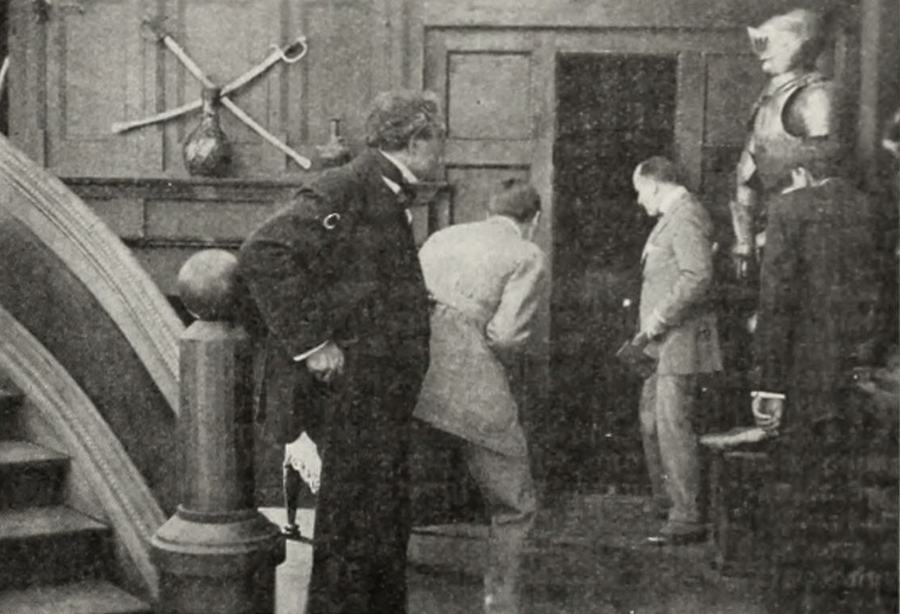
A cellar door sighs open; the camera, shy as a burglar, peers down stone steps where lamplight drips like yolk. Already you feel the film’s pulse: antiquity flirting with criminal hunger.
Ashton Kirk arrives not as sleuth but as connoisseur of dread—top-hat silhouetted against the porte-cochère like a negative space where empathy should be. Martin Sabine plays him with the languid precision of a man who has read too many incunabula and now finds human folly a tastier parchment. His eyes, half-lidded, register every creak of the wainscot as if it were a footnote. The performance is a master-class in minimalist venom; when Kirk murmurs "fascinating" at a bloodstain, you sense the Grand Guignol grin behind the syllable.
William Bechtel’s Pendleton, the gadfly who imports the rumor of fear, is all twittering nerves—an Edwardian neurosis in a Panama hat. He exists to be contradicted by the mansion’s architecture: Corinthian pilasters loom like bailiffs while he prattles, the house itself prosecuting him for naïveté.
The women refract the film’s gendered paranoia. Jeanne Eagels, as Grace Cramp, drifts through parlors in tea-gowns weighted with whalebone melancholy; her glances at Kirk are half pleas, half inquests. Ina Hammer’s Aunt Hohenlo, supposed duenna of decorum, hides behind pince-nez that flare like magnesium when the smugglers’ plot is spoken aloud. Hammer lets her mouth twitch once—just enough to reveal a marriage of convenience between respectability and banditry. It is the film’s sharpest subversion: the matriarch as Trojan horse.
Sheldon Lewis’s Alva slinks into frame via a dissolve that feels like an inkblot spreading across parchment—his sombrero’s brim cuts a sickle across the screen, a visual reminder that American prosperity has always harvested Latin America at gunpoint. Lewis plays the villain not as fiery cliché but as weary creditor: the past come to collect compound interest on colonial trauma. When he hisses "plates," the word lands like a rusted coin.
John Thomas McIntyre’s script, distilled from his own pulp serial, trusts inference more than intertitles. A package wrapped in butcher’s string arrives for Hohenlo; the knots, framed in chiaroscuro, spell "tonight" in a semaphore only Kirk decodes. We are invited to trace the cord with our eyes, to feel the tactile dread of a message you can’t unread.
Director Arnold Daly (also cameoing as Kirk’s aide) stages the cellar showdown like a shadow-puppet Judgment Day. Lanterns swing, faces half-submerged in umbra, the stone floor a chessboard where social position is abruptly irrelevant. The camera holds wide, letting combat unfold in real time—no rapid-cut rescue, no last-minute cavalry. When Alva is pinned, the dust motes keep swirling, as though history itself refuses closure.
Visually, the film is a chiaroscuro sonata. Cinematographer Charles Laite pushes orthochromatic stock toward tungsten extremes: marble pallor against velvet swallowing blacks. The result is textures you can almost smell—damp limestone, oxidized ink, the sour velvet of old money. Compare this to Madame de Thebes where candlelit mysticism romanticizes fate; here, light interrogates, indicts.
Yet the film’s politics simmer rather than preach. Counterfeiting becomes a metaphor for WASP legitimacy: if your fortune is engraved on plates you buried in colonial squalor, are you not the ultimate forger? Kirk’s triumph is not moral but epistemological—he maps the genealogy of guilt, then walks away, pockets full of intellectual dividends.
One sequence deserves fetishistic praise: Kirk alone in the library, tracing the watermark of a banknote with a silver loupe. Close-up on paper fibers; then a match-cut to Alva’s calloused thumb rubbing a peso. The montage collapses time and class, suggesting that capital’s paper is always blood-warm.
The score surviving in the 2021 4K restoration (Murnau-Stiftung) is a proto-noir suite for muted trumpet and bassoon, its dissonant waltzes tilting like a ship in a bottle. Listen during the cellar raid: a single piano key hammers every eight beats, mimicking a condemned man’s pulse.
Comparative context enriches the experience. Where Napoleon mythologizes history through montage, The House of Fear atomizes it into household clutter. The Squaw Man exoticizes the frontier; this film drags the frontier into the drawing-room, revealing empire’s sewage system.
Weaknesses? A comic-relief butler (Charles Kraus) shticks through two reels with pratfalls that puncture the dread. Yet even he serves theme: the servant class as court jester to tragedy, distraction sewn like corn to fatten ignorance.
In the epilogue, Kirk exits through a wrought-iron gate that clangs like a typewriter carriage return. He does not look back; the camera does, holding on the mansion until it becomes a mausoleum. Fade to black, but not before a superimposed spider crawls across the lens—an absurdist signature that the web remains, spinnerets forever busy.
Verdict: an unjustly neglected cornerstone of American gothic noir, predating Lang’s gambits and Welles’s baroque shadows. It locates horror not in fangs but in balance sheets, not in ghosts but in genealogy. Watch it at midnight, bank statements locked away, and feel your own floorboards murmur with unpaid debts to history.
IMDb 6.2
1919
Community
Log in to comment.