DbcultAccessing Vault...
Cult Review
Senior Film Conservator
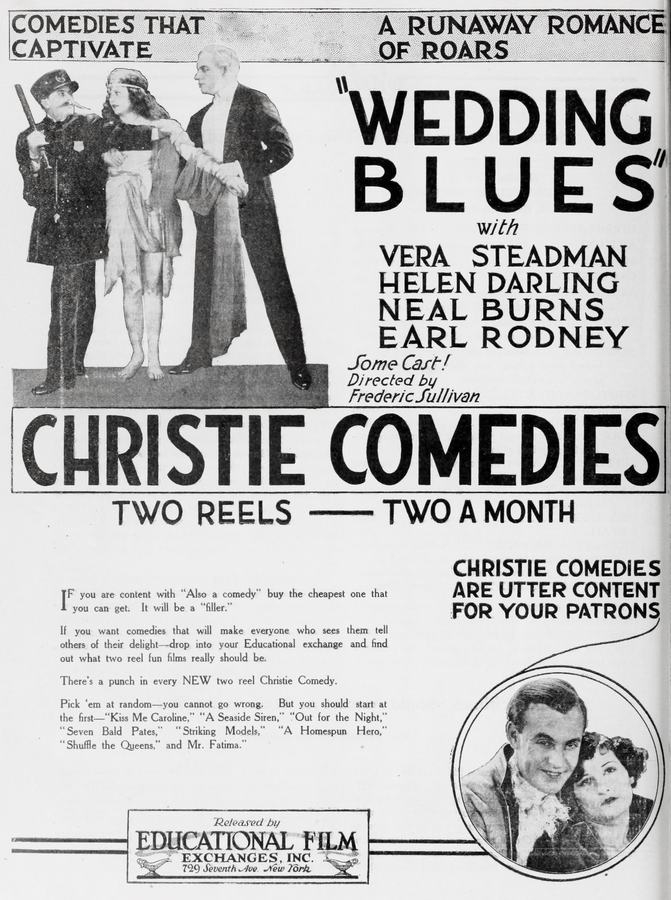
There is a moment—blink and the nitrate will combust—when Earle Rodney’s hapless conspirator tiptoes across a banister like Chaplin on a tightwire of social anxiety, and the whole silent frame seems to inhale. Wedding Blues, a 1926 one-reeler that history filed under ‘trifle,’ suddenly swells into a prism of class farce, gender insurgency, and kinetic grace. The film is only twenty-three minutes, yet it metabolizes the decade’s obsessions—money, mobility, misrule—then spits them back as feather-light mayhem.
Frank Roland Conklin and Scott Darling’s script treats identity like a hand-me-down tux: wrinkled, ill-fitting, yet somehow photogenic. The daughter—played by Helen Darling with the stare of a debutante who has read too many Russian novels—never once announces her longing. Instead, her rebellion flickers in micro-gestures: a gloved finger drumming against a marble balustrade, a cigarette exhaled toward a chandelier as though trying to fog the family crest. The film trusts the audience to decode the semaphore of privilege.
Vera Steadman, as the go-between’s fiancée, storms into parlors with a velocity that disturbs the dust on ancestral portraits. She is the flapper as avenging Fury, yet the screenplay denies her the easy label of ‘shrew.’ When she misreads the elopement plot, her hurt arrives not as tantrum but as wounded entrepreneurial pride—she has, after all, invested years of manicure money into this man.
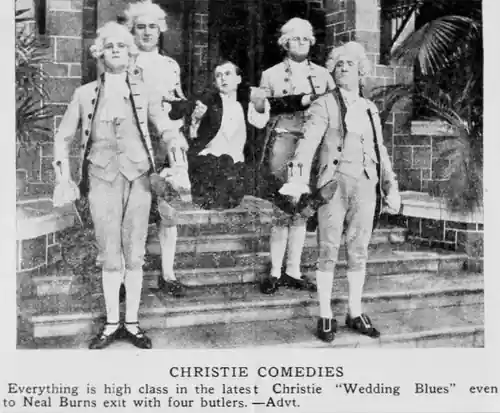
Director Neal Burns—whose name sounds like a vaudeville punch-line—stages class warfare as synchronized slapstick. Four footmen, impeccably drilled, eject our hero in a sequence that rhymes with the factory-line gags of Modern Times still nine years away. Yet the camera lingers on their polished buttons, the way each trouser crease catches the light like a sabre. The joke is not only that one man is outnumbered, but that capital can hire geometry itself.
Compare this to the servant ballet in The Poor Rich Cleaners, where chaos is accidental; here, disorder is contractual. The quartet reappears later, arranged like chess pieces by a father who has mistaken strategy for parenthood. Their final bow—simultaneous, submissive, absurd—feels like a funeral for feudalism performed by actors who haven’t read the obituary.
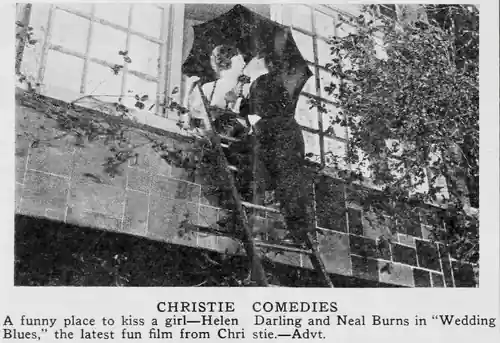
American silent cinema rarely let women flee without moral invoice. Heart Strings ends with a repentant return; The Lady Clare marries the estate. Wedding Blues, contrarily, treats exit as education. The daughter’s suitcase—packed off-screen—becomes a McGuffin lighter than air. We never see its contents; the film cares less for what she carries than for what she refuses to leave behind: the ancestral gaze.
Ogden Crane’s patriarch embodies that gaze. His eyes, under a hedge of eyebrow, glimmer with the cold satisfaction of a man who has turned blood into blue-chip stock. When he finally embraces the true suitor, the gesture is framed in medium-long shot: two men clasp while the daughter’s silhouette recedes, suggesting that patriarchal forgiveness is merely another acquisition.
Watch how Earle Rodney runs: heels flicking, arms semaphore-wild, yet his shadow drags like an anchor. The film projects the twenties’ manic optimism while hinting at the crash around the corner. Every pratfall lands on parquet that might as well be a stock-ticker tape; laughter echoes in rooms that will soon be auctioned. The tonal contradiction is deliberate—farce as pre-emptive nostalgia.
Silent comedies often age into artifacts; Wedding Blues ages into prophecy. Its mistaken identities anticipate the surveillance confusions of Souls Enchained, while its mansion—cavernous yet claustrophobic—feels like a dress-rehearsal for the Gothic spaces in The Hillcrest Mystery. Even the title carries double valence: marital bliss or emotional cyanosis?
Helen Darling’s acting is a masterclass in micro-calibration. Notice the pause before she feigns outrage at the friend’s scheme—two frames where her pupils dilate, acknowledging complicity. Vera Steadman, conversely, works in bold strokes: arms akimbo, chin thrust forward, yet she sneaks in a blink-and-miss-it tremor of the lower lip that humanizes jealousy.
Earle Rodney—equal parts Harold Lloyd and failed poet—has the knack of making panic look like hope. When he tips his bowler to a policeman while hiding a ladder under his coat, the gesture is both etiquette and confession. Compare him to the swaggering cowboys in Where the West Begins; his heroism is bureaucratic—he triumphs by filing the correct lie at the correct window.
Cinematographer Bert Baldridge (uncredited in most archives) shoots interiors like Escher lithographs: doorways nested within doorways, mirrors doubling suspects. A single intertitle—“Father knows best… or does he?”—appears over a shot of the patriarch reflected in a silver tray, his image warped by the convex surface. The film’s visual grammar whispers that authority is distortion.
Exteriors, by contrast, feel almost Soviet in their angularity. When the lovers finally dash across a sunlit avenue, the low angle makes skyscrapers loom like jury members. The metropolis is both accomplice and adjudicator, a secular version of the tribunal that hounds the protagonist of L’assassino del corriere di Lione.
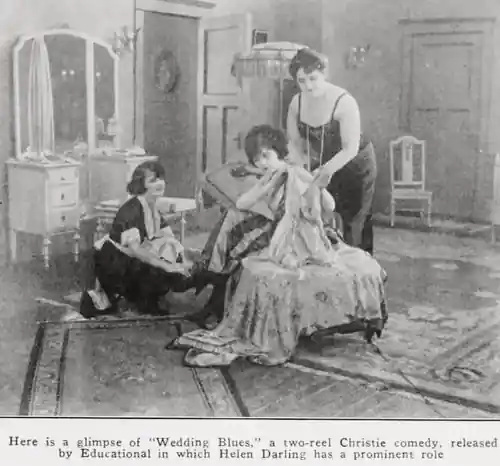
Cross-dressing gags proliferate in silent comedy, yet Wedding Blues inverts the trope. The daughter dons a chauffeur’s coat not to pass as male but to pass as working-class. Class trumps gender; fabric becomes social passport. When she removes the coat, revealing the beaded dress beneath, the edit is timed to a cymbal crash on the orchestral track—an aural exclamation mark that she has re-entered the prison of pearls.
Meanwhile, the male schemer slips into a maid’s apron to evade guards. The joke is not feminization but invisibility: servants, like women, are looked through rather than at. The film thus anticipates the Foucauldian notion that power renders certain bodies transparent.
Modern viewers, weaned on CGI, might find the pacing glacial. Resist the urge to scroll. Burns orchestrates rhythm through negative space: a sustained shot of a doorknob turning becomes a drumroll; a cut to a cat yawning in a wingback chair delivers punch-line. The strategy recalls the open-road languor of Drag Harlan, where tension pools in the horizontal silence.
Sound historians often dismiss silent comedy as proto-slapstick awaiting the kazoo of talkies. Yet the absence of dialogue forces the eye to choreograph timing. When the fiancée discovers the elopement note, the film holds on her face for exactly 28 frames—enough for recognition, not enough for tears—then smash-cuts to a horse rolling its eyes. The equine reaction shot, absurd on paper, lands as emotional synecdoche: we all feel whinnying betrayal.
For decades, Wedding Blues survived only in a Portuguese-language dupe at Cinemateca Brasileira. When a 35 mm nitrate surfaced at a Michigan estate sale in 2018, the tinting was still legible: amber for interiors, cyan for exteriors, rose for flirtation. The restored version—streamable courtesy of Kino Lorber—retains the watercolor shimmer that digital often flattens. Seek it out; pixelated thumbnails on algorithmic platforms cannot replicate the tremble of celluloid.
Film programmers, besotted with feature-length sagas, relegate one-reelers to curtain-raiser status. Yet brevity is the film’s ethics. It delivers its social verdict, cracks its matrimonial jokes, then exits before repression can reassert narrative order. Compare the bloated marital reconciliations in The Legacy of Happiness; Wedding Blues understands that after the embrace, the credits must roll.
Raising a glass to this minor miracle risks gentrifying its subversion. Still, sip anyway. Let the bubbles of class critique tickle your nose. Let the aftertaste of near-tragedy remind you that every laugh is a small rebellion against the inevitable wedding of capital to itself. And if, during the last shot, you notice the daughter’s smile tremble as rice rains down, blame not the actress but history—she already hears the drumbeat of 1929.
Verdict: 9/10—A pocket-watch of a film that keeps perfect Roaring-Twenties time, then snaps shut like a trapdoor on the era’s illusions.
IMDb —
1919
Community
Log in to comment.